
You open your laptop, type a prompt, and watch an AI tool produce a script in seconds. It's clean. It's usable. It sounds like a hundred other posts in your niche.
That's the problem many creators and small businesses are facing right now. Publishing is easier than ever, but sounding distinct is harder than ever. The bar for making content has dropped. The bar for making trustworthy content has risen.
What separates a creator people remember from one they scroll past isn't just editing, speed, or volume. It's subject matter expertise. That's the layer of real understanding that helps you say something accurate, useful, and specific. In a feed full of polished repetition, expertise is what gives your content weight.
For solo creators, consultants, educators, and small brands, this matters beyond marketing. It shapes how people judge your credibility, whether they return, and whether they recommend you to someone else. If you're also working on developing executive presence at work, the same principle applies. People take clear, grounded thinking seriously when it shows up consistently in how you speak, write, and teach.
Why Expertise Is Your Most Valuable Asset
The creator economy rewards visibility, but trust decides who lasts. Anyone can publish a quick thread, a faceless short, or a carousel built from recycled talking points. Fewer people can explain a topic with enough clarity that an audience feels safe acting on it.
That's why subject matter expertise is your most valuable asset. It turns content from noise into guidance. It tells your audience, “This person understands the terrain. I can follow them.”
Expertise creates contrast
A generic creator often sounds broad. They summarize what's already circulating. They repeat advice without knowing where it breaks.
An expert sounds different because they notice details other people miss:
- They define terms clearly so beginners don't get lost.
- They flag exceptions instead of pretending every rule applies everywhere.
- They use examples from practice rather than stringing together abstract tips.
- They know what can go wrong because they've seen confusion, misuse, or bad outcomes before.
That difference is easy to feel, even when an audience can't name it.
Practical rule: If your content could be swapped with a competitor's post and nobody would notice, expertise isn't showing yet.
Expertise compounds over time
A viral post can earn attention. Expertise builds a body of work.
When you publish from real knowledge, each piece strengthens the next. Your audience begins to recognize your patterns. They know you explain things carefully. They know you don't overclaim. They know your advice comes with context.
For a small business, this can matter as much as product quality. A founder who understands their domain thoroughly can build authority through educational content. A creator who knows one niche unusually well can outperform larger accounts that post more often but say less.
AI raises the value of human judgment
AI can speed up drafting, ideation, repurposing, and packaging. It cannot automatically supply your lived context, your pattern recognition, or your judgment about what matters most.
That's the opening. As more people use the same tools, your expertise becomes the part that can't be commoditized.
Deconstructing Subject Matter Expertise
A simple way to understand subject matter expertise is to compare two people in the same city.
One has a map. The other has lived there for years.
The person with the map can identify streets. The local guide knows which road floods after rain, which shortcut looks faster but isn't, and which neighborhood changes character after dark. Both have information. Only one has expertise.
That's how subject matter expertise works. It isn't just knowing facts. It's knowing what the facts mean in real situations.
The formal definition and what it tells us
A high-stakes example comes from manufacturing validation. In ASTM E2500, a Subject-Matter Expert is defined as an individual with specialized knowledge and technical understanding of critical aspects of systems and equipment, and as the primary authority for identifying critical design aspects, reviewing system architectures, and developing verification strategies that reduce quality risk management failures, as described in this review of ASTM E2500 and the SME role.
That definition sounds technical, but the lesson is practical. An expert isn't just someone who “knows a lot.” An expert helps others make better decisions in situations where mistakes are expensive.
For creators, that could mean:
- a tax educator who explains where popular advice can create compliance problems
- a fitness coach who distinguishes between general motivation and safe form
- a skincare creator who knows when a routine recommendation needs a caution
The three pillars readers usually confuse
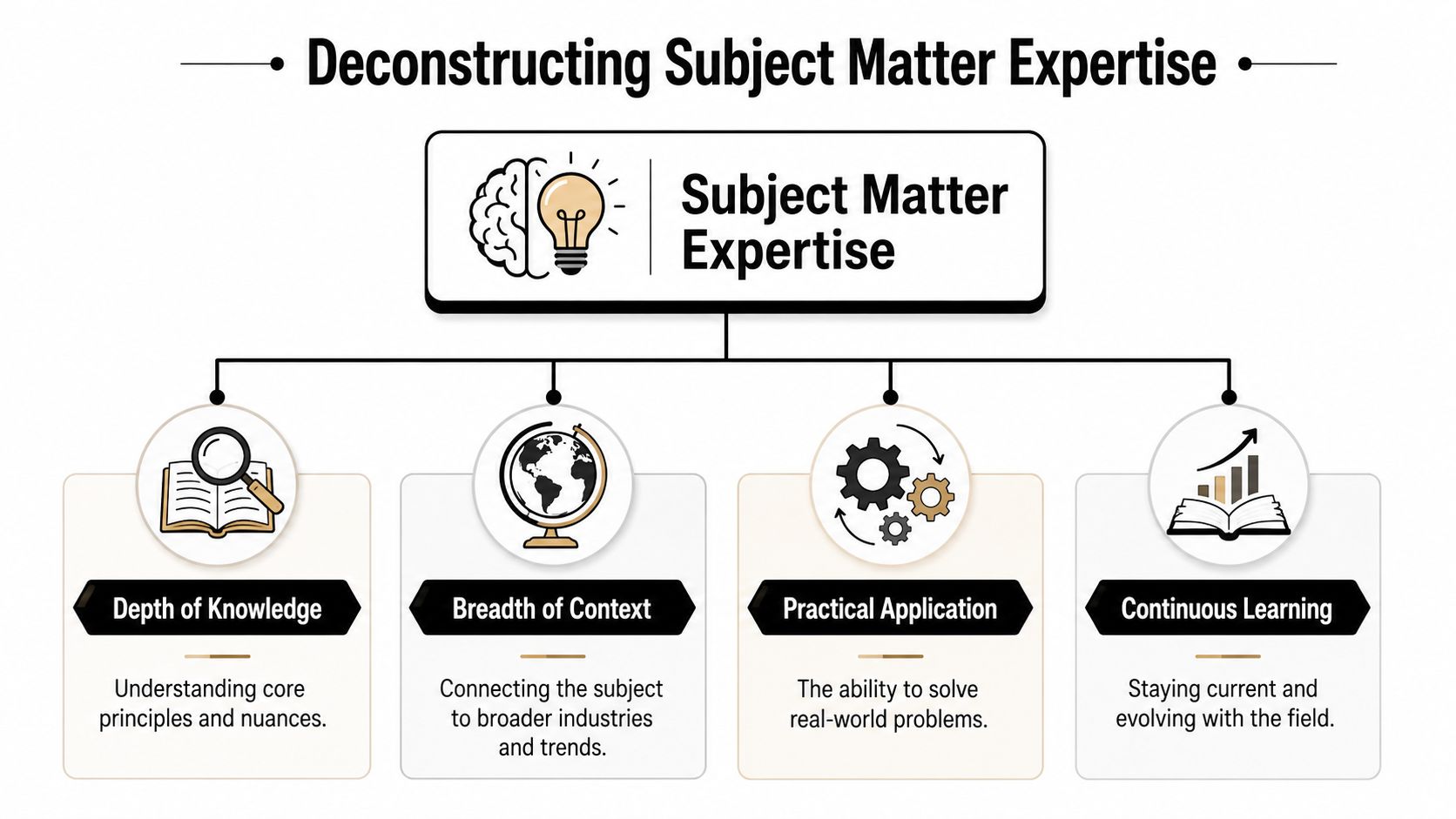
People often assume expertise is mostly about memory. It isn't. It has at least three working parts.
Deep knowledge
This is the foundation. You understand the core ideas, vocabulary, history, and moving parts of a topic.
A creator in personal finance, for example, should know more than common budgeting tips. They should understand the logic behind tradeoffs, common misconceptions, and where advice changes based on circumstance.
Practical experience
Knowledge becomes expertise when it survives contact with reality.
A person may know the theory of storytelling. An experienced scriptwriter knows where audiences get bored, which opening lines create curiosity, and how a strong idea can still fail if the pacing is off.
Contextual understanding
This is the missing piece in many “expert” posts online. Context tells you when advice applies, when it doesn't, and why.
Someone can explain how a content calendar works. A true expert can tell a solo creator, a local business, and a media team to use it differently because their constraints are different.
A tourist reads the map. A guide reads the map, the weather, the crowd, and the timing.
Expertise is broader than credentials
Credentials can help. They aren't the whole story.
Some people have formal qualifications but struggle to apply them. Others have built deep practical understanding through years of focused work, teaching, testing, and problem-solving. That's especially relevant in modern digital work, where roles evolve quickly. If you create online, this broader view complements a practical understanding of what a content creator actually does.
Continuous learning keeps expertise alive
Real experts don't freeze their knowledge at the moment they became competent. They update it. They test it. They revise it when the field changes.
That's why expertise is not a badge. It's a practice.
How to Spot a True Expert and Become One
Online, identifying experts often relies on surface signals. A polished website. A confident tone. A large following. A stack of acronyms after a name.
Those signals can be useful, but they're unreliable by themselves. A better approach is to watch how someone thinks out loud.
The traits that usually reveal the real thing
A high-caliber SME has three core technical skills: deep domain knowledge, clear communication without jargon, and the ability to mentor others, which improves decisions, quality, and outcomes, as explained in this analysis of what strong SMEs do well.
That shows up in visible ways.
| Signal | What it looks like in practice |
|---|---|
| Clear explanations | They can teach a beginner without sounding annoyed or hiding behind buzzwords. |
| Nuanced answers | They rarely treat every situation as identical. They explain conditions and tradeoffs. |
| Comfort with uncertainty | They can say “I don't know” or “it depends” and then explain what would change the answer. |
| Mentor mindset | They help others understand, not just admire them. |
A fake expert often does the opposite. They speak in inflated language, avoid specifics, and answer every question with total certainty.
A quick comparison
Consider two creators discussing email copy.
The first says, “Use emotionally resonant conversion psychology frameworks to enable higher-impact audience engagement.”
The second says, “If your email opens with a vague benefit, readers won't know why they should care. Lead with the problem they already feel.”
The second person sounds simpler, but they probably know more.
If someone can't make a complex idea understandable, they may understand the topic less deeply than they appear to.
How to recognize your own growing expertise
Many capable people dismiss themselves because they imagine expertise means knowing everything. It doesn't. In practice, you're becoming an expert when:
- You notice beginner mistakes early because you've seen them many times.
- You can explain the same idea in multiple ways depending on the audience.
- You know where advice becomes dangerous or misleading.
- You can teach others and improve their judgment, not just hand them instructions.
That last point matters. Teaching exposes weak spots in your understanding fast. If you can help another person apply an idea correctly, your expertise is becoming portable.
Credentials matter less than transfer
A credential proves exposure. Expertise proves transfer.
The question isn't only, “What have you studied?” It's also, “Can you turn that knowledge into clarity, decisions, and better outcomes for other people?”
That's the standard worth aiming for.
A Practical Roadmap to Building Your Expertise
Expertise can feel mysterious when you look at someone who has been in a field for years. Up close, it's usually built in layers. You learn. You try. You get corrected. You refine.
That process is more manageable when you treat it like a roadmap instead of a personality trait.
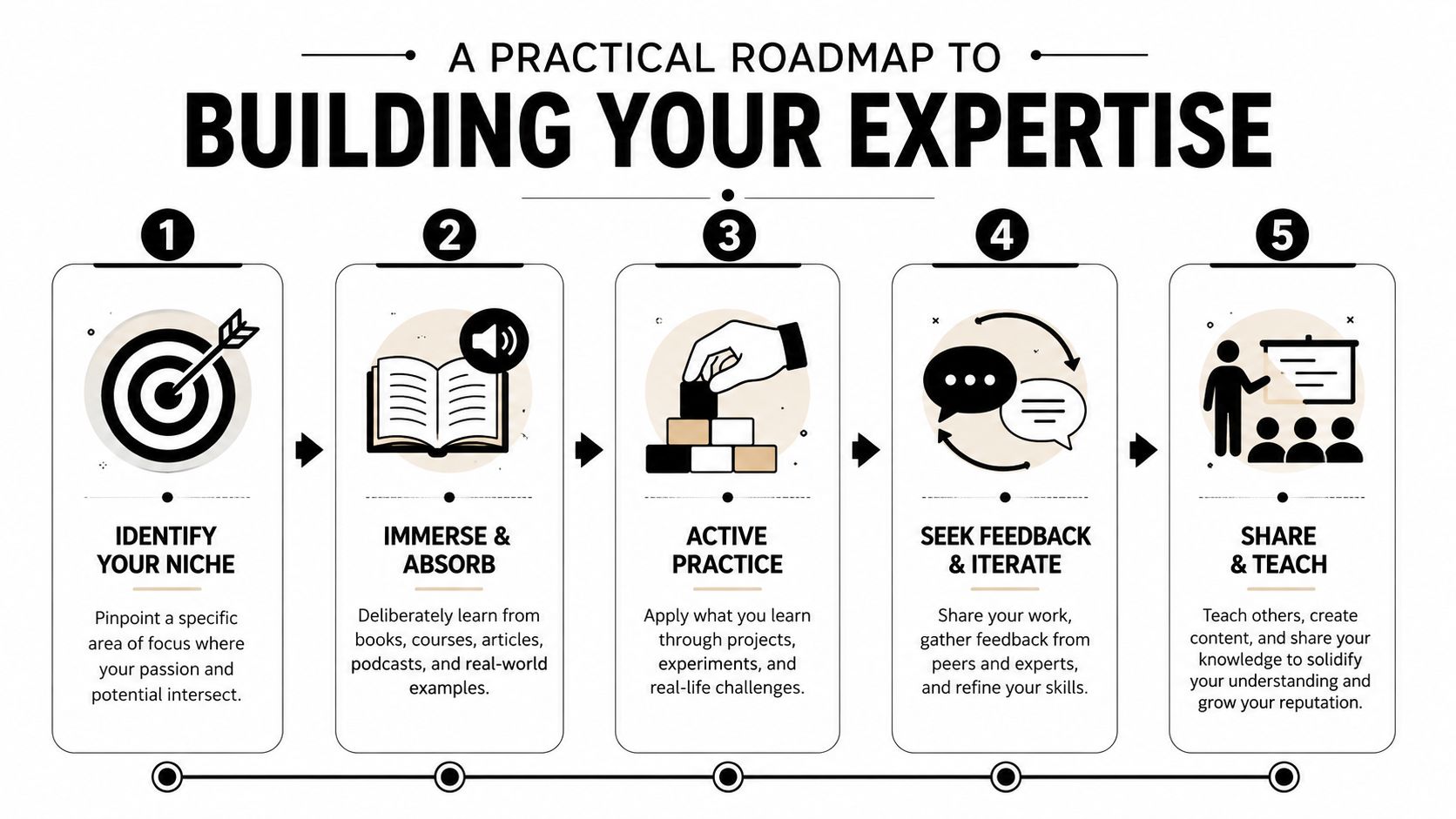
Stage one begins with a narrow niche
Broad ambition often slows progress. Specific focus speeds it up.
If you want to become known for marketing, narrow it. Email onboarding for SaaS. Short-form education for tutors. Local SEO for dental clinics. The narrower your niche, the faster you can see patterns.
That same specificity strengthens your public positioning. For creators shaping a recognizable voice online, this works well alongside the discipline of building a personal brand with clear focus.
Stage two turns study into working knowledge
Foundational learning matters, but random consumption won't get you far. Read with a problem in mind. Watch with a framework in hand. Take notes on what keeps repeating and what experts disagree about.
Useful learning usually includes a mix of:
- Core principles that stay stable over time
- Current examples that show how those principles play out now
- Contrasting viewpoints so you don't confuse one perspective with the whole field
A creator studying storytelling, for example, shouldn't only collect hooks. They should study pacing, tension, point of view, and audience expectation.
Stage three requires active application
Often, people stall at this stage. They keep preparing because producing exposes gaps.
Do the project anyway. Write the script. Audit the funnel. Teach the lesson. Build the campaign. Your mistakes will become part of your training data.
A creator who has published a series of educational shorts usually understands attention, confusion points, and retention better than someone who has only read about video strategy.
Working habit: Don't wait to feel authoritative. Publish small pieces that test one idea at a time.
Stage four depends on community and feedback
Private learning can make you knowledgeable. Interaction makes you sharper.
You need peers, clients, students, or real audience members who show you what lands and what doesn't. They reveal blind spots you can't see from inside your own expertise.
This matters even more when you speak to communities that outside observers may describe too broadly. In underserved contexts, “underserved” is highly context-specific and depends on the population, condition, and intervention, which means standard credentials may miss the cultural insiders or local knowledge that matter most, as explained in this discussion of what underserved really means in practice.
That has a direct lesson for creators. If you make content for a specific cultural, regional, educational, or low-literacy audience, books alone won't make you credible. Trust often comes from ongoing relationships, listening, and adaptation.
Stage five never really ends
Expertise ages if you stop updating it.
Fields change. Platforms shift. Language evolves. Audiences respond differently over time. Good creators revisit old assumptions and improve their explanations as they learn more.
A simple rhythm helps:
- Learn something
- Apply it publicly
- Listen to the response
- Refine your model
- Teach it more clearly next time
That cycle is less glamorous than the idea of “becoming an expert,” but it's how the work happens.
Turning Expertise into High-Impact Content
AI can generate content fast. Expertise decides whether that content deserves attention.
That's the key distinction many creators miss. The tool can help with scripting, structure, formatting, visuals, and consistency. But the value of the finished piece still depends on the thinking that shaped it before the prompt was written.
Expertise matters most at the beginning
One under-discussed issue is when experts should contribute. Research highlights a lack of frameworks for engaging Subject Matter Experts in early “Phase 1” content creation before audience testing, even though that bi-directional involvement is imperative for generative results, as noted in this abstract on early SME engagement in content creation.
For creators, that means the best place for expertise often isn't at the end when you ask for a quote or quick review. It's at the start.
An expert improves content before generation by shaping:
- the angle
- the assumptions
- the boundaries of accuracy
- the cultural context
- the examples worth using
- the mistakes worth avoiding
If those inputs are weak, AI usually produces polished mediocrity.
Generic input versus expert input
Here's a simple comparison.
Generic prompt
- Create a short video script about burnout for entrepreneurs.
Expert-shaped prompt
- Create a short educational video for solo business owners who think burnout only means exhaustion. Explain that burnout can also look like irritability, poor decision-making, and emotional flatness. Use a calm tone, avoid shame, and end with one small action the viewer can take today.
The second prompt contains judgment. It reflects audience understanding, likely misconceptions, and emotional framing. That's subject matter expertise at work.
A stronger content workflow
Creators often treat content strategy and content production as the same thing. They aren't. Strategy decides what should be said and why. Production decides how it gets made and distributed. If you need a cleaner planning model, this guide to what a content strategy includes is a helpful starting point.
A more effective workflow looks like this:
Start with the expert lens
Ask:
- What does my audience usually misunderstand?
- What advice in my niche is oversimplified?
- What detail would only someone close to this topic know?
Those questions create stronger raw material than “What should I post today?”
Use AI for expansion, not substitution
Once you've set the frame, AI can help you produce variations, tighten phrasing, test hooks, repurpose ideas, and convert one concept into multiple formats.
That's where modern creator tools shine. They reduce production friction. They don't replace the need for your point of view.
Add format-specific craft
A sound explanation still needs a strong package. Hook placement, pacing, subtitles, scene changes, and narrative shape matter, especially in short-form video. If you want a practical companion on this side of execution, these actionable video marketing tips are useful for thinking through how educational insight becomes watchable content.
A good creator combines both layers. They know the topic, and they know how to translate it for the feed.
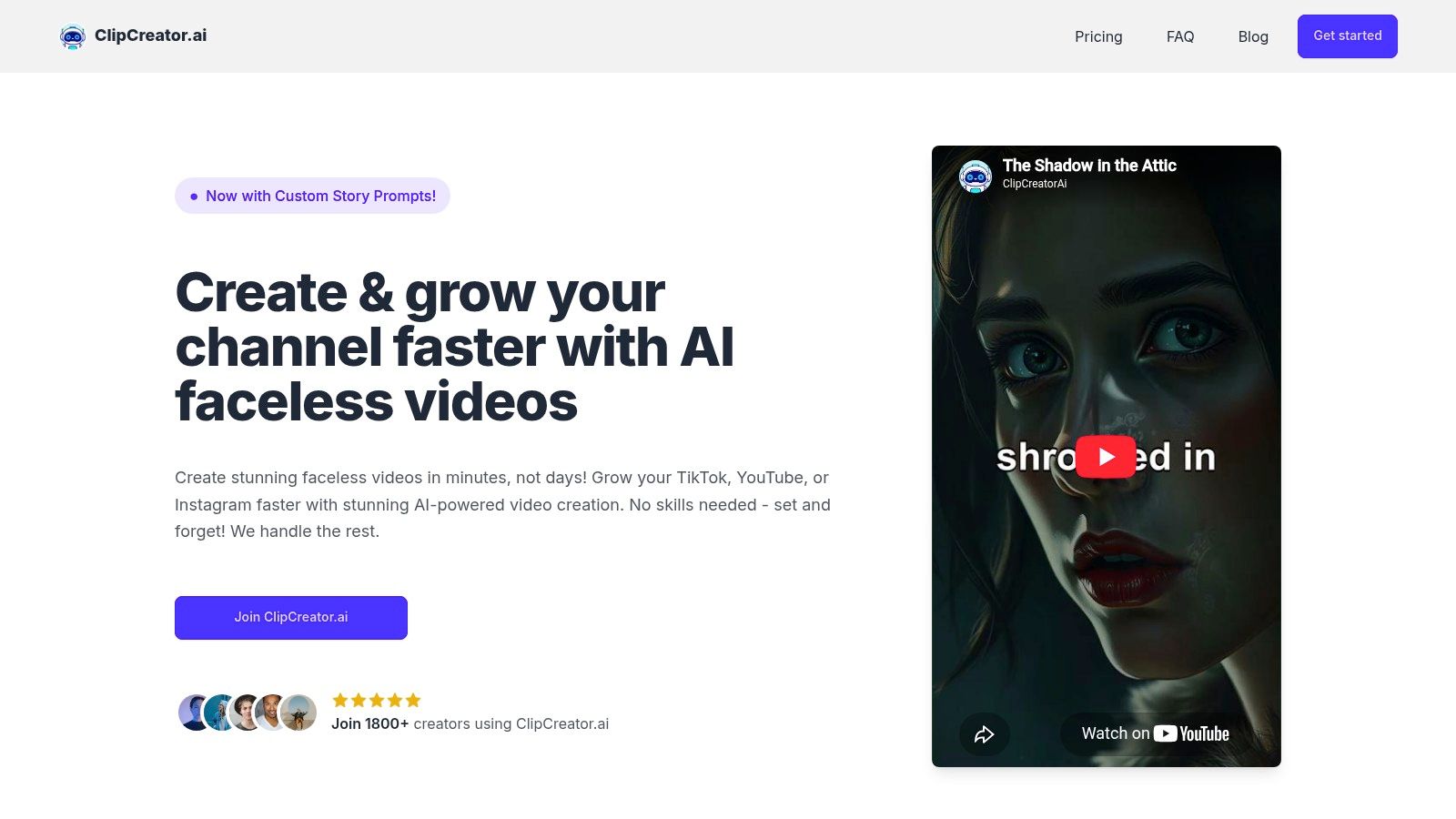
Here's a useful walkthrough of AI-assisted video creation in practice:

The human role becomes more valuable, not less
In an AI-driven workflow, the human contribution shifts upward. You're less occupied with typing every draft manually. You're more responsible for accuracy, framing, nuance, and ethical judgment.
That's good news for people with real expertise. It means your best advantage isn't speed alone. It's the quality of thought you can scale.
Common Pitfalls That Undermine Your Authority
Many people lose authority long before they lose knowledge. The problem usually isn't a lack of intelligence. It's a pattern of habits that weakens how expertise comes across.
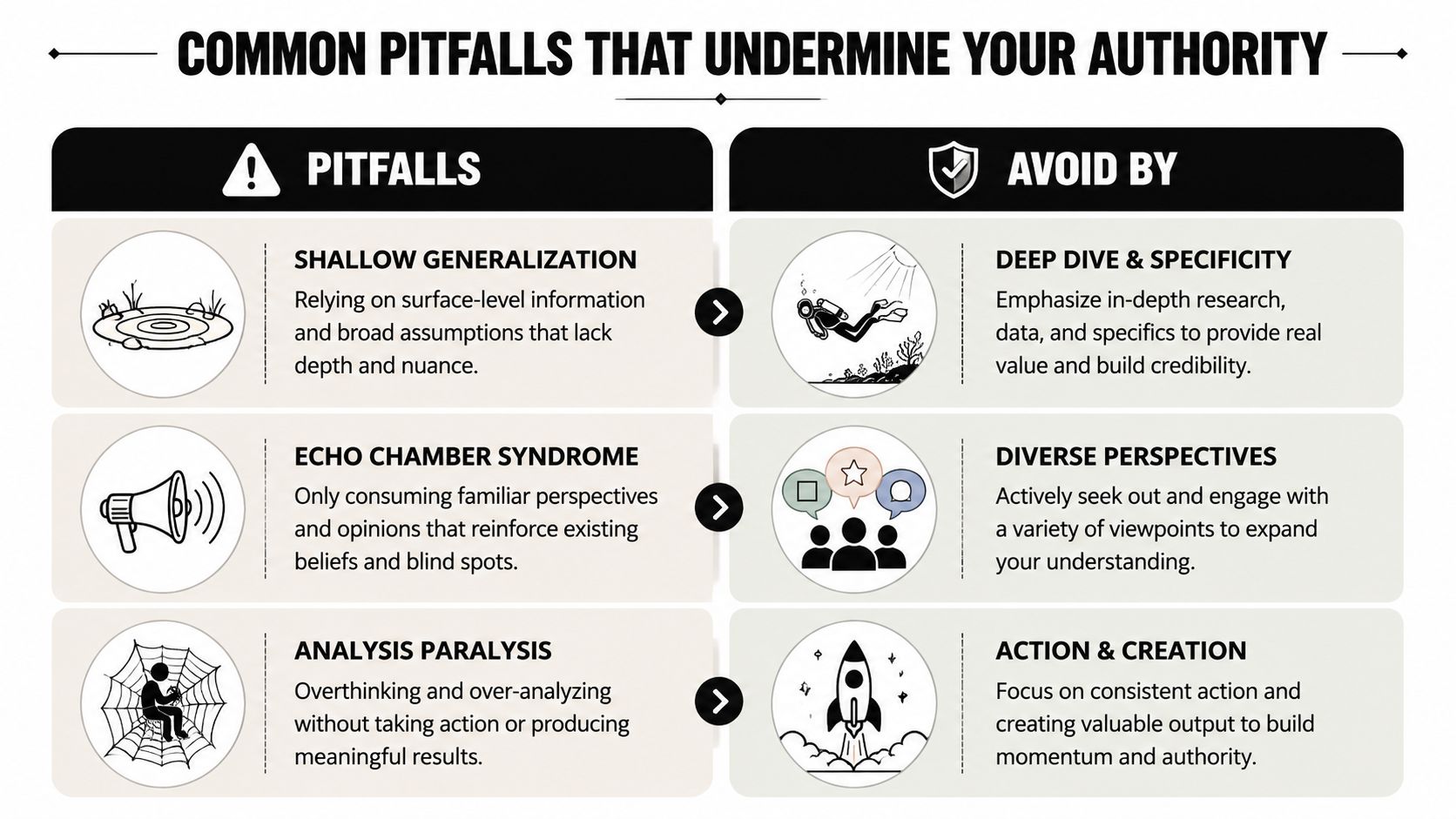
The most common traps
Impostor syndrome
You know enough to help people, but you keep quiet because someone else knows more.
That mindset confuses expertise with perfection. You don't need total mastery to teach what you understand well and responsibly. You need honesty about your scope.
Fix: Define your current lane clearly. Teach what you can explain and support. Refer out when needed.
Overconfidence
This is the opposite problem. Someone learns just enough to feel certain, then speaks as if every case is simple.
Audiences often mistake confidence for competence at first. Over time, oversimplification damages trust.
Fix: Add conditions to your claims. When advice depends on audience, industry, or context, say so.
The curse of knowledge
Experts sometimes forget what it felt like not to know the basics. Their explanations become too compressed.
A designer might say “improve hierarchy” without explaining that this could mean font size, spacing, contrast, or visual order. The advice is technically right but practically useless.
Fix: Test your explanation on a beginner. If they can't act on it, rewrite it.
Mistaking visibility for authority
A polished creator can look expert while saying very little. Nice branding helps. So does confidence on camera. Neither replaces real understanding.
Use this quick check when judging your own content:
| If your post does this | Your authority weakens because |
|---|---|
| Stays broad | It sounds safe but not useful |
| Repeats trend language | It blends into the feed |
| Avoids edge cases | It feels less trustworthy to informed readers |
| Uses jargon as decoration | It creates distance instead of clarity |
Authority grows when your audience can use what you said, repeat it accurately, and trust it under pressure.
Analysis paralysis also does damage
Some creators never publish because they want every piece to prove their expertise. That pressure produces silence.
Authority doesn't come from one flawless post. It comes from repeated demonstrations of useful judgment. Small, clear, specific content usually builds trust faster than grand but delayed content.
A practical standard helps. Aim to be accurate, helpful, and understandable. Then improve publicly.
Your Expertise Is Your Legacy
The strongest creators in an AI-shaped market won't be the ones who automate the most. They'll be the ones who know what deserves to be automated, what needs a human hand, and what an audience needs to hear.
That's why subject matter expertise matters so much. It grounds your content in reality. It sharpens your judgment. It gives your audience a reason to trust you when everyone has access to the same publishing tools.
You don't need to know everything. You do need to build depth, test your ideas in real situations, stay close to the people you serve, and keep refining how you explain what you know.
Over time, that becomes more than content strategy. It becomes your body of work. Your reputation. Your way of helping people make better decisions because you took the time to understand something well.
In a world full of generated noise, genuine expertise doesn't shrink in value. It becomes easier to recognize. And when you pair that expertise with modern tools, your voice can travel farther without losing what made it worth hearing in the first place.
If you want to turn your knowledge into consistent short-form videos without spending hours editing, ClipCreator.ai helps you create faceless videos from prompts, pair them with visuals, voiceovers, and subtitles, and publish them across platforms with less manual work. It's a practical way to scale your expertise into content people can watch.

Create your first video in under 2 minutes
Pick a niche, and ClipCreator.ai generates and auto-posts faceless videos to your channels every day.
Join ClipCreator.ai