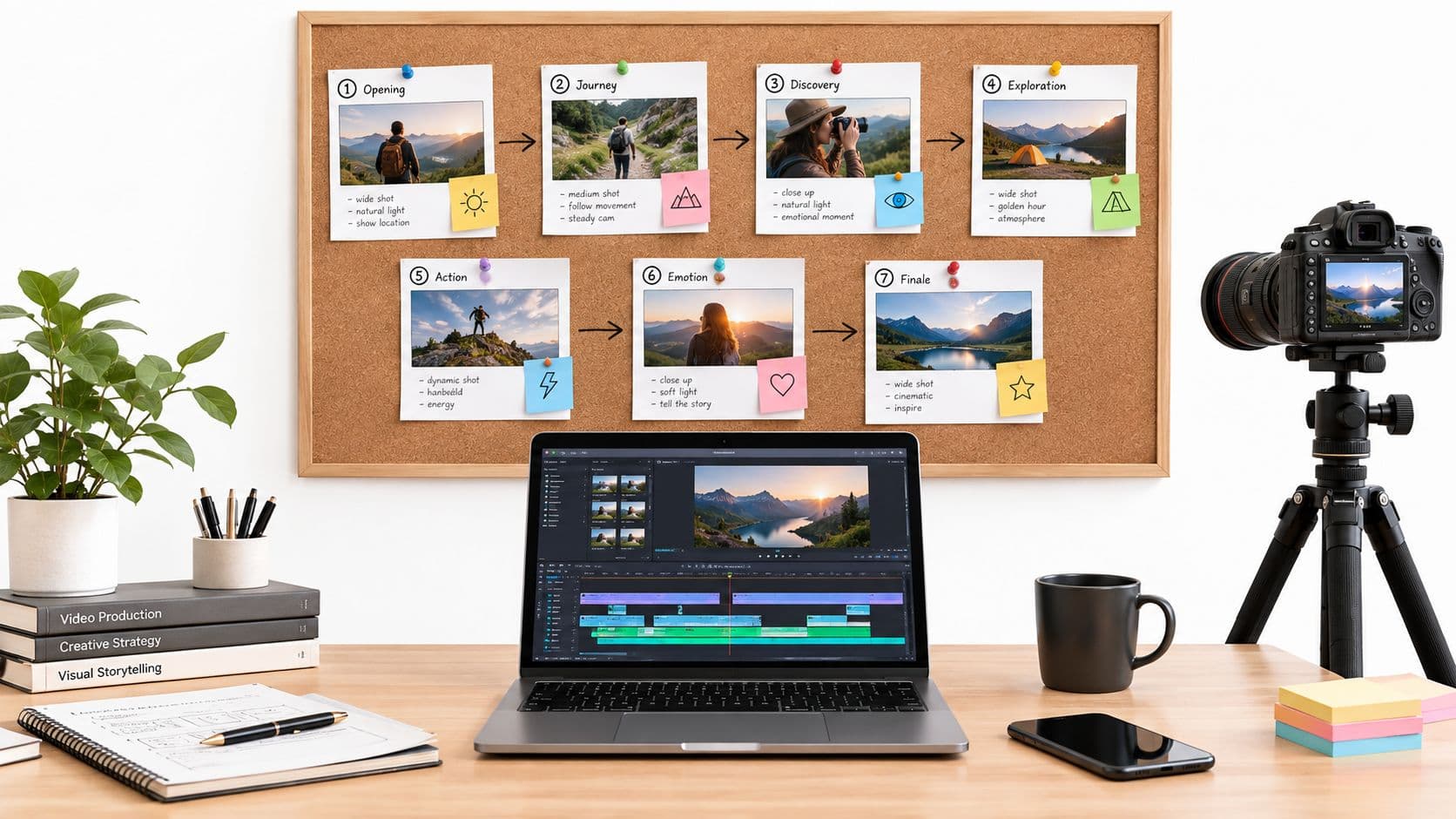
Think of your content strategy as the North Star for everything you create. It’s the essential difference between just making content and building a powerful communication engine for your brand. It’s the “why” behind every video, post, and story you share.
Why a Content Strategy Matters
Posting content without a strategy is a bit like setting sail without a map or a destination. You're definitely moving, but you're probably just drifting. You might get a few likes here and there, but you’re not actually going anywhere specific. You're just making noise in an already crowded sea.
A good strategy turns those random acts of content into a focused, deliberate system. It forces you to answer the tough questions before you even think about hitting record or typing a single word.
This is how you ensure every piece of content has a job. Whether its purpose is to attract a new audience, teach them something valuable, or guide them toward a purchase, your strategy is the thread connecting your creative work to real, measurable results.
From Chaos to Cohesion
Let's be honest—without a plan, content creation can feel like a mad scramble. You're constantly chasing trends, brainstorming last-minute ideas, and your message ends up being all over the place.
A documented strategy is what separates the pros from the amateurs. It’s the shift from working harder to working smarter. It gets your entire brand on the same page, clarifies your message, and puts your resources where they’ll make a genuine impact—turning content from a cost into a high-value asset.
And the proof is in the numbers. As we head into 2026, content marketing isn't just a trend; it's a fundamental business practice. The industry is on track to rocket from $72 billion to over $107 billion by this year alone.
With 71% of marketers confirming that content has become even more critical over the past year, having a documented plan is no longer optional. It's the standard.
A solid strategy gives your entire team a compass. It clearly lays out:
- Your Purpose: What, exactly, are we trying to accomplish?
- Your Audience: Who are we talking to, and what do they actually care about?
- Your Voice: What’s our unique personality? How do we want to sound?
- Your Topics: What subjects will we own to become the go-to authority?
This kind of clarity is a game-changer, especially for smaller businesses. A sharp strategy helps you cut through the noise and compete, even with a leaner budget. If you're building from the ground up, you can learn more about how to craft a content strategy for a small business in our complete guide.
Ultimately, a content strategy is more than a calendar of ideas. It’s the foundational thinking that ensures you’re not just shouting into the void, but building something meaningful and valuable for both your audience and your bottom line.
With a Strategy vs. Without: A Quick Comparison
The difference between a strategic and an ad-hoc approach is night and day. Here's a quick breakdown of what that looks like in practice.
| Aspect | With a Content Strategy | Without a Content Strategy |
|---|---|---|
| Effort | Focused & Deliberate: Activities are planned and have a clear purpose. | Chaotic & Reactive: Chasing trends and last-minute ideas. |
| Audience | Targeted & Understood: Content is created for a specific person. | Vague & General: Trying to appeal to everyone, connecting with no one. |
| Goals | Tied to Business KPIs: Content directly supports growth and revenue. | Vanity Metrics: Focused on likes and views with no clear business link. |
| Consistency | Cohesive & On-Brand: Voice, style, and message are consistent. | Inconsistent & Scattered: The brand voice changes from post to post. |
| ROI | Measurable & Positive: Content is an investment that delivers returns. | Unpredictable & Low: Content is an expense with no clear return. |
| Long-Term | Builds Authority & Assets: Creates a library of valuable, evergreen content. | Short-Lived Impact: Content is forgotten as soon as it's published. |
As the table shows, a strategy provides the structure needed for sustainable growth, while going without one often leads to wasted effort and frustratingly stagnant results.
The 6 Core Pillars of a Winning Content Strategy
A solid content strategy rests on six core pillars. Don't think of them as a checklist you run through once; they're interconnected supports that give your entire plan strength and direction. Getting these right is what separates creators who get predictable results from those who are just making noise.
Ultimately, these pillars answer the most important questions you can ask: who are you making content for, why are you making it, what will it be, where will people find it, how will you manage it all, and how well is it actually working?
Let's walk through each one.
1. Audience Personas: Who Are You Actually Talking To?
Before you write a single word or record a second of video, you have to know who's on the other side of the screen. This is about more than just age and location. An audience persona is a detailed, almost-real profile of your perfect viewer. It gives a name and a face to your analytics, which helps you create content that truly connects.
A useful persona digs into:
- Pain Points: What problems are they wrestling with? What’s keeping them up at night?
- Goals & Aspirations: What are they trying to accomplish, either personally or professionally?
- Information Sources: Where do they hang out online? Whose opinions do they trust?
- Content Preferences: Are they looking for quick-hit video tutorials, deep-dive articles, or casual social media updates?
Think about it. The content you'd create for "Eco-Conscious Millennials" is worlds away from what you'd make for "Overwhelmed Small Business Owners." Your first job is to get crystal clear on your "who."
2. Business Objectives: Why Are You Making This Content?
If you're just throwing content at the wall to see what sticks, you're not just wasting time—you're burning through your budget. Every single piece you publish needs to tie back to a specific, measurable business goal. This is the "why" that gives your creative work a purpose.
Common goals for content include:
- Increasing Brand Awareness: Getting your brand in front of more of the right eyeballs.
- Generating Qualified Leads: Attracting people who might actually buy from you.
- Driving Sales: Directly moving people toward a purchase.
- Improving Customer Retention: Keeping the customers you already have happy and engaged.
A goal like "increase product sales by 20% through our video series" is concrete. A goal like "get more engagement" is just wishful thinking. Connecting your content to real business objectives is the only way to prove its worth.
A documented plan is everything. While over 60% of businesses use sales to measure if their content is working, a staggering 47% of B2B marketers admit they don't have a formal, written-down strategy. This is a huge reason why so many efforts fail—creators often blame unclear goals for poor results. You can dig into more of these content marketing statistics to see the data behind what works.
This is where the blueprint comes into focus. You have to figure out the strategic "why" and "who" before you can get into the tactical "what" and "how."
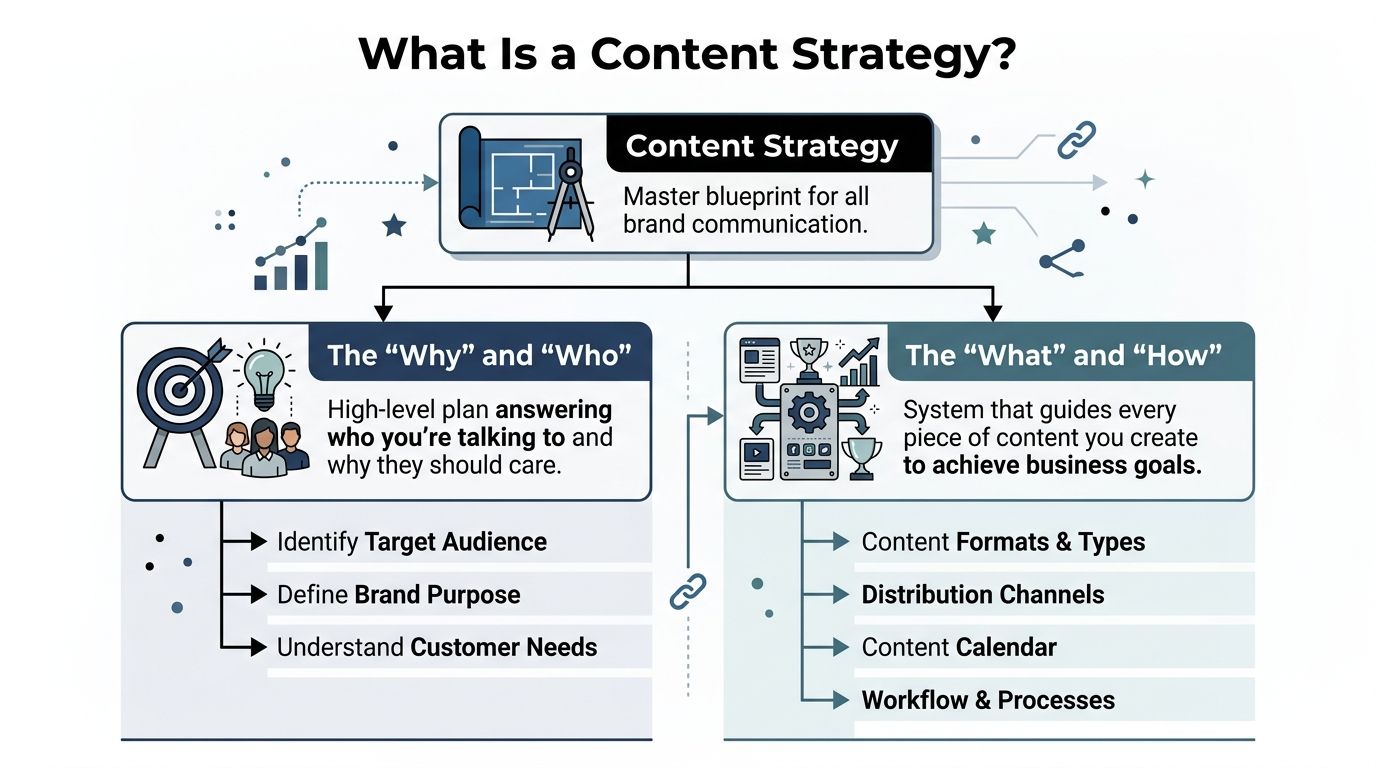
As you can see, the foundation has to be solid before you start building the walls.
3. Topics and Formats: What Will You Create?
Now that you know your audience and your goals, you can finally decide what to create. This breaks down into two key decisions: the topics you'll focus on and the formats you'll use to present them.
Your best topics live at the intersection of what your audience is desperate to know and what your brand can speak about with authority. The aim isn't to cover everything; it's to become the go-to resource for a handful of core themes.
The formats you choose should match what your audience wants and what works best on your chosen platform. A high-energy, 30-second tutorial could crush it on TikTok, but that same idea would need to be a comprehensive guide to work on your blog.
4. Distribution and Channels: Where Will People See It?
Making amazing content is only half the job. If no one sees it, it doesn't matter how good it is. Your distribution plan is your roadmap for getting your content in front of your audience. This can't be an afterthought—it needs to be baked into your strategy from day one.
Think about your channels in three buckets:
- Owned Media: The platforms you have total control over, like your website, blog, or email list.
- Earned Media: The attention you get from others, like press mentions, social shares, and customer reviews.
- Paid Media: The exposure you pay for, like social media ads or sponsored posts with influencers.
The right channels are simply wherever your target audience already spends their time. Don't spread yourself thin trying to be everywhere. It's far better to dominate on one or two key platforms than to be mediocre on five.
5. Governance and Workflow: How Will You Get It All Done?
In the world of content, consistency is everything. A governance and workflow system is what keeps the machine running smoothly. It's the operational plan for how content gets brainstormed, created, approved, published, and updated over time. This is what saves you from chaos.
This system defines who does what (writer, editor, designer), lays out a content calendar, establishes style guides for a consistent brand voice, and creates a clear approval process. A solid workflow is what allows you to produce great content, on schedule, without burning out.
6. Performance Measurement: How Do You Know If It's Working?
This final pillar is what makes the whole system intelligent. Performance measurement means tracking the right numbers—your key performance indicators (KPIs)—to see if your content is actually hitting those business goals you set earlier. This is how you stop guessing and start making data-backed decisions.
The metrics you track must tie directly to your goals. If you want brand awareness, you'll look at reach and impressions. If you want leads, you'll track form sign-ups and conversion rates. By regularly looking at this data, you learn what's working so you can do more of it, and what's falling flat so you can cut your losses.
Putting Your Content Strategy Into Practice
Alright, we’ve covered the "what" and the "why." Now for the fun part: seeing what a content strategy actually looks like in the wild. A plan on paper is one thing, but making it work is what separates the creators who get results from those who just post and pray.
To make this real, let's walk through two completely different mini-playbooks. These will show you how the six core pillars we discussed come together to build a powerful, focused plan for two very different types of creators.
Mini-Playbook 1: The Short-Form Video Educator
First up, let's look at a creator who helps new homeowners with quick DIY fixes. They've built their entire presence on fast, helpful tutorials using YouTube Shorts. Their content strategy is the blueprint that turns their expertise into a predictable stream of traffic and, ultimately, customers.
Here’s a peek under the hood at their strategy:
- Audience Persona: They know exactly who they're talking to: "Stressed Steve." He's 35, a new homeowner, and completely overwhelmed. He’s short on time, learns by watching, and pulls out his phone to search YouTube for immediate solutions. He doesn't want a long-winded explanation; he needs a quick win right now.
- Business Objective: The end game isn't just views. The primary goal is to drive qualified traffic to a paid online course, "Homeowner 101." A secondary, but still crucial, goal is building an email list by offering a free "Essential DIY Toolkit" PDF.
- Content Topics and Formats: Everything is built for speed and clarity. The content is all about ultra-specific, 30-60 second "how-to" videos. Think "How to Fix a Leaky Faucet in 30 Seconds" or "Unclog a Drain Without Chemicals." The format is always a quick-cut video with bold text overlays and a single, direct call-to-action at the very end. No fluff.
- Distribution and Channels: The main stage is YouTube Shorts. Why? Because that’s exactly where "Stressed Steve" is looking for this content. They also repurpose the best-performing videos as Instagram Reels to cast a slightly wider net.
- Governance and Workflow: They keep it simple. A basic spreadsheet acts as their content calendar. The creator batch-films four videos every Saturday morning. This one block of work ensures a consistent posting schedule—three videos per week—without the daily grind.
- Performance Measurement: They measure what matters. Success isn't about vanity metrics. It's about outbound clicks from YouTube to the course sales page and the number of PDF downloads. Views and subscribers are nice, but they’re secondary to the real business goals.
This isn’t just random content creation. Every single video has a job to do: guiding the perfect viewer from a quick tip on YouTube to a valuable business asset.

Mini-Playbook 2: The Personal Brand Consultant
Now for a different flavor. Imagine a consultant who helps entrepreneurs build powerful personal brands. Their weapon of choice is Instagram, where they use a mix of Reels and Stories to attract high-ticket coaching clients.
This playbook really drives home a core idea: your platform and format have to match the action you want customers to take. For a high-touch service like consulting, the goal is to build trust and start a conversation, not just rack up views.
Here’s how their strategy is wired for connection and conversions:
- Audience Persona: Their ideal client is "Ambitious Amelia." She's 28, launching her own venture, and wants to be seen as a thought leader. She’s all over Instagram, following successful founders for authentic, behind-the-scenes advice.
- Business Objective: The number one goal is to book discovery calls for one-on-one coaching. The entire strategy is designed to build authority and create a personal connection, making qualified leads feel comfortable enough to take the next step.
- Content Topics and Formats: They use a strategic mix to build trust from multiple angles:
- Instagram Reels: Quick, punchy tips like "3 Mistakes New Founders Make on LinkedIn" or "How to Film Your First 'Talking Head' Video."
- Instagram Stories: This is for building connection. They run interactive Q&As, share "day in the life" clips, and feature short video testimonials from happy clients.
- Carousel Posts: These are for deeper dives, breaking down a personal branding concept into a shareable, step-by-step guide.
- Distribution and Channels: The focus is razor-sharp: Instagram. All energy goes into mastering this one platform where "Ambitious Amelia" lives and breathes.
- Governance and Workflow: Content is planned out weekly. Reels are batched every two weeks to stay ahead, but Stories are often created on the fly to keep things feeling real and authentic. A "link in bio" tool is non-negotiable for sending people directly to a scheduling page for discovery calls.
- Performance Measurement: The ultimate KPI is crystal clear: the number of booked discovery calls that came from Instagram. They also watch secondary metrics like engagement on Reels and completion rates on Stories, as these are strong indicators of audience trust.
As you can see from both playbooks, a great content strategy isn't a static document. It’s a living system that connects who you’re talking to with what you want to accomplish, creating a clear and logical path for everyone involved.
Building Your Content Strategy From Scratch

Alright, we’ve covered the theory. Now for the hard part: actually rolling up your sleeves and building a content strategy that works. It’s easy to get intimidated here, aiming for some perfect, 100-page masterpiece on day one.
Forget that. The real key is to build a simple, manageable plan you can launch quickly and then improve as you go. Think of it as a ‘minimum viable strategy.’ This approach helps you sidestep the analysis paralysis that kills so many great ideas before they even start. You just need a clear roadmap to get moving. Let's build that roadmap together, step by step.
1. Audit Your Current Presence
Before you can figure out where you're going, you need an honest look at where you are right now. Start by taking a quick inventory of all your existing content and digital footprints. This means your website, any blog posts, your social media profiles, and every video you’ve ever published.
Don’t make this complicated. A simple spreadsheet will do the trick. For each piece of content, just ask: What’s this about? Who was this for? Did anyone actually engage with it? This quick audit will immediately show you what assets you have, what’s probably outdated, and where the most obvious gaps are.
2. Conduct Audience and Competitor Research
Okay, with your own house in order, it's time to look outward. First, get to know your audience on a much deeper level. Forget basic demographics for a minute and focus on their real-world struggles, aspirations, and the questions they're typing into Google. Where do they hang out online? What kind of content makes them stop scrolling and hit the share button?
Next, it's time to size up the competition. Pinpoint 3-5 other creators or brands who are already connecting with the audience you want to reach. Look at the topics they cover, the content formats they lean on, and what they seem to be doing exceptionally well. The goal here isn't to copy them—it's to find the angles they're missing so you can offer a unique perspective.
Don't skip this step. A deep understanding of your audience's needs and the competitive landscape is the foundation upon which your entire content strategy is built. It turns guesswork into a clear, targeted plan of action.
3. Define Your Unique Brand Voice
Now that you have a clear picture of your audience and the market, it’s time to define who you are in all of this. Your brand voice is your personality; it's the consistent feel and tone that comes through in everything you create. Are you funny and a little bit irreverent? Or are you more of the go-to expert who is educational and authoritative?
Write down three or four core adjectives that capture the voice you're aiming for (e.g., "helpful, clear, and encouraging"). Then, nail down your core message—the one big idea you want to be known for. This simple exercise is what ensures your content always feels authentic and consistent.
4. Develop a Sustainable Content Calendar
Your content calendar is where your strategy becomes an action plan. It’s a simple map of what you're going to publish, where, and when. If you're just starting out, simplicity is your best friend. A basic calendar is the perfect tool to help you figure out how to plan social media content without getting completely overwhelmed.
Try planning just one to two weeks ahead at first. This provides structure but leaves room for flexibility. The aim is to find a realistic and sustainable posting rhythm you can actually stick to, which helps you avoid the dreaded "feast or famine" cycle that plagues so many creators. If you're looking for a more in-depth framework, this guide on building a winning B2B content strategy is a fantastic resource.
5. Establish a Simple Creation Workflow
So, how does an idea actually become a published piece of content? A workflow outlines those exact steps. Even if you're a one-person show, mapping this out is crucial for staying efficient and sane.
Your workflow might look something like this:
- Ideation: Brainstorming topics and picking one from your calendar.
- Creation: Writing the script or outline and creating the video or visuals.
- Review: Giving it a final once-over for quality and to make sure it matches your brand voice.
- Publishing: Scheduling the post to go live on your chosen platforms.
Writing these steps down removes the friction and makes content creation a repeatable, less chaotic process.
6. Set Up Basic Analytics Reporting
You can't improve what you don't measure. From the very beginning, have a plan to track your performance. You don't need some fancy, complicated dashboard. Just start by tracking one or two key metrics that directly align with your main goal.
For instance, if your goal is brand awareness, keep an eye on reach and shares. If you're focused on generating leads, track clicks to your website. A simple monthly check-in is all it takes to see what’s hitting the mark with your audience, allowing you to double down on what works and tweak what doesn’t.
Amplifying Your Strategy With AI and Automation
Let’s be honest. Having a brilliant content strategy on paper is one thing, but actually doing the work week after week is another. For solo creators and small teams, the relentless cycle of creating, publishing, and promoting content can quickly lead to burnout. The plan is solid, but the execution feels impossible.
This is where AI and automation change the game. It’s not about handing over your creativity to a robot; it’s about giving yourself a production assistant that never sleeps. Think of it this way: you’re the director, and AI is your crew, handling the repetitive, time-draining tasks. This frees you up to focus on the big-picture thinking that actually grows your brand, especially in the demanding world of short-form video where the audience always wants more.

Overcoming Common Execution Hurdles
The biggest roadblocks to a consistent content flow are almost always time and energy. You know you need to post three times a week, but squeezing in the hours to script, record, edit, and schedule everything is a constant battle. This is exactly where AI tools can step in and make a real difference.
Platforms like ClipCreator.ai are designed to take the heaviest lifting off your plate. They can turn a single idea into a finished video by handling the entire workflow:
- Scriptwriting: Crafting tight, engaging scripts designed specifically for short-form video attention spans.
- Voiceover Generation: Producing a natural-sounding voiceover without you needing a microphone or a quiet room.
- Visual Creation: Finding and syncing up relevant b-roll, clips, and images that bring your story to life.
- Scheduling and Publishing: Automatically pushing your finished videos to all your social platforms at the best times.
This kind of automation directly bolsters your content strategy, making your plans for formats and distribution much easier to manage.
When you automate the hands-on production, you get your most valuable asset back: your creative energy. You can spend that time digging into analytics, refining who you're talking to, and dreaming up your next big idea instead of getting lost in the weeds.
From Strategy To Set-It-And-Forget-It Execution
Imagine mapping out your content calendar and then watching it come to life with just a bit of oversight. That’s the real power AI brings to your strategy. You supply the topics and themes, and the automated system ensures the work gets done, day in and day out. You never miss a post, keeping your brand visible and your audience hooked.
For faceless video creators, this is nothing short of a revolution. It’s what allows you to scale from posting a few videos a week to publishing daily—a pace that would be exhausting to maintain manually. You can explore a variety of ways to use these systems in our guide to AI content creation tools.
Ultimately, bringing AI into your workflow is about making your ambitious content strategy more than just a document. It makes it a reality.
Common Content Strategy Mistakes and How to Fix Them
Even the best-laid content plans can go sideways. It happens. But understanding why a strategy isn't hitting the mark is the first step to building one that actually works and keeps on working. These common slip-ups are almost always fixable once you know what to look for.
If you feel like you're shouting into the void—posting great stuff but getting crickets in return—it's time to put on your detective hat. By figuring out the root cause, you can stop wasting energy on what's broken and get back to creating content that connects.
Creating Content for Everyone (and Therefore, No One)
This is probably the most common pitfall I see. In an effort to cast a wide net, creators end up making content for a vague, imaginary "everyone." The result? Your message becomes so watered-down that it fails to grab the attention of the specific people who would love what you do.
- What it looks like: You're posting consistently, but the needle isn't moving. You get a few random likes, but no real conversation, no shares, and no one sliding into your DMs to learn more.
- The Fix: Go back to your audience research. Right now. Instead of thinking big, think small. Create your next piece of content to answer one specific question for one specific person. It should feel like a direct message, not a billboard.
Flying Blind and Ignoring Your Own Data
Creating content based on a "hunch" is just gambling with your time and energy. Without looking at your analytics, you have no real clue what's working, what's a dud, or—most importantly—why. You're flying blind, hoping to accidentally stumble into success.
A content strategy isn't something you "set and forget." Think of it as a living, breathing system that needs data to thrive. Regularly checking your analytics is how you turn guesswork into a repeatable formula.
When you ignore the numbers, you're doomed to repeat the same mistakes. You'll keep creating content on topics your audience is bored with while completely missing the hidden gems that could be driving all your growth.
The Feast-or-Famine Publishing Cycle
Momentum is everything in the content game. The classic "feast or famine" cycle—where you post like a maniac for a week and then disappear for a month—is a killer for engagement. It confuses your audience and signals to the platform's algorithm that you're not a reliable source.
- What it looks like: Your follower count has flatlined. Your reach drops off a cliff during your quiet periods. When you finally post again, it feels like you're starting from square one every single time.
- The Fix: Be honest with yourself and build a realistic publishing schedule. It is far, far better to post two high-quality videos per week, every single week, than to drop ten in a creative burst and then vanish. Consistency builds trust and trains your audience to actually look forward to hearing from you.
Publishing Content and Praying for the Best
Great content is only half the battle. Hitting "publish" is the starting line, not the finish line. Creating a fantastic video without a plan to promote it is like throwing a huge party and forgetting to send the invitations. You did all that work, just for it to sit alone in a corner.
This mistake is especially painful because it wastes all the effort you've already put in. Every single piece of content deserves its own mini-launch plan.
How to Stop Publishing into Silence:
- Your Inner Circle: The moment you publish, share it with your email list. Link to it from popular pages on your website. These are your warmest leads.
- Social Media Blitz: Don't just post about it once. Schedule multiple posts across all your social channels to promote that one piece of content over the next few days or even weeks.
- Break It Down: Never let a piece of content exist in only one form. That one video can be repurposed into a dozen different assets: a blog post, a series of quote cards, an Instagram carousel, or a text-based tweet thread.
This way, you ensure your hard work gets seen by the widest audience possible, squeezing every drop of value out of your creative efforts.
Common Questions About Content Strategy (Answered)
Even with a solid grasp of the basics, a few practical questions always pop up when it's time to put pen to paper. It's one thing to know what a content strategy is, but it’s another to actually build and run one. Let's tackle some of the most common hurdles so you can move forward with confidence.
How Often Should I Review My Content Strategy?
Your content strategy shouldn't be a dusty document you check once a year. That’s far too slow. Instead, think of it as a living, breathing plan that needs regular attention.
The sweet spot for most creators is a quarterly check-in. This gives you enough time to collect meaningful data and see what’s working, but it’s also short enough to pivot away from tactics that are falling flat. During this 90-day review, you'll look at your metrics, see which posts genuinely connected with people, and adjust your course for the next quarter.
What's the Difference Between a Strategy and a Calendar?
This is a big one, and getting it right is fundamental. Think of it like a road trip: your strategy is the destination, while your calendar is the turn-by-turn GPS directions.
- Content Strategy: This is your "why." It's the high-level game plan that outlines who you're talking to, what you want to achieve, and the core message you stand for. It answers the big question: "Why are we even making this stuff?"
- Content Calendar: This is your "what and when." It's the on-the-ground schedule that maps out exactly what piece of content goes live, on which platform, and at what specific time.
Your strategy gives the calendar purpose. The calendar brings the strategy to life. You can't have one without the other, but they are not interchangeable.
How Long Does It Take to See Results?
It's easy to get discouraged if you expect instant success, so let's set some realistic expectations. You might see some encouraging signs early on—a bump in likes, comments, or shares within a few weeks. That’s great!
But the real, game-changing results? Things like showing up on the first page of Google, becoming a recognized name in your niche, and generating a reliable stream of leads—that takes patience. You should plan for a 6-9 month runway before you start seeing that kind of serious momentum. Content is a long-term investment, not a get-rich-quick scheme. Trust the process, stay consistent, and the results will come.
Ready to stop planning and start doing? ClipCreator.ai can take your strategy and turn it into a steady stream of videos, automating everything from the script to the final upload. Get started today and see how easy it can be to execute your plan.

Create your first video in under 2 minutes
Pick a niche, and ClipCreator.ai generates and auto-posts faceless videos to your channels every day.
Join ClipCreator.ai