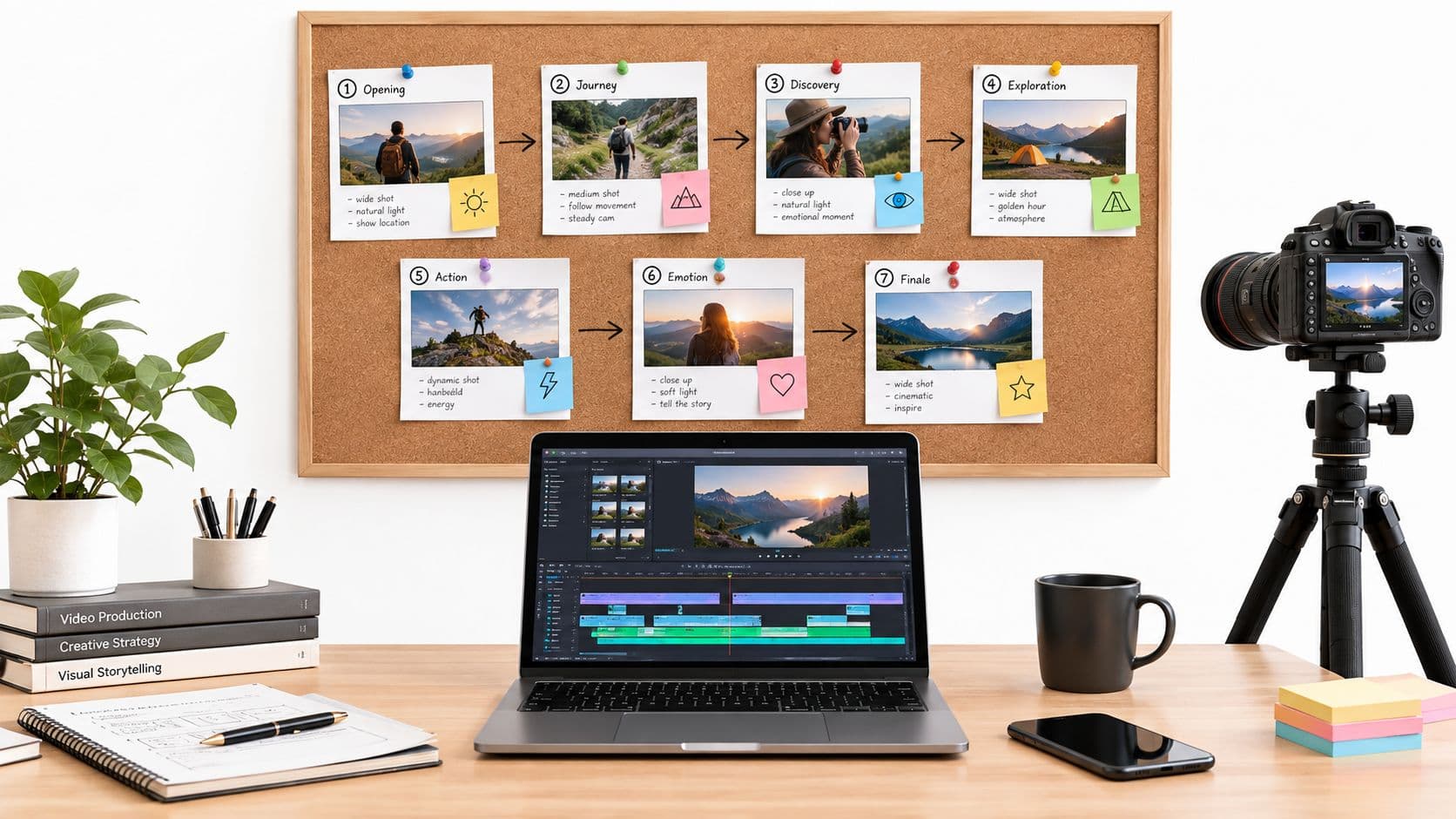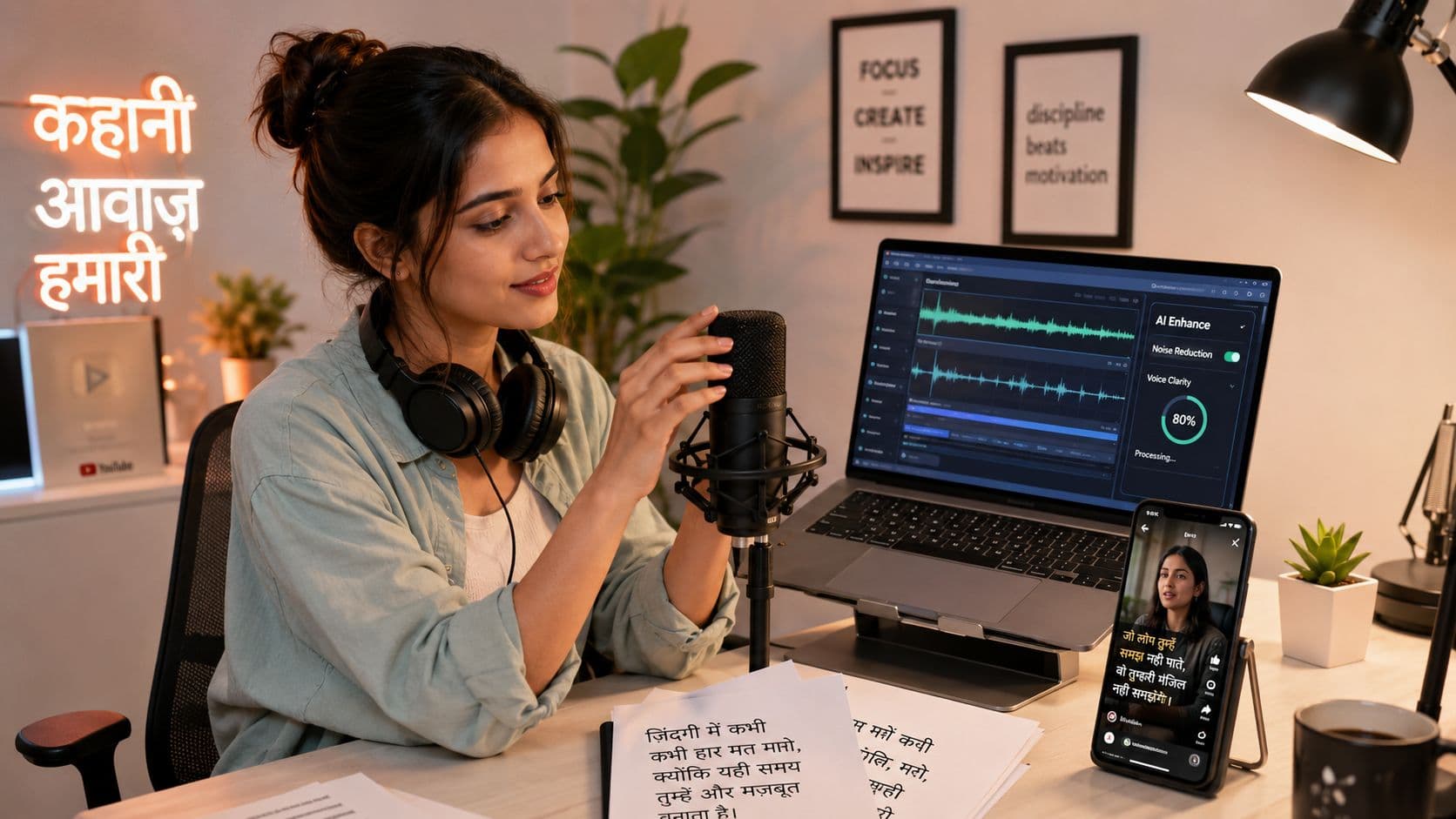
You've got the English cut done, the hook is tight, and the edit already feels close. The problem is the video still sits in that awkward middle ground where English-first pacing sounds polished to you, but it won't survive a phone speaker, a rushed thumb-scroll, or a viewer who needs the point in Hindi right away. That's where dubbing in Hindi stops being a translation task and becomes an audience-fit decision.
A first Hindi dub usually exposes the bottleneck fast. The words may be accurate, but the rhythm feels imported, the joke lands late, or the audio sounds too clean in a way that makes it strangely harder to follow. If the viewer in a crowded bus, small shop, or shared room can't catch the line on the first listen, the dub has already lost its main job.
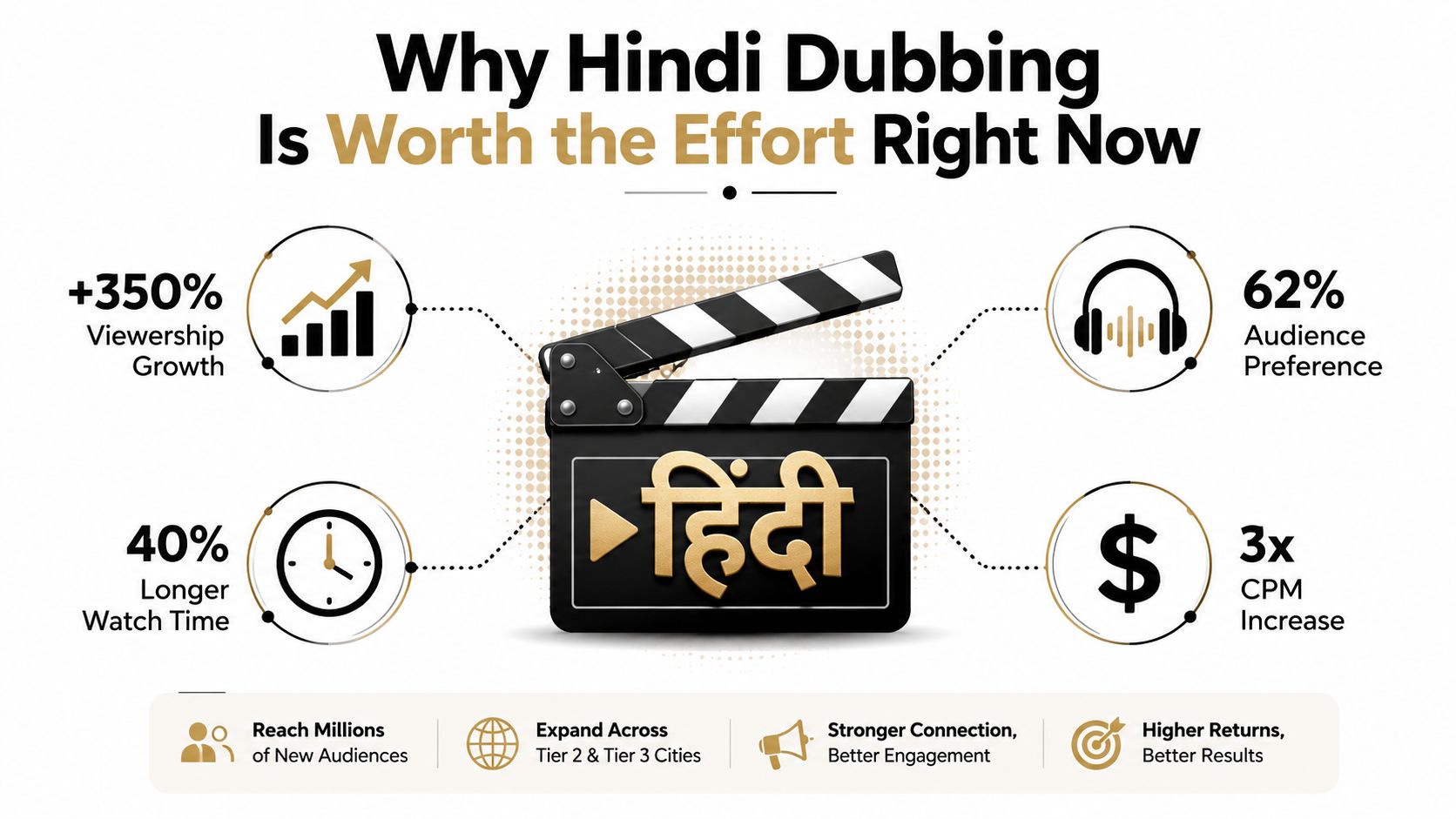
Why Hindi Dubbing Is Worth the Effort Right Now
The first time a creator dubs a short into Hindi, the reaction is usually split. The script feels familiar, but the voice, pacing, and screen rhythm suddenly need to serve a different viewer, one who may not be watching with headphones, and may not be reading every subtitle. That shift is exactly why dubbing in Hindi has moved from a nice extra to a serious distribution choice.
Hindi dubbing has a long commercial runway behind it. The modern history is often traced to the early 1990s, when Jurassic Park is widely cited as the first Hollywood film dubbed into Hindi, and it reportedly earned INR 190 million during its 25-week run in India, which helped prove there was real demand for Hindi dubs in imported films Dubverse's history of Hindi dubbing. That early proof point matters because it set up the broader shift you see now in short-form video, streaming, and mobile-first viewing.
Industry reporting says dubbed Hindi films accounted for 31.2% of the total Hindi-language film box office in 2024, up from about 6% in 2023 The Economic Times on dubbed Hindi films. That doesn't mean every creator should dub everything. It does mean Hindi-dubbed content has crossed from niche localization into a meaningful revenue lane.
The hidden failure mode is simple, and I see it constantly: creators optimize for translation accuracy instead of intelligibility on a phone speaker. If the words are right but the pacing is too dense, the viewer drops. If the mix buries consonants under music, the viewer drops. If the delivery sounds too formal for a mobile-first audience, the viewer drops.
Practical rule: if your Hindi dub can't be understood without leaning in, it's not ready for short-form distribution.
For creators deciding whether to dub every post or only the strongest performers, the answer is usually operational, not ideological. High-performing videos deserve the extra localization pass first. Lower-performing posts can stay in the original language until the format proves it can hold attention. If you're worried about AI safety or brand fit before you start, this internal explainer on whether AI dubbing is safe is a useful companion.
Choosing Your Hindi Audience Before You Touch the Script
A Hindi dub fails fastest when the creator tries to serve everyone at once. Metro bilingual viewers, Tier 2 and Tier 3 Hindi-first viewers, and Hindi learners abroad all want different pacing, vocabulary, and tone. Treating Hindi as one target is the most common localization mistake, and it shows up immediately in the script.
Pick the viewer, then pick the register
A bilingual viewer in a metro market can usually tolerate a little English carryover and faster phrasing. A Hindi-first viewer on a budget phone usually needs cleaner sentence structure and fewer cultural assumptions. A learner abroad may prefer clarity over slang, even if the result feels slightly less native.
That choice changes more than vocabulary. It affects how aggressive your hook can be, whether you keep idioms, how much code-switching you allow, and even how your title art frames the promise. A short that feels playful in one audience can feel chaotic in another.
A simple brief helps. Before any tool opens, write three lines for the dub:
- Who is this for? State the viewer in plain language, not demographics alone.
- What should they feel by second five? Tighten the emotional target.
- What must stay understandable on a phone speaker? Name the line or beat that cannot get lost.
If you want to feed a script generator or AI dubbing tool, use a prompt like this, then adapt it to your own content:
Write this Hindi dub for a mobile-first viewer who will likely hear it on a phone speaker. Keep the tone conversational, avoid formal textbook phrasing, preserve the hook in the first line, and simplify any joke or reference that won't land outside the original audience.
That brief does two useful things. It tells the writer or tool what not to over-explain, and it makes you choose the audience before you start polishing. A dub built for Hindi-first viewers will usually read differently from one built for diaspora audiences, even when both are technically “Hindi.”
The best creators I've seen don't ask, “Can this be translated?” They ask, “Who is this for, and what kind of Hindi will they stay with?”
Script Localization That Retains Viewers
Literal translation is where Hindi dubs die. The sentence may be accurate, but the rhythm lands stiff, the joke arrives late, and the viewer feels the script being translated instead of being spoken naturally in Hindi. That is a retention problem, not a language problem.
The fastest fix is to localize at the transcript level before recording or synthesis. The workflow that usually holds up is simple, upload the source video, set the source and target languages, review the translated transcript segment by segment, then export the dubbed video and separate subtitle or audio files. Transcript review is the QC step that saves the most time, because editing text is faster than re-recording audio and gives you room to fix brand names, jokes, and phrasing before synthesis practical Hindi dubbing workflow.
Cut for short-form, not for completeness
A 60 to 90 second short does not need every source sentence. It needs the hook, the turn, and the payoff. That means trimming filler, compressing explanation, and replacing culture-specific references with something the Hindi viewer can process instantly.
A weak line often becomes stronger when it gets shorter. For example:
- “I was kind of shocked when this happened” becomes “This caught me off guard.”
- A long local reference can become a direct explanation.
- A joke that depends on a niche English pun can become a cleaner reaction beat.
The point is not to flatten the personality. It is to keep the spoken Hindi moving at the same pace as the visual edit. When the line is too long for the cut, the viewer hears the mismatch.
Here is a practical before-and-after shape:
Original feel, “I kept testing it, and the results were way better than I expected.”
Hindi-optimized feel, “I tested it a few times, and the result was better than I expected.”
The second line is not more poetic. It just gives the audience less friction.
Write in chunks that match scene cuts
Segmenting the Hindi script by shot or beat makes a bigger difference than you might expect. One chunk per visual idea keeps the voice from drifting over unrelated frames. It also makes it easier to catch bad transitions before you export.
If you are using ClipCreator.ai's script writing workflow or any similar drafting tool, keep the script editable in small blocks. That makes it easier to swap a stiff line for a conversational one without rebuilding the whole track.
The line between good and great is usually a transcript that sounds like someone spoke it naturally in Hindi, not a translation that merely survived syntax.
Picking the Right Hindi Voice for Short-Form
Voice choice is usually the biggest retention variable in a Hindi dub. The visual can be strong, and the script can be localized well, but if the voice feels wrong, viewers notice immediately. That's why the choice between human voiceover, AI TTS, and hybrid workflows matters more than whether the subtitle font looks premium.
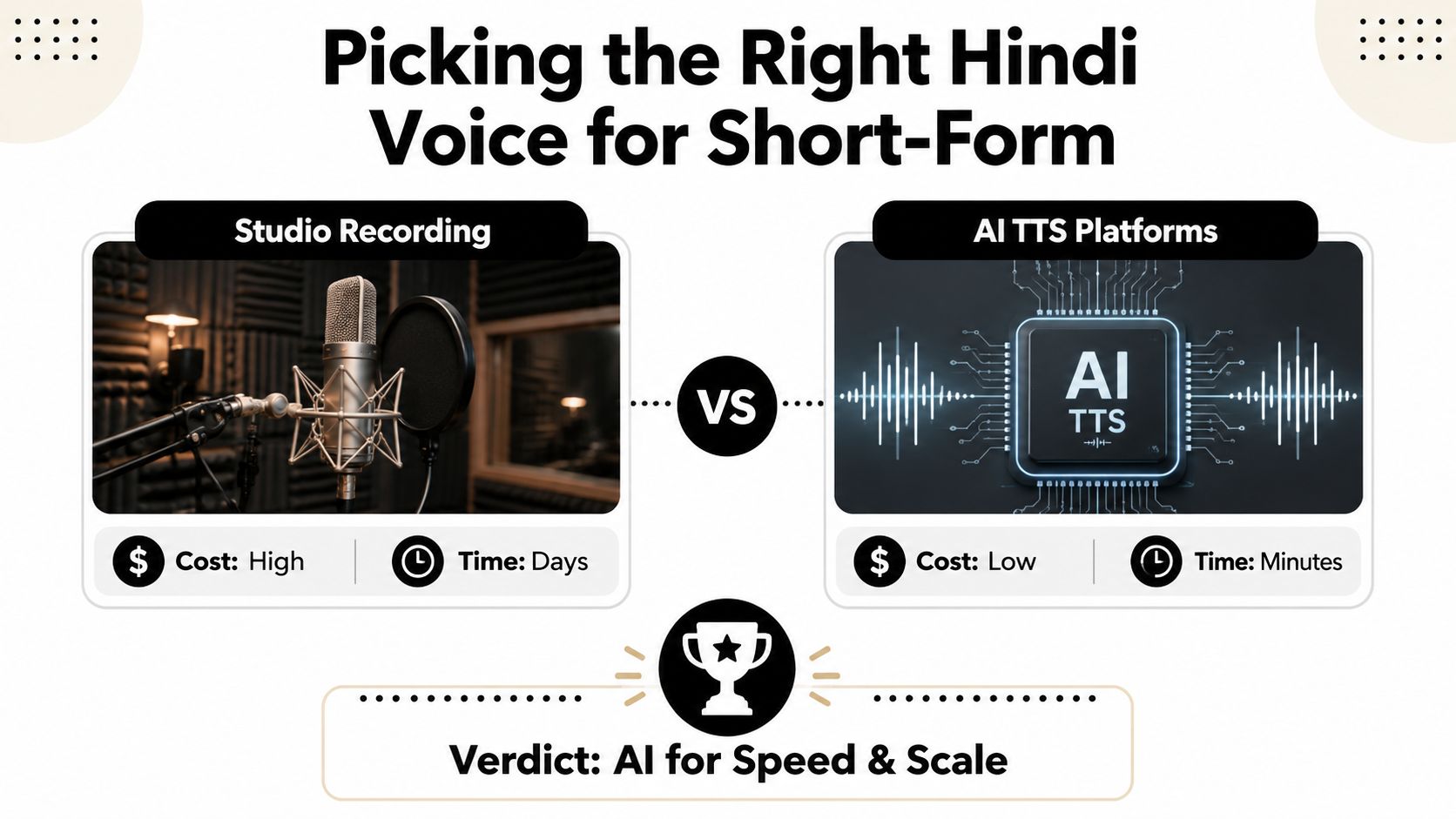
Human voice, AI voice, or hybrid
A human voice still wins when the brand depends on nuance, comedy timing, or emotional lift that needs a very specific performance. Studio work also gives you more control over accent texture and micro-pauses, which can matter in story-led videos.
AI TTS has become the better default for speed and scale. Tools such as ElevenLabs, Murf, Sarvam, and built-in voices inside editing suites now make Hindi dubbing quick enough for volume workflows, especially when you're pushing out shorts regularly. If the content is informational, explainers often benefit from this speed because iteration matters more than perfection.
Hybrid pipelines sit in the middle. You can generate the voice with AI, then clean the pacing, emphasis, and pauses so the line breathes more naturally. For short-form, that often gives you most of the speed benefits without the stiffest edge of raw synthesis.
If you want a deeper compare-and-contrast on voice generation, this AI text-to-speech voice guide is relevant. It's especially useful if you're choosing between a more neutral voice and one that carries more personality.
Choose voice by job, not by hype
The decision rule is straightforward:
- Use human voice when the video is brand-sensitive, emotionally delicate, or performance-heavy.
- Use AI TTS when you need consistent output and can tolerate slightly less expressive nuance.
- Use hybrid when you want speed but still need better timing than raw defaults give you.
Accent neutrality matters too. A voice that sounds too regionally marked can narrow the audience if your target is broader Hindi-first mobile viewers. On the other hand, a completely flat voice can feel robotic, especially in story content. The sweet spot is usually clear, conversational Hindi with enough inflection to keep the viewer listening.
A good Hindi voice doesn't call attention to itself. It carries the edit forward.
There are still cases where a human voice earns the extra cost. If the script depends on punchline timing, irony, or trust, pay for the voice. If you're publishing at volume and testing what works, ship with AI first and use the data from actual retention before upgrading.
Syncing Voice, Visuals, and Burned-In Subtitles
Once the Hindi voice is in place, the work becomes a timing job. A dub can sound fine on its own and still feel wrong the moment the voice trails the mouth, the cut lands late, or the burned-in subtitles crowd a vertical frame. Dubbing quality is not only about word choice, it is about matching emotion, timing, and mouth movement so the edit still feels native on a phone screen.
For a practical visual reference while you check the edit, the short video below is worth watching during your QA pass.

Align the voice to the motion, not the other way around
For professional Hindi dubbing, the standard is clear. The voice should start when the mouth opens and finish when it closes, while still preserving the emotional timing and body-language timing of the original performance. That is the point raised in professional dubbing guidance. Every frame does not need to match perfectly, especially on shots where the face is not visible, but obvious drift pulls attention away from the content.
Keep the major beats aligned. If the source clip cuts on a reaction, the Hindi line should land into that reaction, not run past it. If the original pauses for impact, keep the pause. A lot of bad sync comes from trying to squeeze every word into every frame instead of protecting the rhythm that holds the scene together.
Burn subtitles for vertical playback
Subtitles are part of the main viewing experience in short-form. Viewers often watch without sound or catch only part of the audio, so the subtitle stack has to carry meaning fast. Keep the chunks short enough to read quickly on a phone, and place them where they do not compete with the speaker's face or the main subject.
Break by meaning, not by sentence length. A long sentence can become two short subtitle cards if that keeps the reading load manageable. On mobile, crowded text hurts comprehension faster than slightly simpler language.
A clean workflow helps:
- generate the voice,
- align it to the scene cut,
- build subtitle chunks,
- test the whole piece in vertical format.
If the subtitle stack makes the frame feel busy on a phone, it is too much.
Background music and SFX need restraint too. The Hindi voice should sit above the mix without flattening the original atmosphere. Give the hook enough room, then let the visual carry the rest.
For audio sync and edit cleanup, the AgentPulse audio sync tips are a helpful reference when you are checking whether the voice lands cleanly on cut points and whether the edit drifts at the seams.
Mixing, Loudness, and the Phone-Speaker QA Pass
A Hindi dub can sound fine in the edit bay and still fail on the device that matters. The voice gets soft under the beat, the consonants blur, and the line that should carry the hook disappears on a cheap phone speaker. This is the key test for Tier 2/3 mobile viewing.
Recording noise is one of the fastest ways to lose that test. Clothing rustle, desk taps, and room noise all force extra cleanup, and they can leave the final mix sounding thin or overprocessed if you keep patching problems after the fact. Creators who record casually usually spend more time fixing audio than they planned.
Run the final render where your audience will hear it
A phone-speaker QA pass belongs before publish. Play the finished dub on a budget handset, or any weak speaker that behaves the same way, then check clarity, balance, and clipping. If the dialogue sinks under the music, the viewer will not stay long enough to care how accurate the translation was.
For audio sync and edit cleanup, the AgentPulse audio sync tips are a helpful reference. Use them when you are checking whether the voice lands cleanly on cut points and whether the edit drifts at the seams.
A fast QA checklist
Use a short pass before every publish:
- Dialogue clarity: Make sure consonants are easy to hear.
- Music balance: Keep the bed audible, but never let it bury speech.
- No clipping: Watch for harsh peaks that make the voice distort.
- Vertical playback: Confirm the text and face positions still work on a phone.
- Final export sanity: Listen once after export, because render issues show up there, not in the timeline.
Practical rule: if you cannot understand the dub in one casual phone playback, do not publish it yet.
Polish has limits here. A Hindi dub does not need cinematic treatment, it needs a clean, intelligible mix that survives real listening conditions and lets the viewer follow every line without effort.
Publishing Cadence and Where ClipCreator.ai Fits
A Hindi dub only pays off when it fits a repeatable publishing rhythm. Treating it as a one-off creative experiment wastes the main advantage, which is distribution. The practical call is whether to dub every short, or start with clips that already showed traction in the source language. For most creators, dubbing the winners first is the safer move, then expanding once the format proves it can keep Hindi viewers watching too.
Audience fit changes the pacing and the script choices. India-wide Hindi speakers, Hindi learners, and Hindi-first viewers in Tier 2 and Tier 3 markets do not respond to the same delivery. A mobile-first audience usually does better with a sharper hook, fewer culture-specific references, and a voice that gets to the point without drifting. If every clip sounds equally formal, the output may look polished and still miss the people who are watching on a phone speaker.
The operating cost is part of the decision too. A 2025-style Hindi YouTube dubbing guide estimates 4 to 5 days for a full Hindi track and monthly costs of roughly ₹28,000 to ₹64,000 for weekly uploads Hindi voice-over workflow economics. Those figures are not universal, but they make the trade-off clear, cadence and budget sit at the center of the workflow, not at the end of it.
For creators who want faceless short-form production without building every step manually, ClipCreator.ai fits as an automation layer at the end of the loop. It generates short videos, adds voice and subtitles, and helps with scheduling across platforms, which is useful when the goal is steady output rather than custom editing every time. The judgment still stays the same, automation helps most after the format is already proven and the audience fit is clear.
The smartest weekly rhythm is simple. Publish one or two Hindi-dubbed uploads, check whether the voice still works on a phone speaker, then scale only if the response justifies the extra work. If the dub survives that test, you can keep the pipeline moving without polishing every clip as if it were a flagship release.

Create your first video in under 2 minutes
Pick a niche, and ClipCreator.ai generates and auto-posts faceless videos to your channels every day.
Join ClipCreator.ai