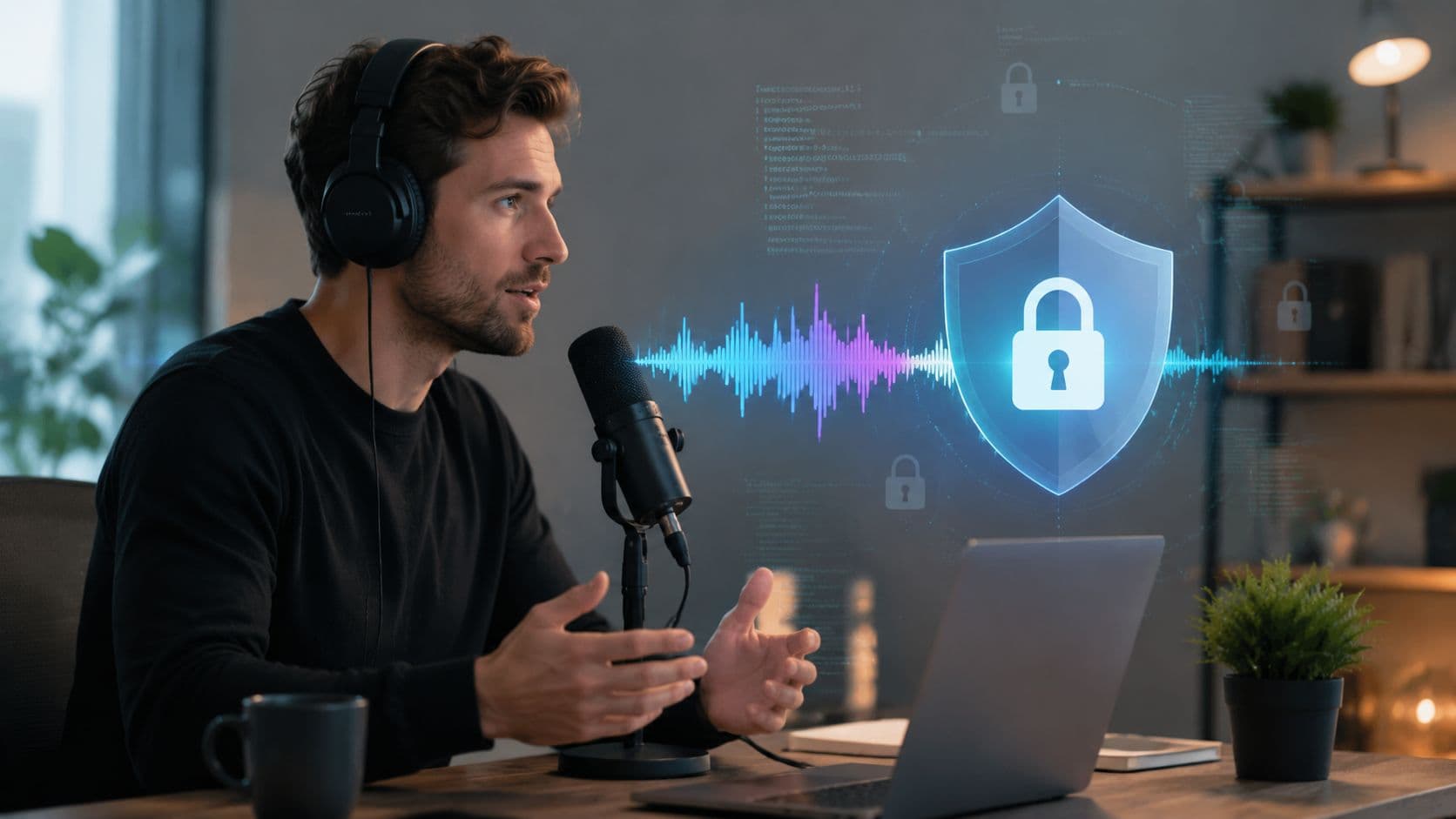
AI dubbing is safe only when the platform uses strong safeguards like encrypted data transmission, no third-party data sharing, guaranteed voice-data deletion, and SOC 2 compliance, and some reputable tools delete voice data within 24 to 72 hours after processing. Ignore those standards, and the risks become very real: impersonation, privacy violations, licensing trouble, and brand damage from poor output.
If you're making faceless short videos for TikTok, YouTube Shorts, or Instagram Reels, AI dubbing probably feels like the obvious next step. You can turn one script into multiple languages, test different voices, and publish faster without recording every version yourself. That upside is real.
The uncomfortable part is that most creators don't get stuck on the editing. They get stuck on trust. Is dubbing AI safe? Can a platform keep your voice data? Could a cloned voice be misused? Could a bad translation make your content sound awkward or flat?
Those are the right questions. AI dubbing itself isn't automatically safe or unsafe. It's more like handing over a house key. If you give it to a trusted person with clear rules, you're fine. If you hand it to someone careless, you've created a risk.
The Creator's Dilemma with AI Voices
Short-form creators usually hit the same wall. You want to scale output, maybe localize a winning video, maybe try a more polished narrator voice, but you don't want to wake up later and find out the tool used your uploads in ways you didn't expect.
That worry isn't paranoid. It's practical.
A faceless channel often depends on automation. You might generate scripts, add visuals, sync subtitles, and use AI narration in one workflow. That convenience can hide an important detail: your audio is data, and whoever processes that data needs rules, security, and clear consent practices.
Why creators feel uncertain
The confusion usually comes from three places:
- The tech feels invisible: You upload audio, choose a language, and a dubbed file appears. Because the system feels simple, it's easy to miss what happened behind the scenes.
- Terms are often hard to read: Licensing, retention, and model-training language can be buried in legal text.
- "Voice" feels personal: A thumbnail or caption doesn't feel like your identity. A voice does. People recognize it, trust it, and associate it with your brand.
Practical rule: If a platform can't explain what happens to your voice data in plain language, don't upload anything you care about.
For creators, the biggest mistake is treating AI dubbing like a harmless filter. It isn't. It's closer to granting temporary access to part of your identity or part of your brand.
The real safety test
A safer question than "Is dubbing AI safe?" is this: Is this specific platform safe for my content, my audience, and my voice rights?
That shift matters. The technology can be used responsibly. It can also be abused. Using your own voice or properly licensed synthetic voices is generally permissible, while using someone else's voice without explicit consent is legally unacceptable, as explained in Perso's overview of AI dubbing safety.
For a non-technical creator, that means safety comes down to a few grounded checks:
- Who owns the voice being used?
- How long is the data kept?
- Does the company share data with third parties?
- Is there human review before you publish?
Once you know how the system works, those questions get much easier to answer.
Understanding How AI Dubbing Works
AI dubbing sounds futuristic, but the basic idea is simple. A system listens to speech, turns it into structured audio data, maps that speech into another language or delivery style, and then generates a new spoken track.
The easiest way to think about it is as a digital voice key.
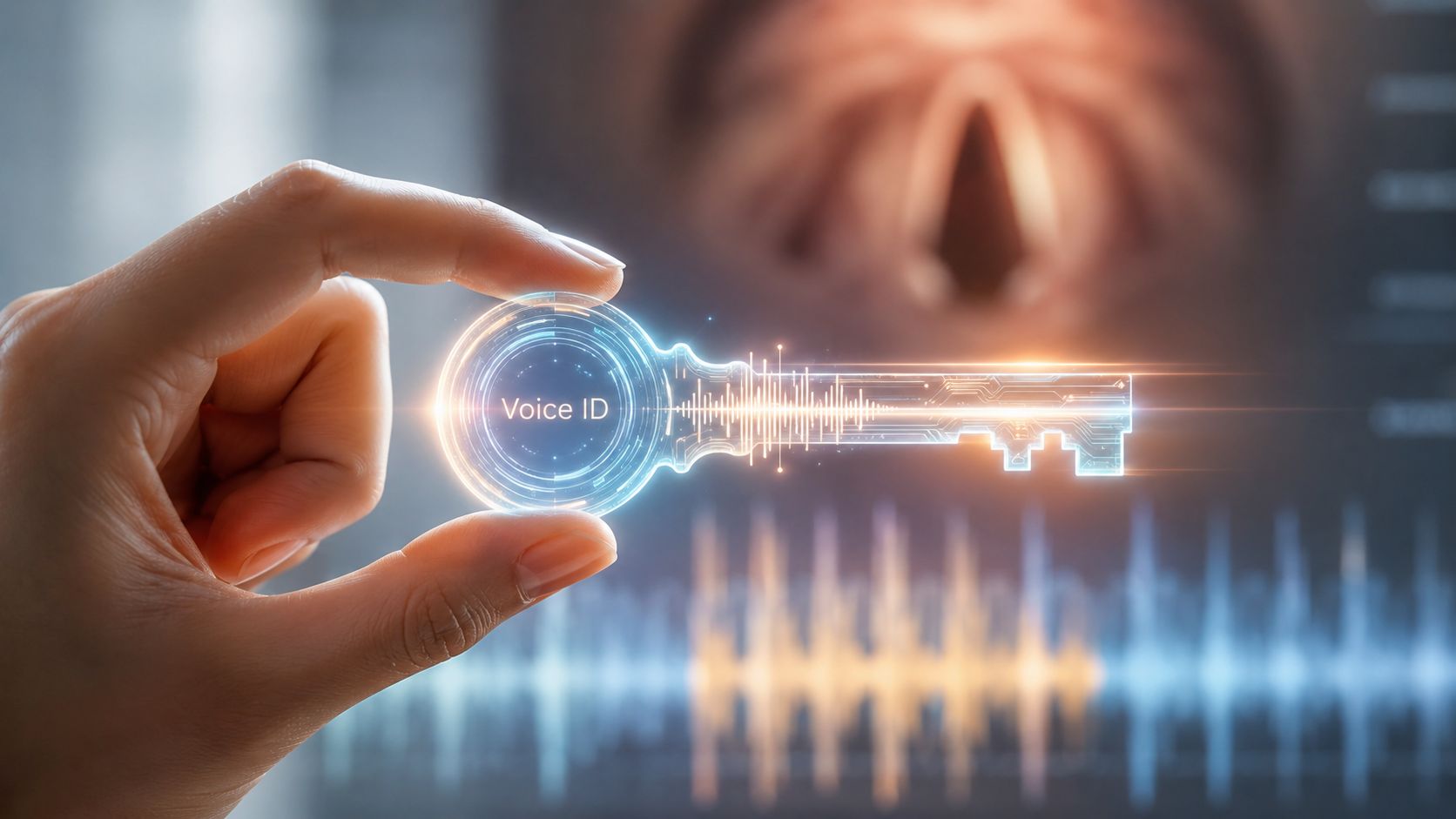
The digital key analogy
A physical key can open the right door. A copied key can also open it if the wrong person gets access.
Voice data works in a similar way. When you upload speech to an AI dubbing tool, the system isn't just hearing words the way a person does. It's extracting patterns such as rhythm, tone, pronunciation, and pacing. Those patterns help the tool create a new spoken version.
That doesn't mean every platform is cloning your identity. Some are generating speech from licensed synthetic voices. Others let users clone or closely mimic a real voice. The safety difference is huge.
If you're new to AI audio workflows, this broader primer on text to speech for videos helps connect the dots between narration tools and dubbing tools.
Where the real risk enters
The risk starts when a platform keeps that "digital key" longer than needed, or uses it for purposes you didn't clearly approve.
According to Vozo AI's discussion of dubbing safety, AI dubbing is technically safe when platforms enforce strict data retention policies, specifically deleting voice data within 24 to 72 hours after processing and avoiding indefinite storage. The same source says reputable providers use consent verification workflows with identity checks and revocation processes before cloning a real person's voice.
That matters because deletion limits what can be copied later. Consent checks reduce the chance that someone uploads another person's voice and pretends they had permission.
A safe dubbing tool shouldn't act like a warehouse for voice samples. It should act like a secure checkout counter. Process the job, finish the task, and clear the data.
What creators should take from this
You don't need to understand machine learning to use AI dubbing safely. You only need to understand the handoff.
When you upload audio, ask yourself:
| Question | Why it matters |
|---|---|
| Is this my own voice or a licensed synthetic voice? | Ownership and consent come first. |
| Does the platform say how long data is stored? | Long retention creates extra risk. |
| Can consent be revoked for cloned voices? | A trustworthy system plans for change. |
If a tool is vague on any of those points, that's not a small detail. That's the safety issue.
The Four Key Risks of AI Dubbing
Most creators don't run into trouble because dubbing "breaks." They run into trouble because a tool is used in a way that crosses a legal, ethical, or quality line.
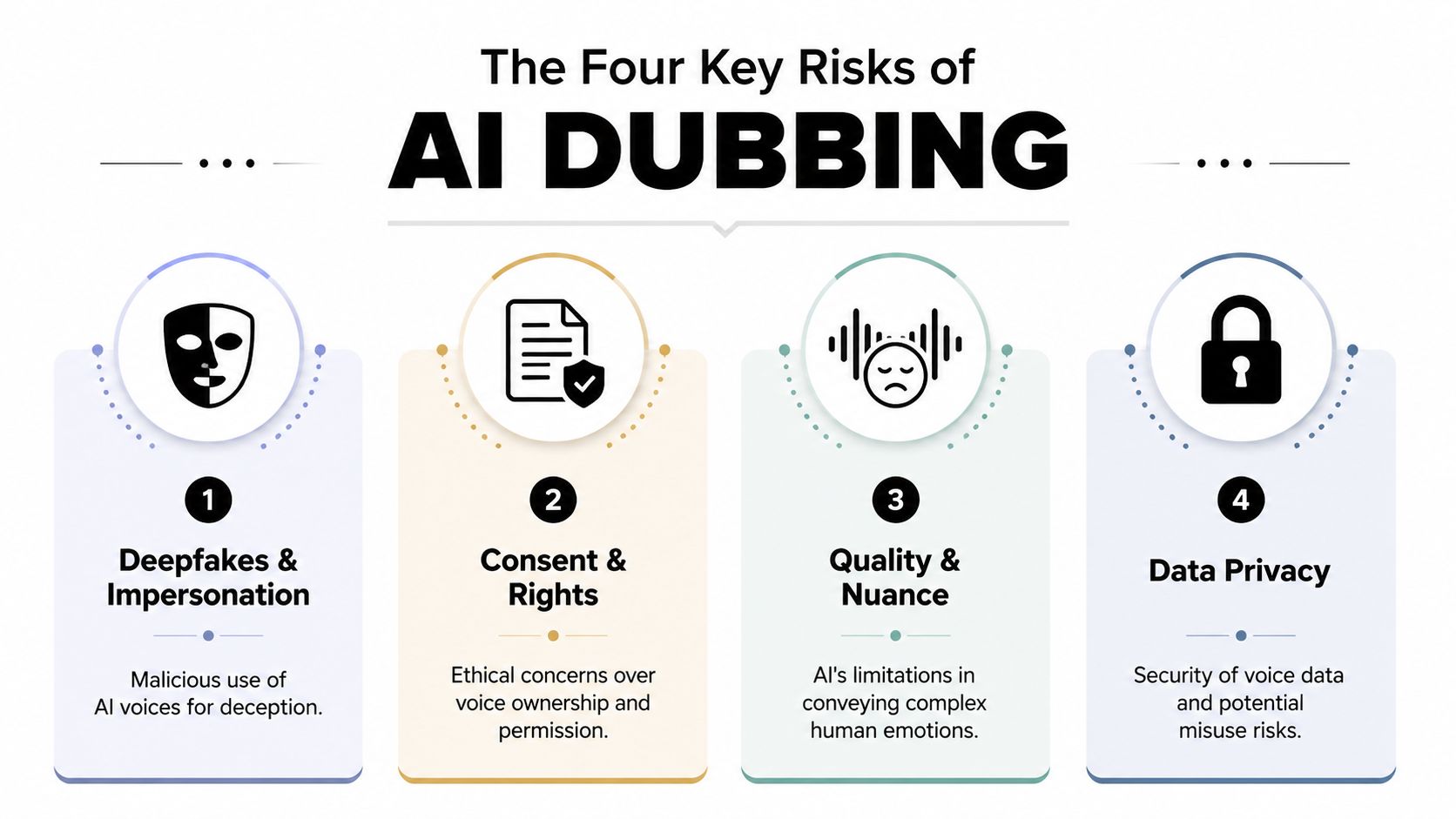
Deepfakes and impersonation
This is the headline risk. A voice that sounds real can be used to fool listeners into thinking a real person said something they never said.
Murf's explanation of dubbing safety notes that the ability to replicate voices has led to deepfakes, where AI-generated voices are used maliciously to impersonate individuals, spread misinformation, or commit fraud. For a short-form creator, that could look like fake endorsements, fake reactions, or fake commentary clips designed to go viral.
If you want to understand how quickly synthetic media tools are evolving, browsing resources like PostSyncer AI content tools can help you see why voice misuse is no longer a fringe issue.
Consent and privacy
A voice is personal data, but creators often underestimate that because audio files feel routine. Uploading your own narration is one thing. Uploading someone else's clip to clone or mimic them is another.
Using someone else's voice without explicit consent is not acceptable. Even if your intent is "just a parody" or "just a test," the platform still has to process that voice sample. If consent isn't clear, you've already stepped into risky territory.
Here's a simple analogy. Borrowing a stock photo with a license is normal. Copying someone's passport photo from social media and using it in an ad is not. Voice works the same way.
Copyright and licensing
Some creators assume that if a platform offers a voice, that voice must be safe for commercial use. That's a dangerous assumption.
Murf also warns that users need to review licensing terms before using any AI voice tool to avoid violating intellectual property rights. That includes checking whether a voice is licensed for commercial content, whether dubbing rights differ from narration rights, and whether platform terms claim broad reuse rights over your uploads.
For creators working with clips, commentary, and remixed media, these fair use guidelines for creators are a useful companion check before you publish.
If the license is unclear, treat the voice as unavailable. "Probably allowed" isn't a legal standard.
Accuracy and brand reputation
This risk is less dramatic than deepfakes, but it hurts creators more often.
The issue isn't only translation mistakes. It's emotional mismatch. A horror short that sounds cheerful. A bedtime story that sounds robotic. A motivational clip that sounds flat in the target language.
Verified data states that emotional tone accuracy can drop below 60% for languages with fewer than 1 million LLM training tokens, and human QA is still required for 45% of non-dominant language outputs. For faceless channels, where the voice carries much of the personality, that kind of mismatch can weaken trust fast.
If your audience can't see a presenter, they lean harder on narration for credibility. So even a technically correct dub can still feel wrong.
What Makes an AI Dubbing Platform Safe
A safe dubbing platform protects more than the final audio file. It protects your source clip, your script, your voice settings, and the rights attached to all of them.
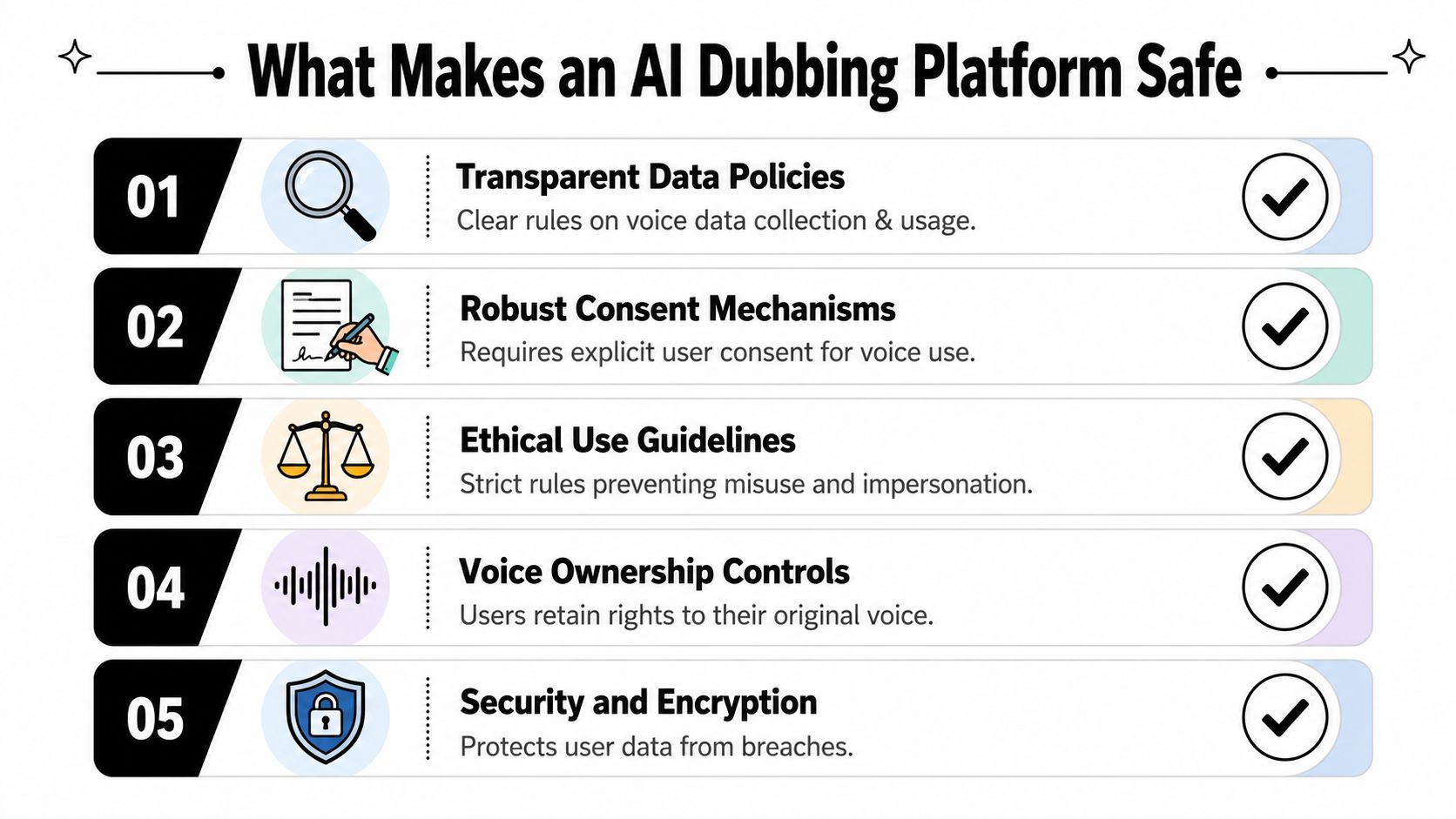
For faceless short-form creators, that matters more than it may seem at first. Your channel often depends on audio doing jobs that a visible host would normally handle: trust, tone, identity, and consistency. If the platform mishandles your files or your voice settings, the risk is not abstract. It can affect your brand, your upload workflow, and the credibility of every clip that follows.
Required platform controls
Start with four checks.
- Encrypted transmission: Your audio should travel through the platform the way a locked package moves through shipping. Other people should not be able to read or intercept it in transit.
- No third-party sharing: The platform should say clearly that your uploads are not passed to outside partners for training, promotion, or unrelated analysis.
- Clear deletion policy: Finished jobs should not sit in storage without a stated reason or timeline. Good platforms explain when files are deleted and what, if anything, is retained.
- Independent security controls: SOC 2 or a similar audit shows the company has documented processes for handling customer data safely.
Those checks sound technical, but the idea is simple. You are lending the platform your raw materials for one task. A safe tool completes that task without turning your files into a long-term asset for someone else.
Control matters as much as security
Many creators hear "safe" and think "hard to hack." That is only one part of the question.
A safer test is this: after you upload a clip, who still has control over it? If the terms allow broad reuse for model improvement, internal testing, or future product development, your content may be protected from outsiders while still being reused in ways you did not expect. For a faceless creator, that can include narration style, script patterns, and branded voice choices that make your channel recognizable.
Zero-retention or immediate-deletion language is often a better sign than vague promises about privacy. You want processing, not possession.
For a plain-English legal perspective on policies and vendor risk, this guide to startup data protection is useful background reading.
Signs the platform was built for creators, not only big teams
Enterprise security badges help, but short-form creators need practical controls they can use.
Look for consent steps before voice cloning, visible account permissions, export and deletion options, and terms written in language a solo creator can understand. If a tool hides its retention policy, makes deletion hard to request, or blurs the line between licensed synthetic voices and cloned voices, treat that as a warning.
A good creator-focused platform also separates voice quality from voice rights. If you are comparing tools, this roundup of best text to speech software for creators can help you assess voice options without assuming that good sound automatically means good safety.
A quick trust checklist
Use this before you upload a real project:
| Safety check | What you want to see |
|---|---|
| Data policy | Plain language on collection, storage, deletion, and training use |
| Consent workflow | Verification steps and a way to revoke cloned voice access |
| Licensing | Commercial rights explained clearly |
| Security posture | Encryption, independent audits, and limits on data sharing |
| Creator controls | Easy deletion requests, account permissions, and support you can reach |
Polished audio is not proof of safe handling. A dub can sound great and still come from a platform with weak data practices.
Best Practices for Short-Form Creators
You upload a 30 second faceless short, turn on auto-dubbing, and schedule it for three languages before dinner. The next morning, one version mispronounces a product name, another sounds oddly sarcastic, and now you are wondering where your original voice file ended up.
That is the primary safety question for short-form creators.
A faceless channel can publish fast, but speed creates its own risk. You may not be protecting a big company archive. You are protecting your voice, your content library, your ad-ready videos, and your reputation with viewers who decide in seconds whether your channel feels trustworthy.
Read the terms like you are checking a rental agreement
You do not need to read every line. You do need to find the parts that control what happens after you upload.
Focus on four items:
- Training use: Does the tool say your audio or video can be used to improve its models?
- Storage: Does it explain how long files stay on the platform?
- Ownership: Does it clearly say your content remains yours?
- Voice cloning rules: Does it require proof of consent before cloning a voice?
A good rule is simple. If the policy feels slippery, your files probably are too. For a solo creator, unclear terms can turn one quick dub into a long cleanup job.
Use the safest voice option that fits the video
For many faceless shorts, you do not need to clone a real person at all. A licensed synthetic voice is often the lower-risk choice for explainers, list videos, product clips, and story content.
That tradeoff is worth understanding. Voice cloning is like handing over a copy of your house key. A standard synthetic voice is more like renting a studio microphone for the day. Both can produce audio. Only one gives the platform something closely tied to your identity.
If your audience mainly wants clear narration and steady tone, choose clarity over novelty.
Add a human review step before you publish
This is the boring part. It is also the part that saves channels.
AI dubbing can get the words mostly right and still miss the meaning. That matters more in short-form video because every sentence carries more weight. A strange pause, a flat joke, or the wrong emphasis can make the whole clip feel off.
Use a quick review checklist before anything goes live:
- Listen to the full dub once at normal speed.
- Check names, brand terms, prices, slang, and punchlines.
- Compare captions to the spoken audio.
- Make sure the emotional tone matches the original clip.
- If the language matters to your audience, get a native speaker to review a sample.
A creator workflow works best when AI handles the first draft and a human handles the final judgment.
A quick walkthrough can help you think about workflow decisions in practice:

Keep your process boring on purpose
The safest short-form creators usually do the same few things every time. They use a small set of trusted tools. They keep notes on which voice was used for which channel. They save copies of licenses and consent records. They delete source files they no longer need.
That routine may sound unglamorous. It works for the same reason labeled folders work. You want fewer surprises when a video performs well, gets reused in an ad, or needs to be defended later.
Treat AI dubbing like your publishing checklist. Consistent habits protect faceless channels better than clever shortcuts.
Your AI Dubbing Safety Questions Answered
A faceless short video can go from draft to published in minutes. That speed is useful, but it also means one bad voice choice can slip into a post before you catch it. The safest approach is to treat AI dubbing like music licensing. If you cannot clearly show who owns the voice and what you are allowed to do with it, do not publish it.
Can I get sued for using an AI voice
Yes. The risk usually comes from using a voice without consent, using a voice outside the license terms, or using a cloned voice that sounds like a real person in a misleading way.
For short-form creators, the practical rule is simple. Use your own voice, use a voice you have written permission to clone, or use a synthetic voice with commercial rights clearly stated in the platform terms. If the license is hard to find or full of vague wording, treat that as a red flag.
Is AI voice cloning ever legal
Yes, if the person behind the voice clearly agreed to it and that permission can be proved later.
Consent works like a signed release form for a photo shoot. A casual message saying “sure, go ahead” may not protect you if the voice gets reused in ads, repackaged across channels, or kept in the platform after the project ends. A safer setup includes written consent, clear usage rights, and a platform that explains how it stores or deletes the voice model.
How can I tell if an AI dubbing service is trustworthy
Start with what happens to your files after upload. Your raw audio is the master key to your content. A trustworthy service should tell you whether it encrypts uploads, how long files are stored, whether your audio is used to train future models, and how you can delete your data.
Then look at reputation risk. For faceless channels, the voice is often the brand. If the dub mispronounces product names, flattens a joke, or turns a confident line into something awkward, viewers may not blame the software. They will blame your channel.
A good test is small and boring on purpose. Upload one sample clip. Read the terms. Check whether the service gives clear controls, clear ownership language, and support when something goes wrong. If the company is vague about data handling or the sample dub sounds off, keep looking.
If you want a simpler way to produce faceless short-form videos without stitching together a dozen separate tools, ClipCreator.ai helps you generate, package, and publish videos in one workflow. It's built for creators who want speed, consistency, and ownership without turning every upload into a technical project.

Create your first video in under 2 minutes
Pick a niche, and ClipCreator.ai generates and auto-posts faceless videos to your channels every day.
Join ClipCreator.ai