You've got a blank script, a folder of unfinished ideas, and a message from your best friend that's funnier than anything you've posted lately. That's a useful starting point. The strongest best friend shorts turn a recognizable interaction into a scene viewers want to send to someone specific.
Friendship offers plenty of material: the terrible suggestion, the suspiciously quiet group chat, the friend who remembers your coffee order but forgets the meeting place. The theme is broadly familiar, though not everyone experiences friendship the same way. The OECD's analysis of social connections found that 95% of respondents had interacted with nearby friends or family during the previous week, while 8% reported having no close friends.
Build around recognition, not an assumption that everyone has a perfect bestie. These faceless-ready concepts give you scripts, visual directions, voiceover choices, and publishing tactics you can turn into a repeatable production workflow. None guarantees virality. Each gives viewers a clear reason to keep watching or share.
1. POV Your Best Friend Reacts to Your Worst Idea
“I'm going to cut my own bangs before the wedding.”
That's the opening, not the backstory. Start with the questionable decision, then let the sensible friend expose the detail that makes it worse.

Build the argument around a reveal
Use this original dialogue as a template:
- The pitch: “I watched a tutorial. I'm basically qualified.”
- The objection: “Was the tutorial longer than your attention span?”
- The escalation: “I already cut the left side.”
- The payoff: “Put down the scissors. I'm bringing clips.”
For your custom generation prompt, specify a fictional friendship comedy, alternating labeled speakers, and a final visual punchline. Describe a bathroom counter, abandoned scissors, and a phone lighting up with an incoming call. Those objects carry the scene without showing faces.
Give the impulsive friend quick, confident delivery and the practical friend slower, dry responses. If you're using a single narrator, make speaker labels unmistakable rather than relying on exaggerated voices.
Production rule: The objection should reveal something new. Repeating “that's a bad idea” isn't escalation.
Keep captions short enough to read without pausing. These TikTok caption approaches can help you separate the opening hook from the final sharing prompt.
Batch alternate premises, such as an impulsive haircut, an overpacked road trip, or an ill-advised message. Schedule them apart, and compare whether viewers quote the punchline or recognize the setup.
2. Best Friend Then vs. Now Timeline
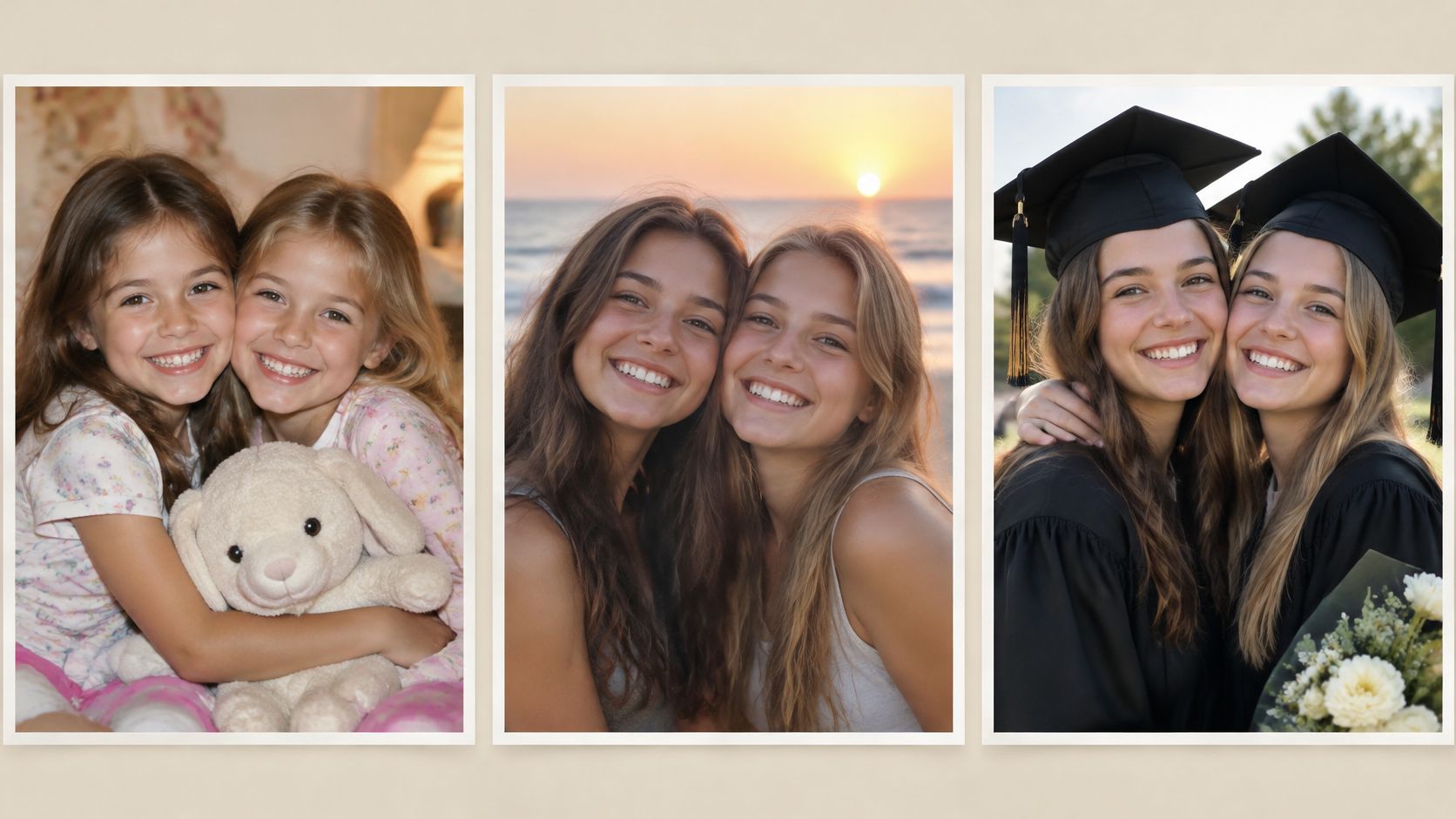
A friendship timeline needs more than changing hairstyles. Give viewers a reason to care about what changed between the beginning and the ending.
Start with a specific contrast: friends who once shared a school desk now leave voice messages across time zones. The emotional payoff comes from a habit that survives the change.
Keep a visual detail constant
Write the narration around meeting, change, distance, and reconnection. An original fictional script might begin, “We became friends because neither of us understood the homework,” and end, “Now we don't understand our schedules. We still figure things out together.”
In the custom prompt, request a cohesive illustrated scrapbook style. Repeat a recognizable object, such as matching keychains, through school bags, moving boxes, and an apartment doorway. Faceless silhouettes, hands exchanging notes, and objects photographed from above can establish continuity without inconsistent generated faces.
Use a warm narrator rather than separate character voices. Allow the closing image to remain visible while the final subtitle finishes.
The trade-off is specificity versus privacy. A real friendship anniversary can feel personal, but get permission before including private messages, names, or a falling-out. Label invented stories as fiction rather than presenting generated memories as documentary footage.
Schedule a complete emotional arc as a standalone short. If you continue the story, make the next installment about a different transition, not missing context that viewers needed to understand the first post.
3. Tag Your Best Friend Relatable Quiz
“Who says they're outside while they're still looking for their shoes?”
A useful friendship quiz lets viewers recognize someone before you ask them to tag anyone. The scenario does the work; the call to action gives them somewhere to take that recognition.

Qualitative research on TikTok sharing describes people exchanging videos to maintain connection and communicate social meaning. That supports designing for a particular friend-to-friend exchange, not treating every viewer as an isolated spectator.
Make participation effortless
Build your generation prompt around a question, illustrated clues, and an affectionate reveal:
- Question card: “Which friend turns a casual outing into an expedition?”
- Visual clues: A packed tote, backup snacks, a printed route, and an umbrella under clear skies.
- Reveal: “The planner. You complain until you need the snacks.”
- Social prompt: “Send this to your emergency-snack friend.”
Use bright, uncluttered images and a lightly amused narrator. Put the participation prompt on screen so viewers don't need audio to understand what to do.
Avoid quizzes that disguise an insult as engagement. “Who ruins everything?” invites a different conversation from “Who packs for every possible weather forecast?”
Use these interactive video examples to vary the interaction rather than repeating the same tagging request. Rotate between choosing a role, predicting an answer, and spotting a familiar habit. Schedule categories as a recognizable series, but change the situations so returning viewers get a fresh joke.
4. Best Friend Story Time with Plot Twist
“My best friend asked me to collect a cake. The name on it was mine.”
That fictional opening creates a concrete question. Why is the narrator collecting their own cake? You don't need a dramatic emergency or a misleading accusation to make the next scene interesting.

Plant the clue before the twist
Outline the story backward from the reveal. In this example, the friend arranged a surprise picnic but needed the narrator away from the setup, and the bakery accidentally exposed the plan.
The custom prompt should request a clearly labeled fictional anecdote with an opening mystery, a plausible misunderstanding, and a warm resolution. Ask for images of a bakery box, a handwritten collection note, a message notification, and a picnic blanket disappearing behind a tree.
Keep the narrator conversational. A melodramatic delivery can make a harmless misunderstanding sound like a betrayal, which changes what viewers expect from the ending.
A satisfying twist changes how viewers interpret an earlier detail. It shouldn't require a completely unrelated event.
Use a brief pause before showing the cake inscription, then move directly to the reveal. Don't keep promising that something unbelievable is about to happen.
These short story video techniques offer a useful starting point for shaping narration around visual scenes. Schedule each story with its resolution intact, then test a different opening on a later, distinct story. Reposting the same reveal with cosmetic changes won't tell you much about which premise viewers prefer.
5. Friendship Milestone Countdown
Not every friendship milestone involves a graduation or a major trip. Finally arranging a call, finishing a shared project, or reviving an abandoned walking tradition can make a more distinctive short.
Build the countdown toward a meaningful moment, not a number with no story attached. For example, a fictional long-distance friendship series could follow the preparations for a reunion: clearing the spare room, finding an old playlist, and buying the snack they always shared.
Turn each card into a small scene
Use a reusable visual template with a progress label, a story image, and a short line of narration. Your custom prompt should specify the destination of the countdown and the emotional change in each entry.
- Script: “The guest room is ready. I've hidden the laundry outside the frame.”
- Visual: An overhead view of a neatly made bed beside a suspiciously overflowing cupboard.
- Voiceover: Warm and understated, with the joke delivered as an admission.
- Closing prompt: “What would you put in your best friend's welcome basket?”
Map the sequence before scheduling anything. Otherwise, you risk publishing filler because the calendar needs another entry.
Keep a consistent type treatment and color palette, but change the scene rather than merely swapping a label. A local café could adapt the concept around friends returning for their usual order, provided any real customer story is shared with permission.
The trade-off is commitment. Countdown formats create an expectation of a destination. If the event changes, explain the change or end the series rather than manufacturing a celebration.
6. Best Friends Try Weird Challenges
The challenge should be easy to explain and safe to imitate. Guessing a snack from an exaggerated description is a better faceless premise than a stunt whose appeal depends on danger or humiliation.
For inspiration, watch how the challenge is introduced and how the reactions establish the participants' personalities.

Show the decision, not just the result
For a fictional animated version, try “describe a familiar food as though you're reviewing expensive furniture.” The viewer should be able to guess along before the answer appears.
Build the production prompt around these elements:
- Rule: A friend describes the mystery snack without naming it.
- Banter: “It has a confident structure, but the surface is emotionally unstable.”
- Visual reveal: A flaky pastry surrounded by exaggerated luxury-product lighting.
- Payoff: The other friend confidently guesses something completely different.
Use object close-ups, illustrated hands, answer cards, and reaction symbols. Keep each character's delivery consistent across episodes so viewers recognize the competitive friend and the overly literal friend.
Don't imply that generated images document a real taste test. Label the scenario as an animated skit, or use actual footage if you're making claims about what someone tasted or did.
Schedule self-contained challenges and invite viewers to suggest harmless variations. If you add trending audio, check the platform's available usage permissions and keep it below the narration. A trend isn't worth losing the words that explain the game.
7. Best Friend Advice Column
“My friend posted pictures from a gathering I wasn't invited to. Should I stop replying?”
That's a useful advice premise because it contains a feeling, an uncertainty, and a decision. Answer the uncertainty without declaring the absent friend guilty.
Write advice people can actually use
Structure the script as acknowledgment, clarification, and a possible next step. An original response might read: “Feeling left out makes sense. The pictures don't tell you why you weren't invited. Ask privately before deciding what the friendship means.”
Research discussed in the Oxford-hosted material on friendship and social media supports examining private support, exclusion, and friendship jealousy rather than treating public posts as the whole relationship.
For the custom prompt, request a supportive educational script, a clearly labeled hypothetical question, and calm visual scenes. Show a phone being set down, a draft private message, and friends sitting on a park bench.
Accessibility deserves deliberate production attention. Research on short-form video accessibility reported an accessibility rating of 3.21 out of 7 for sampled videos.
Use readable, high-contrast subtitles, explicit speaker labels, and enough visual context to follow the advice without sound. Review generated captions instead of assuming every name and emotional phrase is correct.
Editorial boundary: Offer communication options, not diagnoses of people you haven't met.
Collect audience questions with permission, remove identifying details, and schedule related topics together. Don't turn someone's vulnerable comment into entertainment without their consent.
7 Best Friend Shorts Ideas: Quick Comparison Guide
| Content Format | 🔄 Implementation Complexity | ⚡ Resource Requirements | 📊 Expected Outcomes | ⭐ Key Advantage | 💡 Ideal Use Case |
|---|---|---|---|---|---|
| POV: Your Best Friend Reacts to Your Worst Idea | Low; template-based dialogue and punchline | Low; two voice styles, captions, and a few images; 15–30 seconds | Strong completion potential; broad relatability | Fast, repeatable comedic format | Frequent short-form skits |
| Best Friend Then vs. Now Timeline | Medium; requires a clear chronological arc | Medium; consistent visuals and narration; up to 90 seconds | Emotional engagement, shares, and repeat viewing | Strong storytelling and series potential | Friendship anniversaries or reflective narratives |
| Tag Your Best Friend Relatable Quiz | Low; simple question-and-reveal structure | Very low; captions and a brief script; 10–20 seconds | High potential for comments and tags | Quick to produce and easy to adapt | Engagement-focused posts for groups, brands, or teams |
| Best Friend Story Time with Plot Twist | High; suspense and payoff require careful writing | Medium; narration, pacing, and supporting images; 45–90 seconds | Longer watch time and series potential | Compelling narrative arc | Storytelling channels and anecdote series |
| Friendship Milestone Countdown | Low; recurring template with planned milestones | Low; visual cards and short captions; 20–40 seconds | Builds posting consistency and audience habit | Easy to schedule as a series | Anniversaries, school milestones, or brand campaigns |
| Best Friends Try Weird Challenges | Medium; needs a clear challenge and outcome | Medium; step-by-step visuals and lively narration; 20–45 seconds | Curiosity-driven watch time and trend reach | Flexible, timely concept with visible payoff | Trend-led entertainment or educational challenges |
| Best Friend Advice Column | Medium; requires useful, responsible answers | Low to medium; audience questions, concise scripts, and visuals; 30–60 seconds | Saves, shares, and audience submissions | Delivers practical value in a repeatable format | Educators, coaches, and advice-focused creators |
Turn One Idea Into a Week of Shorts
Choose formats you can produce consistently without flattening every friendship into the same joke. A reaction skit and an advice column make a useful pairing: one invites recognition, while the other gives viewers language they might use privately.
Create a small batch of script variations in ClipCreator.ai using custom prompts. Specify the relationship dynamic, the opening line, the visual style, the narrator's delivery, and the ending before generating. “Funny best friend video” leaves too much undecided; “fictional text-message skit about an impulsive haircut, illustrated bathroom objects, dry narration, affectionate ending” gives the production a clear direction.
Schedule a test you can learn from
Review the generated images, voiceover, and subtitles before scheduling. Check that the same objects and character details remain consistent, the joke makes sense without audio, and no caption reveals the payoff too early.
- Keep the premise comparable: Publish equivalent vertical cuts across TikTok, Reels, and Shorts, adapting captions to each platform.
- Separate the results: Track completion, shares, comments, and friend tags by platform rather than combining them.
- Choose a useful next test: Change the hook or the ending, not every creative element at once.
Don't assume a platform winner in advance. The cross-platform findings collected by ShortsIntel differ substantially by methodology and account mix, making controlled testing more useful than a universal reach promise.
Consistency matters, but publishing more isn't a substitute for giving viewers a satisfying scene. Metricool's short-form analysis, reported by Marketing Tech News, describes growing publishing competition alongside declining performance on some measures.
Start with a complete story, a readable edit, and an ending someone would send to a friend. Schedule the batch, review the responses, and build the next scripts around what viewers recognized, questioned, or shared.
ClipCreator.ai turns custom prompts into faceless videos with scripts, story-aligned images, voiceovers, and subtitles, plus scheduling and publishing tools. Bring a best-friend scenario, generate your first version, and review the dialogue and visuals before adding it to your publishing schedule.

Create your first video in under 2 minutes
Pick a niche, and ClipCreator.ai generates and auto-posts faceless videos to your channels every day.
Join ClipCreator.ai