You've built a faceless channel that viewers recognize in seconds. The narrator sounds calm, the sentences are short, and every story ends with the same quiet invitation to return tomorrow. Then you generate a new series, change one prompt word from gentle to dramatic, and the whole channel suddenly sounds like a stranger. Understanding Brand Voice vs Tone explains why that happens, and how you can change mood without losing identity.
Why Faceless Creators Confuse Voice and Tone
A scary story channel works because viewers know what they're getting. The narrator speaks slowly, pauses before a reveal, and never jokes after a frightening moment. The audience trusts that pattern, even though they never see a face.
Then the same creator launches educational Shorts. The new scripts open with loud hype, slang the channel has never used, and a pushy call to action. Nothing is technically wrong with the words. But loyal viewers sense a break. They came for a steady storyteller, and now they're hearing a salesperson.
That break rarely comes from bad intentions. It comes from prompting by mood. You ask for suspenseful, then funny, then motivating, and each output invents a new personality to match. The tone changes, but so does the vocabulary, point of view, and attitude. Without rules underneath, every format becomes a fresh guess.
Faceless video makes the problem sharper. You don't have facial expressions, clothing, or a familiar room to signal continuity. Your identity lives in word choice, sentence rhythm, narrator warmth, pacing, subtitles, and what you refuse to say. If those signals drift, viewers have little else to hold onto.
The Production Problem Behind the Style Problem
Think of voice as your production settings and tone as the scene lighting. You can light the same room warmly for a bedtime tale or dim it for horror. You wouldn't rebuild the room every time. Yet many creators rebuild their verbal identity with every prompt because they haven't separated fixed settings from adjustable ones.
Practical rule: Decide who the channel is before deciding how a single video feels.
That order matters. Once the underlying identity is locked, a darker episode still sounds like your channel. Without it, fluent scripts can be polished, grammatical, and completely forgettable because nobody can tell who is speaking.
Defining Brand Voice and Brand Tone Clearly
Brand voice is the stable personality and language identity your channel uses across communications. It includes your preferred vocabulary, point of view, sentence rhythm, attitude toward the audience, and topics or phrases you avoid. If viewers removed your logo and channel name, voice is what would still make a script sound like yours.
Tone is the situational emotional adjustment of that voice. It's how the same personality sounds when the context changes. A clear, confident, helpful channel can use a serious tone for a safety announcement, an empathetic tone in a support reply, or an energetic tone in a short hook. The personality stays recognizable. The emotional temperature moves.
The easiest metaphor is a person you know well. Voice is their face. Tone is their expression. Your friend can look concerned, amused, or excited, but you don't mistake them for someone else. Your channel should work the same way, which is why resources like these brand voice tips for authentic content are useful when you're turning a vague personality idea into choices you can repeat.
Where Readers Usually Get Stuck
People often define tone first because tone feels concrete. They write instructions like these.
- Be playful on TikTok: Use faster pacing and lighter jokes.
- Be serious for lessons: Slow down and explain each step.
- Be warm in comments: Thank viewers and answer directly.
Those instructions aren't wrong. They're incomplete. Playful for whom, and with what limits? A dry, understated channel and a loud, slang-heavy channel can both be playful, but they shouldn't sound alike. Tone directions only work when they sit on top of a defined voice. Otherwise, each writer, prompt, or tool fills the gaps differently, and your audience hears several channels sharing one name.
Side-by-Side Criteria That Separate the Two
Use the table below as a decision filter. When you're unsure whether something belongs in your voice guide or in a single video brief, ask which column it fits.
Brand Voice vs Tone at a Glance
| Criterion | Brand Voice | Brand Tone |
|---|---|---|
| Stability | Stays steady across series and platforms | Shifts by topic, audience, and moment |
| What it describes | Personality, beliefs, point of view | Emotional feeling of one piece |
| Who owns it | The channel or brand | The individual script or reply |
| How often it changes | Rarely, and only deliberately | As often as context requires |
| Where you feel it | Vocabulary, rhythm, attitude, taboos | Warmth, urgency, humor, suspense |
| Example | Curious guide who explains without hype | Reassuring in a lesson, tense in horror |
A wellness channel might always sound calm, plain-spoken, and non-judgmental. Its tone becomes more urgent in a video about warning signs and more celebratory when a viewer shares progress. A finance channel might keep a direct, evidence-first voice while sounding cautious during market volatility and encouraging in a beginner budgeting lesson.
Storytelling shows the split clearly. The voice could be warm, observant, and slightly mischievous. A bedtime episode uses a soft tone and longer sentences. A scary episode uses a darker tone and shorter fragments. The narrator still notices small details, respects the audience, and avoids cheap shock language, so both episodes belong to the same channel.
Culture Changes Tone Expectations
Tone isn't universally interchangeable. A 2025 survey of 500 Southeast Asian consumers found roughly 60% preferred formal brand communication, especially in Malaysia, Singapore, and Thailand, while 55% in the Philippines and Indonesia favored casual, friendly styles. About 70% in the Philippines and Vietnam preferred humorous communication, compared with roughly 65% in Thailand and Malaysia who favored a more serious tone in professional contexts.
That doesn't mean a channel needs a new voice for every region. It means the same respectful, clear voice may need a more formal tone in one market and a friendlier, more humorous tone in another.
Building a Voice System That Stays Consistent
Start with one session and four decisions. You're not writing a brand book. You're building a small set of rules that a human writer or an AI prompt can follow without guessing.
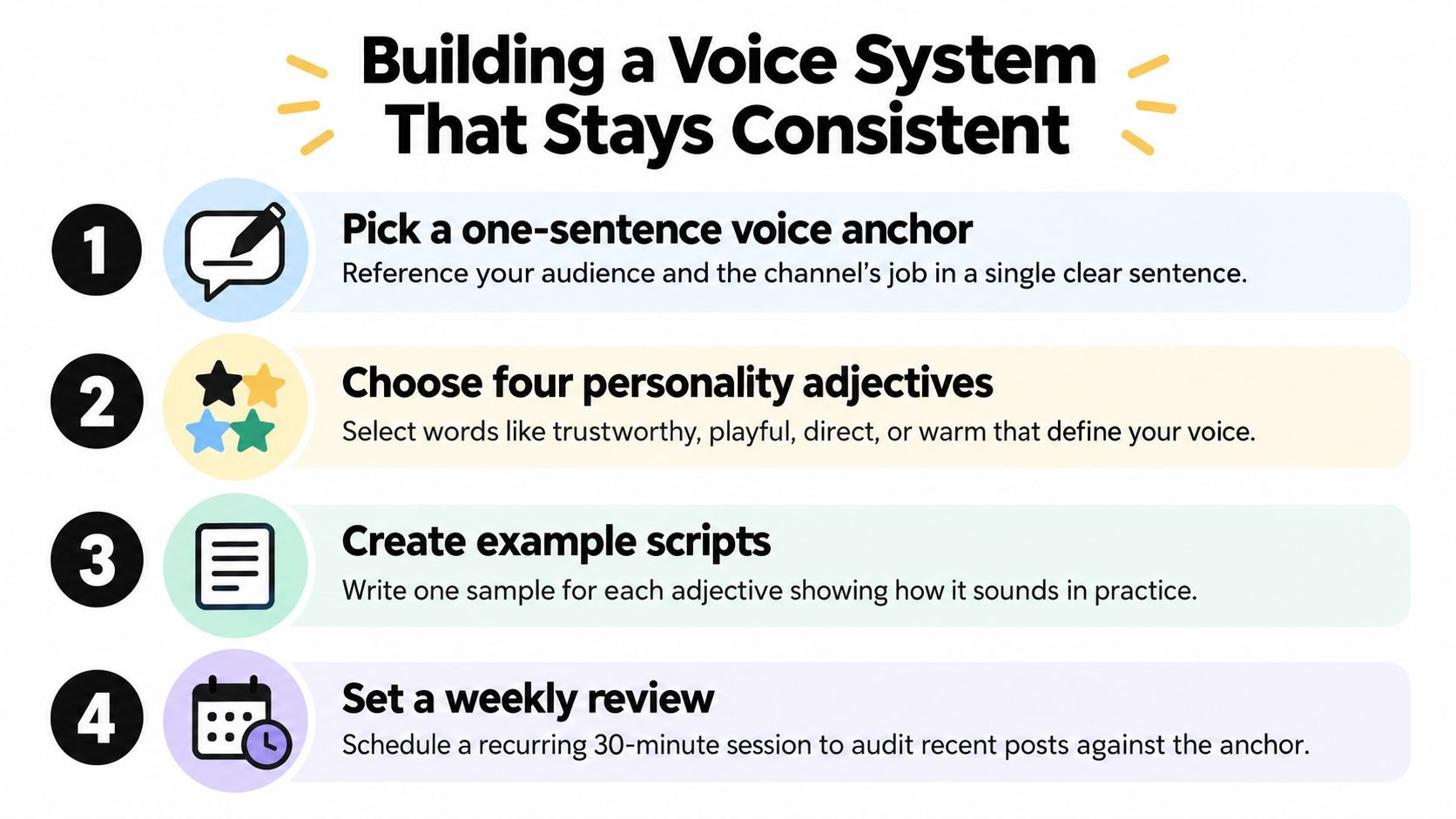
- Pick a one-sentence voice anchor: Name the audience and the channel's job. For example, we tell curious night owls short, eerie stories that feel intimate, never sensational.
- Choose four personality adjectives with boundaries: Write each as this, not that. Warm, not gushing. Direct, not blunt. Curious, not rambling. Confident, not cocky.
- Lock taboos and preferred language: List banned words, topics you won't exploit, claims you won't make, and phrases your narrator naturally uses.
- Approve three reference scripts: Pick examples that sound unmistakably right. Future scripts get compared with these, not with an abstract adjective.
Consistency has a commercial reason to take seriously. Lucidpress and Demand Metric research conducted between 2016 and 2021 associated consistent brand presentation with an estimated 23% revenue increase in early surveys, with later work reporting 10% to 20% revenue growth. In a 2021 survey of more than 400 brand-management professionals, 68% of organizations credited consistency with at least 10% revenue growth. Those figures show association, not proof that consistency alone caused the gains.
Layer Tone on Top
After voice is locked, add tone briefs for recurring formats. A hook can be urgent, a lesson reassuring, a horror climax suspenseful, and a comment reply grateful. Each brief should specify pacing, sentence length, narrator warmth, and the call to action. If you want the deeper mechanics of repeating identity across touchpoints, this guide to building consistency in branding across every channel pairs well with the four steps above.
What Changes Between a Scary Story and a Lesson
The image below separates flexible delivery choices from identity rules that shouldn't move when your genre changes.
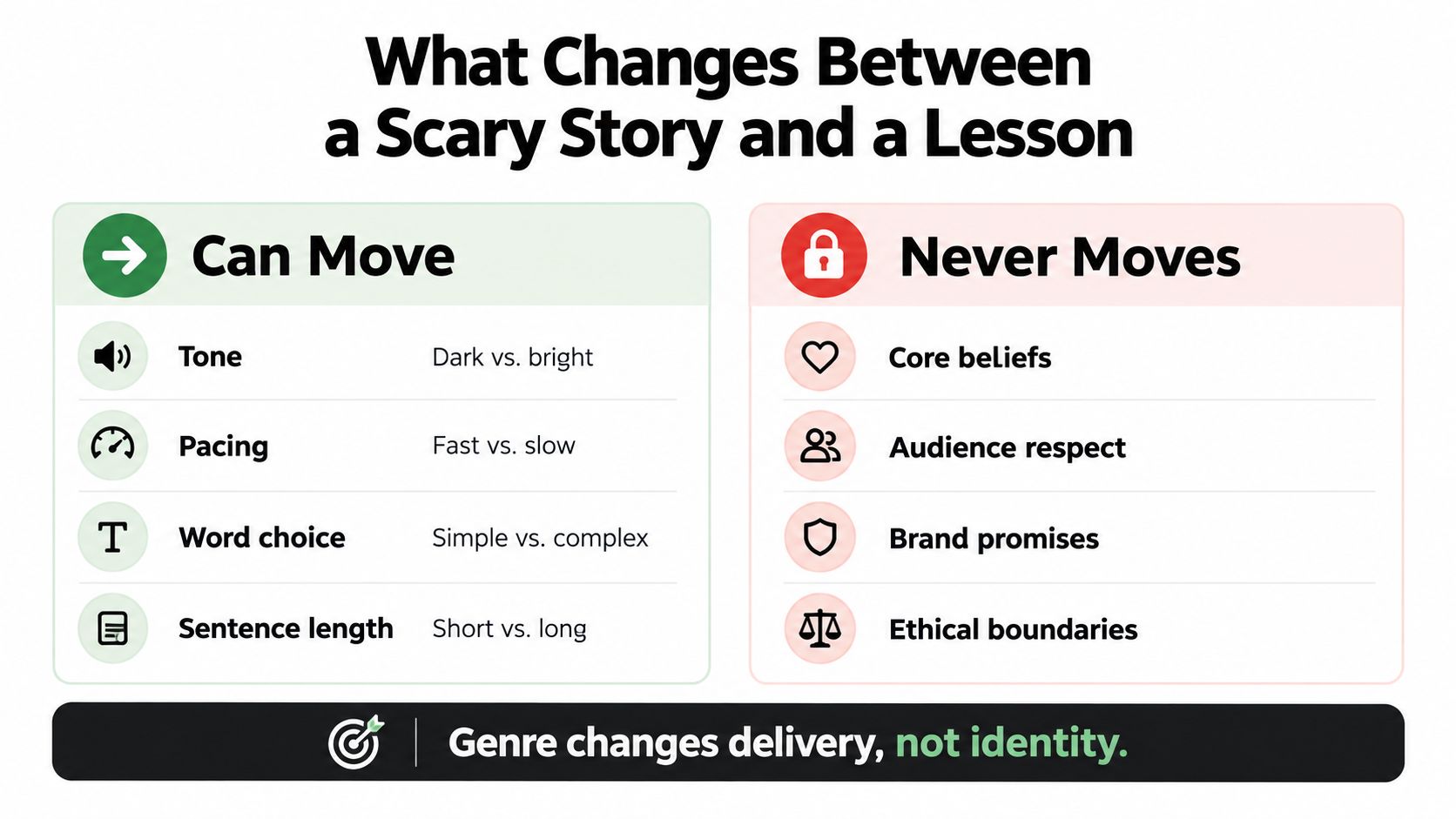
Suppose your voice anchor is a calm guide who notices details others miss. That guide can tell a horror story and teach a micro-lesson. What changes is the production dial, not the personality.
- Tempo and suspense: Horror slows before a reveal, then cuts sentences short. A lesson keeps an even pace and repeats the key point once.
- Narrator warmth and subtitle density: Horror can use cooler narration and sparse subtitles to protect tension. A lesson usually needs warmer narration and fuller subtitles so viewers can follow names, steps, or terms.
- Call to action: Horror might end with, listen again tomorrow night. A lesson might end with, try the first step and tell me what happened.
What never moves is just as specific. Your core beliefs, perspective, respect for the audience, taboo vocabulary, and signature detail-first rhythm stay locked. If your channel never mocks frightened characters in horror, it shouldn't mock confused beginners in lessons. That continuity is how viewers recognize you across formats. For creators working in horror specifically, this walkthrough on how to make a horror story video that holds tension shows genre choices in practice.
The risk grows when automation scales output. A 2025 industry survey cited in recent coverage found 63% of marketers struggle with authenticity and brand voice in AI-generated content, while only 7% of consumers said visibly AI-generated marketing increases trust and 31% said it decreases trust. Fluent output isn't the same as on-brand output.
The short video below gives another plain-language explanation of the distinction before you apply it to your own scripts.

Scorecard for Checking Every Script Before Publishing
Adjectives don't catch drift. A scorecard does. Before publishing, rate each script as pass or rewrite against your anchor sentence and reference scripts. ClipCreator.ai is one example of a tool where this check matters, since it can generate scripts, visuals, voiceovers, and subtitles from custom prompts, so your voice rules need to be clear before generation starts.
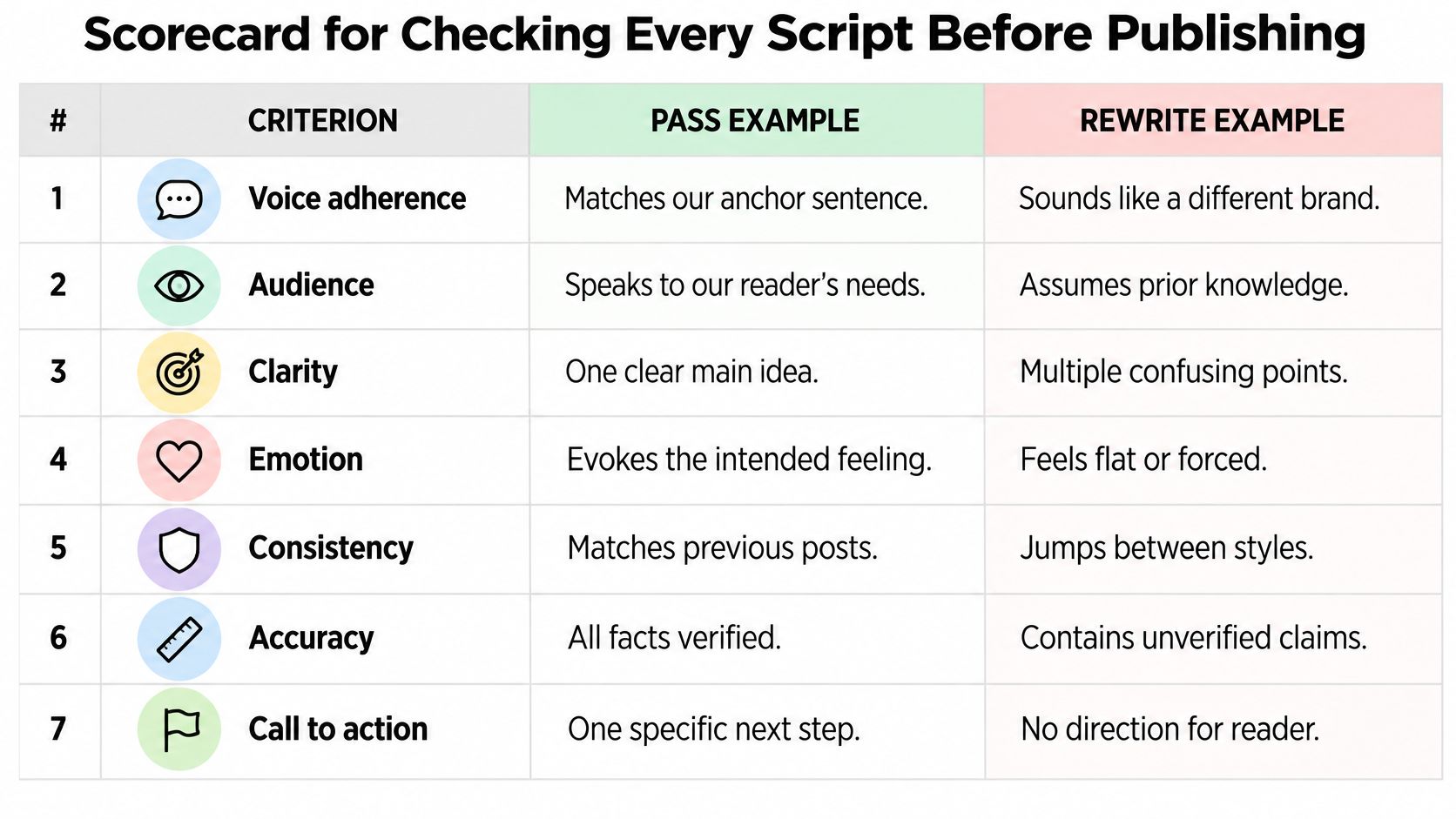
Use these seven checks.
- Voice adherence: Pass if it matches your anchor and reference scripts. Rewrite if it sounds like another channel.
- Audience fit: Pass if it assumes the right knowledge level. Rewrite if beginners would be lost or regulars would feel talked down to.
- Emotional fit: Pass if the feeling suits the topic. Rewrite if a serious moment turns flippant.
- Factual reliability: Pass if claims are verified. Rewrite if a confident line has no source.
- Originality: Pass if examples and phrasing are yours. Rewrite if it reads like generic category copy.
- Disclosure: Pass if AI assistance is handled transparently where required. Rewrite if viewers could feel misled.
- Platform suitability: Pass if pacing, subtitles, and the call to action fit TikTok, YouTube, or Instagram. Rewrite if you're forcing one format onto another.
That last cluster matters because trust is fragile. A 485-person study from the Czech Republic associated recognition of AI-generated marketing with lower perceived trust, authenticity, and credibility. Recent reporting also noted 52% of social-media users are concerned about brands posting AI-generated content without disclosure, and 46% remain uncomfortable with AI-generated formats such as virtual influencers.
Fluent is not a quality standard. Review high-risk claims, sensitive topics, and disclosure decisions yourself, even when the script reads smoothly.
To make the review repeatable, pair the scorecard with an audio-visual script template for planning narration and visuals together so voice, images, and subtitles get checked in one pass.
Consistent Voice and the Revenue Case for Automation
Automation doesn't reduce the need for voice discipline. It increases it. When you publish occasionally, one off-brand video is an exception. When you publish daily across TikTok, YouTube, and Instagram, small drifts become the channel viewers experience most often.
The revenue research cited earlier points in the same direction as audience behavior. Recognizable presentation helps people identify you quickly, remember what you stand for, and decide whether to trust the next video. Tone flexibility supports that process because it lets you fit a lesson, a story, or an announcement without pretending every moment deserves the same emotional energy.
The contrarian point is simple. AI makes fluency cheap. It doesn't make distinctiveness cheap. If every faceless channel uses similar prompts, similar narrators, and similar hooks, surface polish stops differentiating anyone. Your specific beliefs, taboos, rhythm, and relationship with viewers become the asset competitors can't copy by generating faster.
A Small Operating Routine
- Lock the anchor: Keep the one-sentence voice definition where every prompt starts.
- Pre-approve references: Maintain a small library of scripts that define right.
- Score every generation: Run the seven checks before scheduling.
- Audit monthly: Compare recent published videos with the reference library and fix recurring drift at the prompt level.
That routine turns voice from a creative preference into infrastructure. You invest once in clear rules, then automation helps you repeat them at a pace manual writing can't sustain.
Frequently Asked Questions About Brand Voice and Tone
How Do I Detect Voice Drift Across Many Videos
Don't rely on memory. Pick your three approved reference scripts and compare a sample of recent videos against them for vocabulary, point of view, rhythm, narrator warmth, subtitle density, and calls to action. Drift usually appears as repetition of a small error, such as hype words creeping into lessons or jokes landing after serious moments. Fix the prompt or brief that produced the pattern, not just the single script.
Should I Disclose AI Assistance to Viewers
Treat disclosure as part of trust, not as fine print. Follow platform rules and local requirements, and be especially careful when narration, imagery, or a virtual presenter could make viewers assume a human performance that didn't happen. The concern and discomfort figures covered earlier show why hiding assistance can damage credibility even when the content itself is useful.
How Do I Handle Cultural Tone Differences
Keep the voice stable and adjust tone deliberately. The Southeast Asian survey covered earlier found different preferences for formality, humor, and seriousness across countries, so a global channel shouldn't assume one emotional register travels unchanged. Test regional captions or versions where the audience warrants it, and watch comments for signals that humor, directness, or formality feels off.
How Often Should I Refresh a Voice System
Refresh tone briefs whenever formats or audience expectations change. Revisit the voice itself less often, and only when your audience, promise, or point of view has shifted. A quarterly review is enough for most creators if monthly audits are already catching drift. Change adjectives only when your reference scripts prove the old ones no longer describe the channel viewers recognize.
Lock your voice anchor, brief tone by format, and score every script before it ships, then let automation handle the repeatable production work of scripts, voiceovers, subtitles, and scheduling. Visit ClipCreator.ai to generate faceless short videos for TikTok, YouTube, and Instagram from prompts shaped around your own voice rules.

Create your first video in under 2 minutes
Pick a niche, and ClipCreator.ai generates and auto-posts faceless videos to your channels every day.
Join ClipCreator.ai