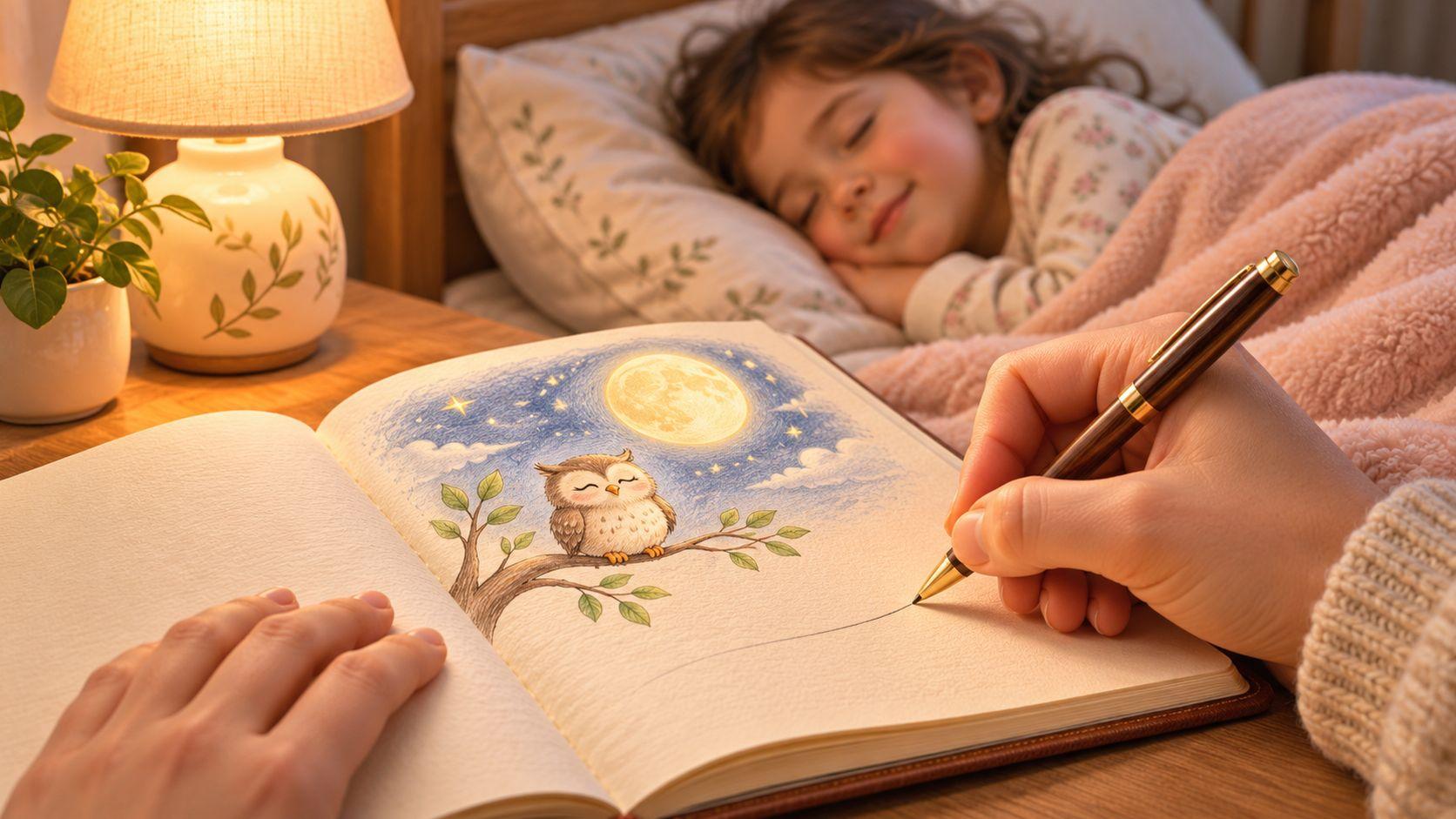
You're two pages from the end, the lamp is dim, the duvet is warm, and your four-year-old is sitting bolt upright asking who is at the door. Nothing in the story was frightening. It was exciting, and excitement is the opposite of what the next ten minutes need.
I've spent years editing children's books, and the manuscript that fails at bedtime is rarely a bad story. It's a good daytime story read at the wrong hour. A daytime story builds energy toward a climax. A bedtime story has to lose energy on purpose, resolve early, and hand the child back to a quiet room.
So here's the working method I give writers: plan the size of the story around the child's tiredness first, build it on a simple goal and outcome, keep the tension low, and end on a line the child can hear every night.
Story Length and Tension by Child's Age
Length and tension scale with age, and the ending always sounds calm. Choose your row before you write a single line, not after.
| Age | Target length | Conflict level | Ending style |
|---|---|---|---|
| Ages 2-3 | 70-200 words (1-3 minutes aloud) | None, or a lost item found within a line | Goodnight to named objects |
| Ages 4-5 | 200-350 words (3-5 minutes aloud) | One small problem solved in one attempt | Calm summary and a sleepy image |
| Ages 6-8 | 350-500 words (5-7 minutes aloud) | One problem with two attempts | Resolution and a quiet reflection |
| Ages 9-10 | 500-630 words (7-9 minutes aloud) | One goal with a setback, resolved gently | Resolution with a warm last line |
How to read the table. Decide how many minutes the bedtime slot allows tonight, then pick the row that fits inside it. Count the words in the finished draft instead of estimating, and read it aloud at the slow pace you'll use in the bedroom, because a script that looks short on the page runs long once you start pausing for breath.
Where the rows bend. An overtired, anxious or bedtime-fighting child needs the row above the one that matches their birthday: shorter, with less conflict. For siblings of different ages, write to the younger child's row and let the older one choose the character or the setting, which keeps one story working for two listeners.
Bedtime reading is also an established household ritual, not a novelty. In a 2010 Ipsos Public Affairs poll commissioned by sleepbetter.org, 46% of parents of children aged 7 or younger reported that their child most often read a bedtime story before going to sleep (Ipsos). A slot inside a routine has a fixed size, and a story that overruns it costs the family the wind-down it was written to protect.
The same discipline that makes any piece of writing readable, fixing the length and the shape before drafting, is set out in these article writing tips for content creators. If you need a premise that fits your row, start from a set of good bedtime story ideas and cut it down to size.
How to Build a Bedtime Story in Five Steps
A bedtime story that works has the same spine every time: a character who wants one thing, a mild problem, one or two attempts, and a calm outcome. Researchers describe narrative the same way, as goal-directed, causally connected elements rather than a string of pleasant events (story-grammar research). Five steps build that spine in order.
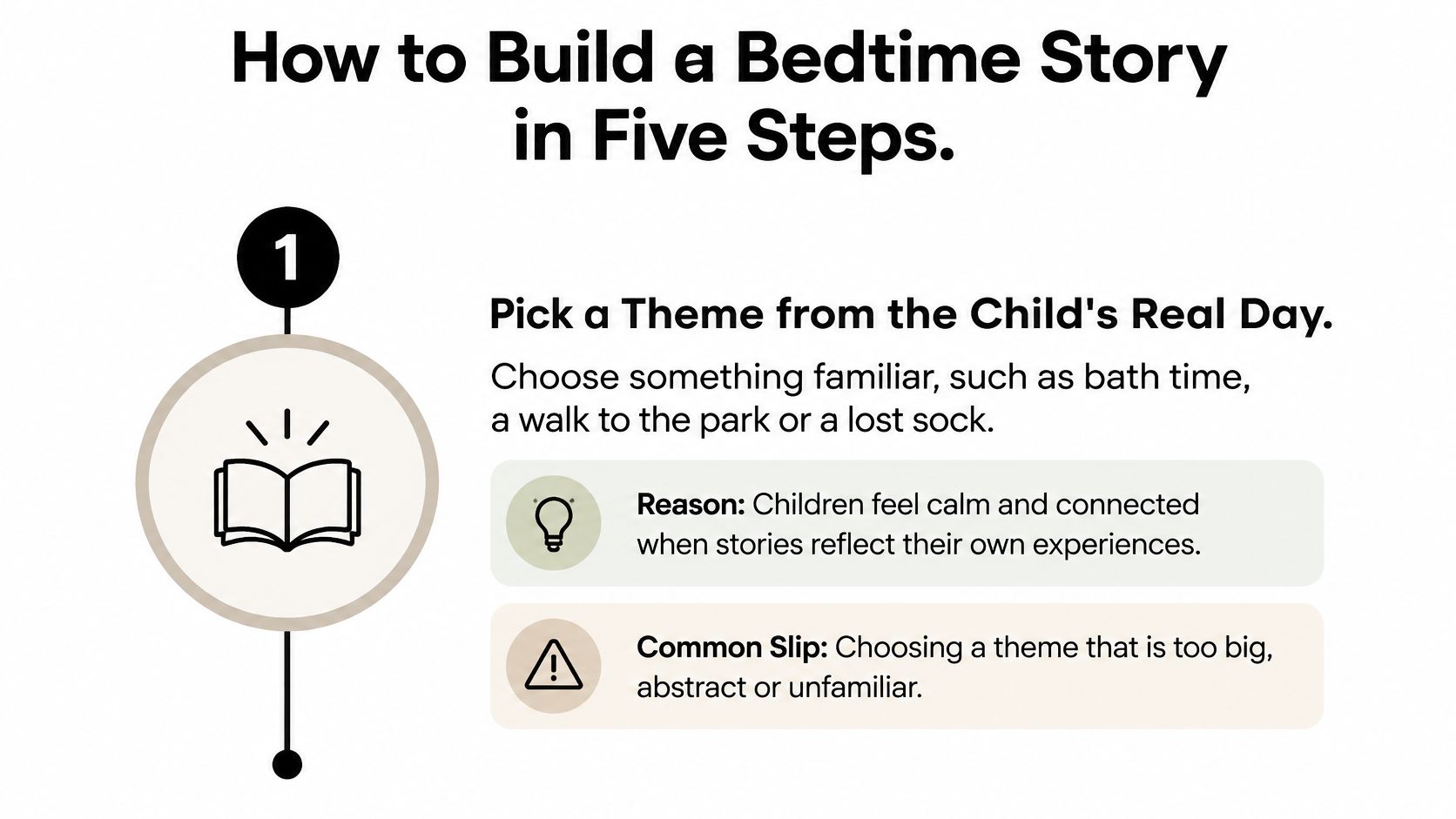
- Pick a theme from the child's real day. Bath time, a walk to the park, a lost sock. Familiar settings are easier to follow when a child is half asleep, because there's nothing new to decode. The common slip is choosing a setting you love rather than one the child has stood in.
- Give one character one simple want. A small owl who wants to find the moon before it hides behind the hill. One want, stated plainly, is the rail a tired listener holds. The slip is giving the character two wants, which splits a drowsy child's attention in half.
- Introduce the problem inside the first 10 to 15 percent of the story. Then show one or two attempts, and make each attempt change the situation rather than repeat it. In the owl story, the first try might reach the wrong hill, and the second try follows the sound of a night bird to the right one. Put the goal in the opening lines and the rest follows. The slip here is the third attempt: by then the child is already heavy-eyed and the extra scene only stretches the runway.
- Resolve the problem with a calm outcome, not a new threat. The moon comes out from behind the hill and stays there. No new character arrives at the end. The slip is a final surprise, which resets everything the previous pages achieved.
- Add a repeated refrain and a goodnight close the child can say with you. "And the house said goodnight to the lamp, the chair and the sleepy bear." Repetition matters because it teaches the child to expect the move from story to sleep, and the moment they stop joining in is usually the moment they're going under.
Practical rule: test recall with three questions after the draft, not ten. Who wanted what, what changed, and how did it end. If you can't answer them in one breath each, the story has too many moving parts.
Classroom research points the same direction. Teaching narrative structure improves children's comprehension more than vocabulary-focused lessons do, and young preschoolers struggle to track several goals at once. One dominant goal and concrete verbs are what a three- or four-year-old can hold onto. The owl wants the moon. He climbs, he listens, he finds it. Every verb is something a small listener can picture with their eyes closed.
If you want the underlying craft in more depth, the narrative writing techniques that hold a longer story together apply here too, just compressed.
Keeping Tension Low and Ending Calm
A child who seemed nearly asleep can sit straight up at the wrong final line. One unanswered question, one character still in danger, one door left open, and the mind starts searching again. Keep the stakes small because an unresolved story keeps a child's mind searching for the answer after the light goes off. That is the central design problem, and the ending is where weak bedtime manuscripts usually fail.
Three adjustments do most of the work. Replace suspense with a mild problem solved quickly: one problem inside a line or two for a three-year-old, one problem with two attempts for a seven-year-old. Swap storms, dark forests and monsters for familiar sights such as a bath, a bed, a lamp or the kitchen window. Then slow the rhythm with short lines and repeated phrases, so the prose itself gets quieter as the pages turn. A bedtime plot works like a staircase going down. Each page should carry the listener one step lower, never back up.
Research on more than 1,000 children's bedtime books argues that how sleep is portrayed, positively or negatively, may shape both parent and child attitudes and behavior (how bedtime stories affect sleep). Treat the last page as the part of the story that does the settling, rather than a quick wrap-up after the main action.
Build the ending in a fixed order
A reliable sequence runs: familiar opening routine, low-stakes curiosity, brief exploration, sensory settling, then a predictable goodnight. A pilot randomized trial of bedtime routines involving 86 toddlers found that intervention families were more likely to include reading at follow-up, which tells you the routine around the story is doing measurable work (Frontiers in Sleep).
That routine frame is why a repeatable story beats a clever one. A longitudinal study that followed 4,274 children in 20 U.S. cities from birth to age 5 found that regular language-based bedtime routines were associated with longer sleep duration and benefits for cognitive development (the longitudinal study of 4,274 children). Familiar narratives let a child anticipate the transition to sleep instead of bracing against a surprise. Predictability is the point. A child who can guess the final shape of the story can relax inside it.
Match the ending to the effect you want
| Ending type | Effect on settling | Example line | Better choice |
|---|---|---|---|
| Cliffhanger | Keeps the mind alert and searching | A dragon at the door, to be continued | A settled reveal that the danger is gone |
| Moral lecture | Feels like a test before sleep | So remember, always share your toys | Show the kindness happening, then a sleepy image |
| Open question | Leaves the mind hunting for an answer | Where did the moon go? | Answer it, or promise a soft answer tomorrow |
| Goodnight refrain | Signals that the story has finished | The house said goodnight to the lamp | Repeat it on every night of the series |
Practical rule: if the last image is a character setting off somewhere, the child's next question is where. End with a character who has already arrived and isn't going anywhere.
Each row in the table follows the same logic. A cliffhanger asks the child to keep wondering. A lecture asks the child to keep thinking. An open question asks the child to keep searching. A repeated goodnight asks nothing at all, which is exactly what a tired listener can manage. When you revise, read the final page and count how many things the child still has to wonder about. The right number is zero.
For a short video version under 90 seconds, put the strongest moment early rather than in the final seconds. The last quarter of the runtime should feel like settling, with the resolution already behind the viewer, or the child is left alert at the exact moment the screen goes dark.
Children follow a simple story structure easily, so comprehension is rarely the limiting factor. The common pitfall is overloading the script with characters, settings and reversals until a young listener can't predict the final emotional state. Simplify until they can. If a side character appears only to complicate the middle, cut that character. If a setting changes after the problem is solved, keep the story in one place. Every extra moving part is one more thing a tired mind has to hold.
Make the final paragraph the slowest passage in the story. Short sentences. A warm blanket, a dim lamp, slow breathing. Then read only that paragraph aloud and watch whether the child's breathing changes.
A Short Model Story to Copy
For the ages 4-5 row, give the owl a small wish, a manageable obstacle and a way home. The step labels below sit outside the story; leave them out when reading aloud.
Step 1, the routine and the want. Once upon a bath time, a small owl wanted just one thing: to see the moon before it went to bed. Its towel waited beside the round window.
Step 2, the goal and a mild problem. The owl looked out into the garden. The sky was soft and blue. The moon was not there. It was hiding behind the little hill, just beyond the garden trees.
Step 3, one attempt. "I will find it," said the owl. It flew over the garden, one quiet wingbeat at a time, and climbed the little hill, slow and steady, until both feet were on the top.
Step 4, a calm resolution. The moon slid out from behind the hill. It rose bright and steady over the trees, and nothing else moved in the sky. "There you are," said the owl. It stayed a moment, then turned toward home.
Step 5, the refrain and the goodnight close. Back inside, the owl wrapped its towel around its shoulders. The cloth felt warm and soft against its feathers. It tucked its wings under. The bath was still. The house said goodnight to the lamp, the chair and the sleepy bear. The owl closed its eyes, and the room went quiet.
The story is about 200 words, at the short end of the suggested band. Its extra space goes to the towel's warmth and softness rather than another event, so the ending has room to settle.
For ages 6-8, add a failed attempt before the hill: the owl searches the tall tree and finds only leaves. After the moon appears, add the reflection, "The moon had been there all along, waiting behind the hill." This makes the draft modestly longer, with another attempt and a thought to connect it to the resolution. Keep the return home unchanged. An older child who is already tired may need no extra attempt at all.
For another premise, use these story ideas and prompts, then borrow this model's proportions: a brief wish, a quiet effort and enough space to come home.
Personalizing Without Stereotypes or Oversharing
Personalization is not inserting a name. A name swap changes nothing about whether the story fits the child, and it can smuggle in assumptions the child never asked for.
A 2025 EMNLP study created and analyzed 5,531 personalized stories from three language models, testing nationality, ethnicity, religion, gender and parental roles, and documented cultural and topical bias in the generated narratives (a 2025 EMNLP study of personalized stories). So the question "how do I make a story feel like my child" needs a better answer than a form field.
Start from what the child tells you, not what you infer. Favorite animal, an imagined place, a preferred mood, the toy that already sleeps in the bed. Those are low-risk inputs that make a story feel personal because the child chose them.
Keep these out of prompts and drafts. Full names, school and teacher names, address or neighborhood landmarks, health information, and any routine specific enough to identify the home.
Run the stereotype check
Ask three questions of every draft. Is the mother always the one caregiving? Are the boys always the adventurers? Has one nationality or religion been treated as the default setting? Then swap the roles and see whether the story still works. If it collapses, the assumption was carrying the plot.
Represent a disability, or a family without a parent, as an ordinary part of life rather than a plot twist. The character uses a wheelchair the way another character wears glasses: it's a detail, not a lesson.
Practical rule: let the child revise the story. Which animal tonight, which ending, what happens at the gate. Co-authoring gives them agency, and it takes the pressure off you to invent perfectly at 7:30pm.
Close with a question that opens a conversation rather than closing one: "What would you have done with the owl?"
Test Your Draft Before Tonight's Reading
Run this check in about two minutes, before you read a word aloud.
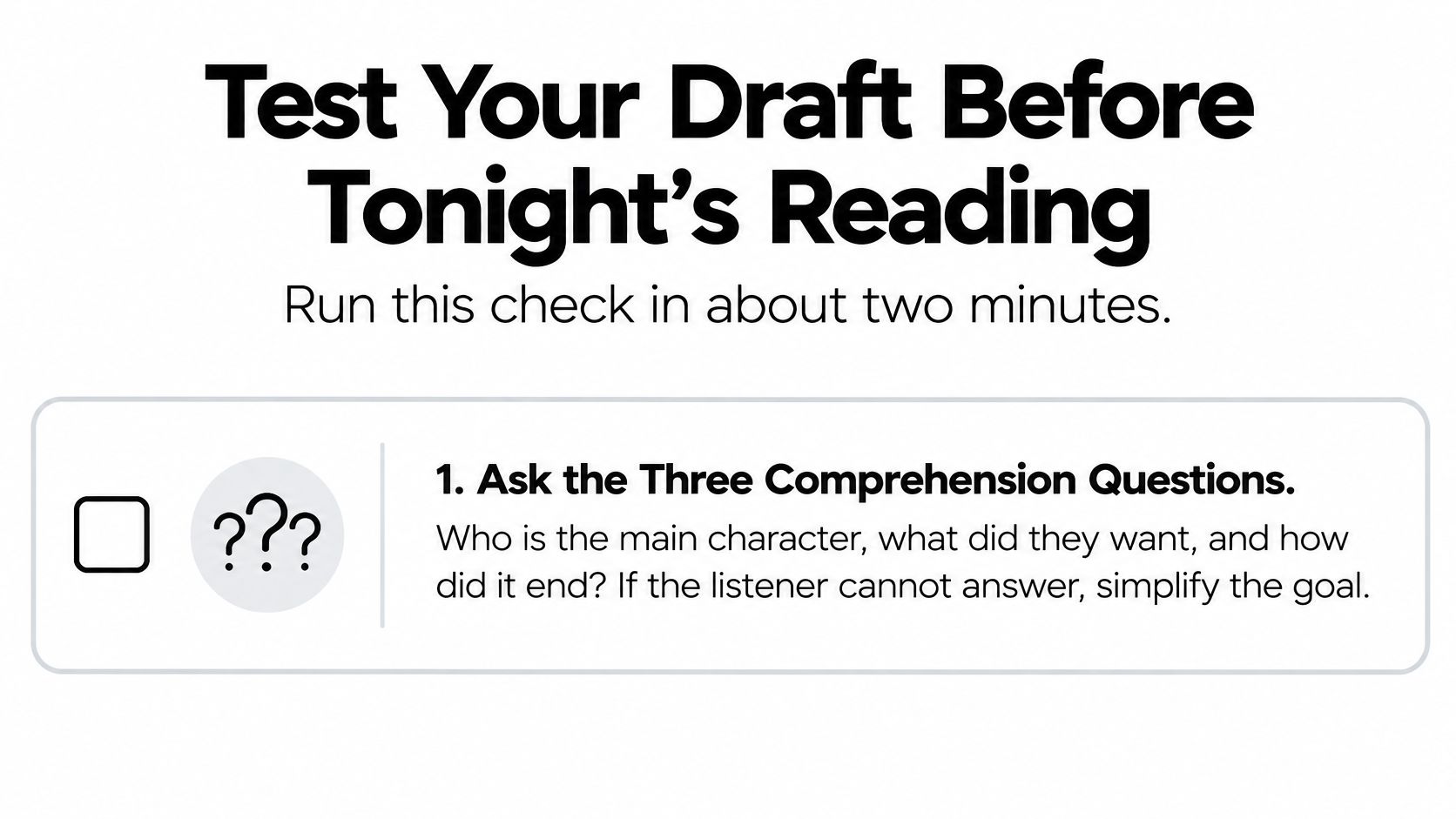
- Ask the three comprehension questions. Who is the main character, what did they want, and how did it end? If a listener can't answer, simplify the goal rather than adding explanation.
- Time it out loud. Read at the pace you'll use in the bedroom and compare the minutes against the length row for the child's age in the first table. Trim words, not scenes, if you're over.
- Mark anything that spikes. A sudden noise, a cliffhanger, a scary image. Replace each one with a calmer version drawn from the familiar sights you've already used.
- Check the last paragraph. It should contain the goodnight refrain, and it should be the slowest passage in the whole story.
Three habits make the next hundred nights easier. Keep one fixed opening line so the child knows the story is starting. Reuse the same character across several nights, because familiarity is what makes a story restful. And keep a short notebook of the stories that settled the child, so you can reach for a proven one instead of inventing at the worst possible hour.
If you're producing these as short videos rather than telling them live, our pre-made Bedtime story type starts from a calm template, so you're editing a wind-down instead of building one from scratch.
Tonight, choose the row that matches the child's age and how tired they are, and if they're overtired, anxious or fighting bedtime, drop to the shorter version.
ClipCreator.ai turns a bedtime story script into a short vertical video with AI-written narration, story-matched images, voiceover and subtitles, so a calm wind-down story can go out to your audience without a full production day. You can start from the pre-made Bedtime story type or write your own prompt, then set the days and times your videos publish. Visit ClipCreator.ai to see how the story pipeline works and get your first bedtime video scheduled.

Create your first video in under 2 minutes
Pick a niche, and ClipCreator.ai generates and auto-posts faceless videos to your channels every day.
Join ClipCreator.ai