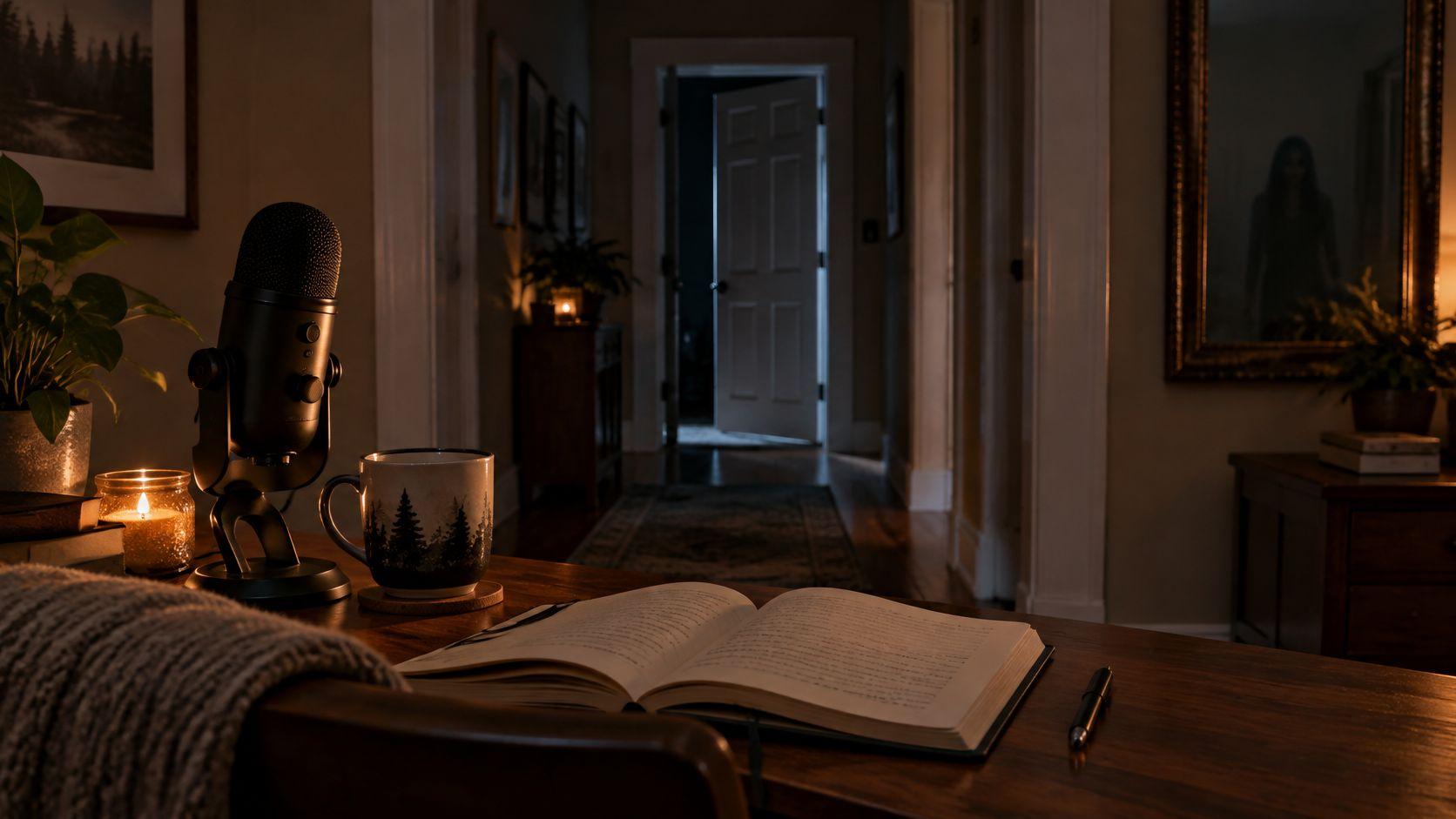
You've got a blank notes app open, a half-formed idea about a haunted hallway, and about sixty seconds of video to fill. You type a monster into the second line because you want it scary fast, then realize you've got nowhere left to go. That's the most common trap in how to tell a scary story for short video. You don't have a length problem. You've got a fear budget problem. Every reveal you spend early is one you can't spend later, so the craft is deciding what to withhold, when to show a sliver, and what to cut first when the clock runs out.
The Five-Step Structure Behind a Scary Story
| Step | What the viewer learns | Timestamp | Example beat |
|---|---|---|---|
| 1. Familiar setting and vulnerability | Where the character is and what they could lose | 0:00-0:15 | A night nurse alone on a quiet ward |
| 2. Observable warning | Something is wrong, but not yet clear what | 0:15-0:25 | A locked supply room door is standing open |
| 3. Delayed explanation with rising proximity | The danger is closer and the cause is still unknown | 0:25-0:40 | Footsteps stop outside the room and then repeat |
| 4. Staged disclosure | Part of the threat is shown | 0:40-0:50 | A figure visible only in a reflection |
| 5. Resolution or withheld outcome | The ending reframes an earlier detail, or stays open | 0:50-1:00 | The note she ignored earlier was written in her own handwriting |
Walking through each step
Step 1 works because the ward is ordinary and the nurse is alone. Don't write "she was in danger." Write what she stands to lose, such as being the only person who can reach a patient if an alarm sounds. A specific vulnerability gives every later sound a cost.
Step 2 needs something the viewer can see and check. A locked door standing open is better than a vague cold feeling because the viewer can ask a clear question. Who opened it? That unanswered question is the engine.
Step 3 is where beginners rush. They explain the footsteps right away and kill the tension. Instead, let the sound stop, repeat, and come closer while the cause stays unknown. You're delaying explanation, not delaying events.
Step 4 shows a fraction. A figure in a reflection lets viewers doubt their own eyes, which is scarier than a full costume reveal. Step 5 then reframes the note from earlier, so the ending changes what the beginning meant rather than just adding noise.
Why suspense beats stacked shocks
A review of empirical horror research defines suspense as the buildup to a threat, tension before its manifestation, and threat resolution, and experiments summarized in that review found that audience enjoyment increased as suspense increased. Repeated shock beats, by contrast, become predictable. Your viewer learns the rhythm, braces at the right moment, and stops feeling anything.
If you want more ways to map beats before you write, working through narrative structure examples helps you see how different arcs spend information at different speeds.
Three-question check: Can you name your warning sign, the detail that felt normal but was wrong, and the reframe at the end? If any answer is vague, that beat isn't written yet.
Timing Fear in Waves Instead of One Jump Scare
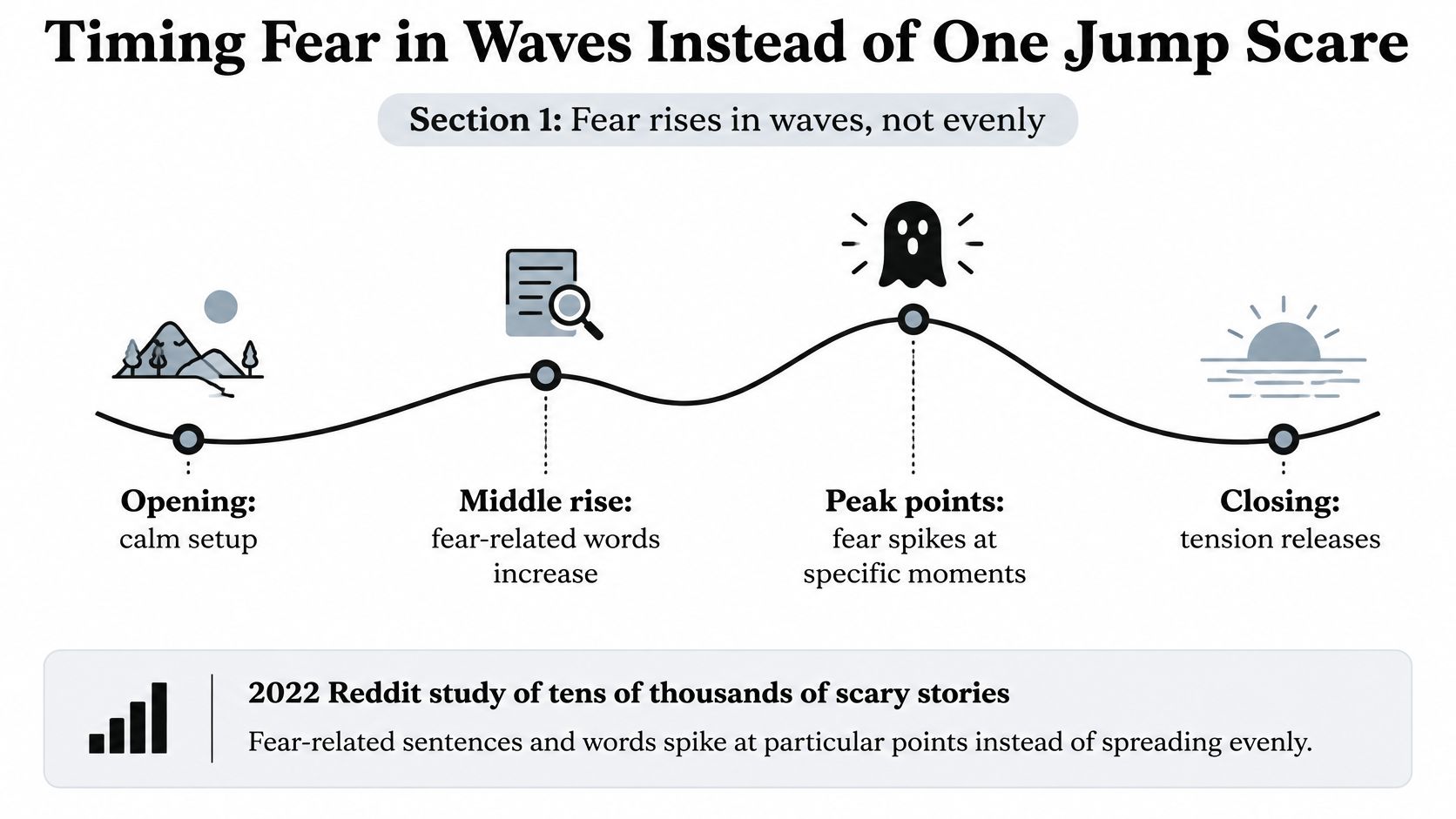
A 2022 computational study of scary stories on Reddit analyzed tens of thousands of narratives and found that fear-related sentences and words tend to spike at particular points rather than remain evenly distributed throughout a story. In practical terms, writers don't keep fear at one level. They let it rise, ease, and rise higher.
Three waves in 45 seconds
Try this shape with a child's drawing. Wave one, 0:00 to 0:15, is an unsettling detail. In the first five seconds, a mother finds her daughter's drawing of their living room, and there's a tall stranger standing behind the couch. Nobody screams. She laughs it off, which gives the viewer room to worry on her behalf.
Wave two, around 0:20, is a stronger threat cue. The next morning there's a new drawing on the fridge. Same room, same stranger, but now he's standing closer to the couch, and the daughter says she didn't draw it. The fear changes kind here. It's no longer "that's odd." It's "something is moving and it has a direction."
Wave three, 0:30 to 0:45, lands a concentrated reveal at about 0:38. A third drawing shows an empty couch and the stranger facing the viewer, smiling, with the front door open behind him. The mother turns around. You cut before we see the room.
Forewarning and payoff variety
Notice that the first drawing does two jobs. It's a scare and a forewarning, a hint that this object tracks danger. That hint builds dread during the calm seconds because viewers are watching for the next change. A second identical shock wouldn't do that. It would just be louder.
Vary what each wave pays off. One clue can turn out false, the next can expose a consequence, and the final beat can reframe the opening. That variety stops viewers from predicting your pattern.
The Reddit findings are observational, not a universal formula. Treat the waves as a testable default, watch where real viewers drop off, and move your spikes accordingly.
Each wave must be a different kind of fear, not the same scare played louder.
Setting, Sensory Detail and Point of View
A bedroom at 2 a.m. A radiator ticks as it cools. The hallway light flickers, but only when nobody's looking at it, and the air near the door feels colder than the rest of the room.
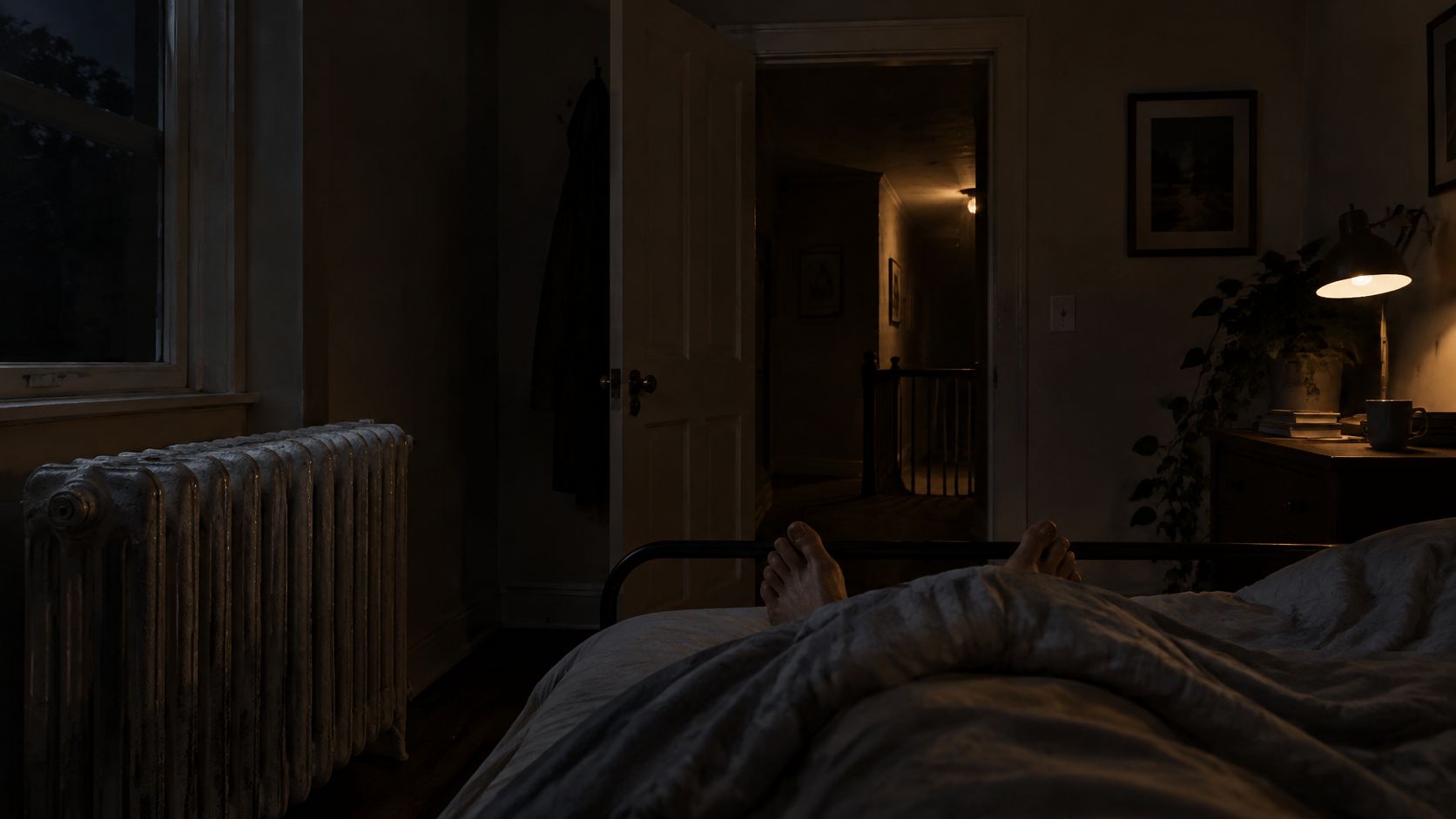
That sketch works because the place is unremarkable. Put extraordinary danger in a recognizable environment, a home, school, road, or workplace, and viewers place themselves inside it without effort. A survey summarized by the LCD Compendium via Publishers Weekly reported that 81.3% of respondents consumed horror media several times a year or more. People return that often for atmosphere they can inhabit, not for one loud moment.
Choosing details that carry weight
Lead with sound, because sound suggests something you can't yet see. A floorboard that never creaks in daylight tells viewers the house behaves differently at night. Add one temperature or smell detail, then pick one object that carries the threat, such as the hallway light. Three objects compete. One object becomes a signal viewers watch for.
Compare two lines. "Something is in the house" is generic danger. "The lock on her bedroom door is on the outside" is a concrete protagonist risk. The second line scares more because it answers who is trapped and how.
Point of view controls what you can hide. First person creates intimacy and limits knowledge, so the threat stays off screen naturally. Second person pulls the viewer into the action and suits very short videos. Third person adds distance and fits a narrator who knows more than they're saying. For more on pairing words with frames, these visual storytelling techniques show how a single image can hold a detail the narration only mentions once.
Try this exercise. List five sensory details for your setting, then keep only two for the voiceover. The three you cut were probably decoration.
Short-Form Templates for 15 to 90 Seconds
A 60-second horror video works like a fear budget. You have a fixed number of seconds, and every extra sentence spends some of them. Shorter horror premises with fast escalation often hold viewers better than long plots on short-form platforms. A tight premise that spends its seconds on a warning and a reveal beats a plot that tries to finish every thought.
| Template | Beat structure | Runtime | Best for |
|---|---|---|---|
| Single twist | Normal moment, one wrong detail, reversal | 15-30 seconds | Hooks and teasers |
| Warning then reveal | Observable warning, delayed threat, one reveal | 30-45 seconds | Standalone story posts |
| Found-object recap | Narrated discovery of an object or message, then its consequence | 30-60 seconds | Mystery and creepypasta-style stories |
| Full escalation | Five-step arc with staged clues and a reframed ending | 60-90 seconds | Series episodes with returning characters |
Writing one premise three ways
Take the drawing idea and give each runtime a different budget.
At 60 seconds, you can show three drawings, a parent's doubt, and a final reframe. That is the full spend: a setup, a second clue, then the turn.
At 30 seconds, keep two drawings and cut the doubt. The second drawing has to do two jobs. It is both the escalation and the reveal. Beginners often keep the parent's reaction here, then rush the last line so the scare lands as a caption nobody has time to read.
At 15 seconds, keep one drawing and one line. "My daughter drew our living room today. We don't have a man standing behind our couch." The warning and the reversal survive in every version. If a line disappears when you shorten the video and the scare still works, that line was never the premise.
What to cut first
When the draft runs long, cut in a fixed order so you stop bargaining with yourself.
- Backstory first: How the family got the house rarely matters. Viewers need the risk, not the history.
- Extra description second: If a detail doesn't change what viewers fear, it spends seconds you need for the reveal.
- Full resolution last: An open ending is often a feature in horror, so this cut costs you the least.
Never cut the warning or the reveal. Without a warning, the reveal feels random. Without a reveal, the warning feels like a promise you broke.
Choose by job, not by ambition. Use short templates for hooks, teasers, and testing a new premise. Save full escalation for series episodes where viewers already know the characters and will grant you slower early beats.
Adjusting Intensity for Kids, Mixed Ages and Global Viewers
Most advice on how to tell a scary story pushes in one direction. Make it scarier. That leaves you with no method for the classroom channel, the family audience, or viewers in a culture where your central image reads differently. You need a dial, not a volume knob.
| Fear type | Example | Suits | Adjust when |
|---|---|---|---|
| Implied | A door left ajar and a cold draft | All ages, classroom and family channels | Default choice when the audience is unknown |
| Psychological | A character doubts what they saw | Teens and adults | Make the ending emotionally clear |
| Supernatural | An unexplained figure that is never fully shown | Older teens and adults | Add a recovery beat for mixed audiences |
| Graphic | Visible injury or gore | Adult audiences only | Check platform rules and age settings before posting |
Why distance matters
Fear lands when it feels recognizable, and it stays enjoyable when viewers keep some psychological distance. An unrealistic threat can feel controllable, which is why a ghost that only appears in drawings works for younger viewers while a realistic intruder in a child's bedroom may not. Guidance from the Scouts on the benefits of being scared warns that graphic or overly frightening material may cause nightmares and recommends monitoring audience reactions.
So monitor them concretely. Read comments mentioning nightmares or a child who couldn't sleep. Watch for early drop-offs right after an intense beat, and treat reports as data rather than noise. A spike in drop-off at one timestamp usually means the intensity, not the pacing, is the problem.
Three habits for every script
- Attach an intensity label: Write implied, psychological, supernatural, or graphic at the top of the draft so the decision is deliberate.
- Write one alternative line: Keep a softer version of your strongest beat ready, so you can soften without rewriting the whole story.
- Add a recovery beat: For younger or mixed audiences, end with safety restored, a light on, a parent in the room, a small joke.
Also check culturally specific details before posting. A local custom, religious object, or gesture can read as offensive somewhere else even when you meant it as atmosphere. Culturally neutral sensory details, cold air, a ticking sound, a door that won't stay shut, travel well because they depend on the body rather than on local knowledge.
Voiceover, Captions and Visuals in a Faceless Video
A live teller gets eye contact, physical presence, character voices, and natural pauses for free. A faceless video gets none of that, so each job has to be assigned to a tool you control.
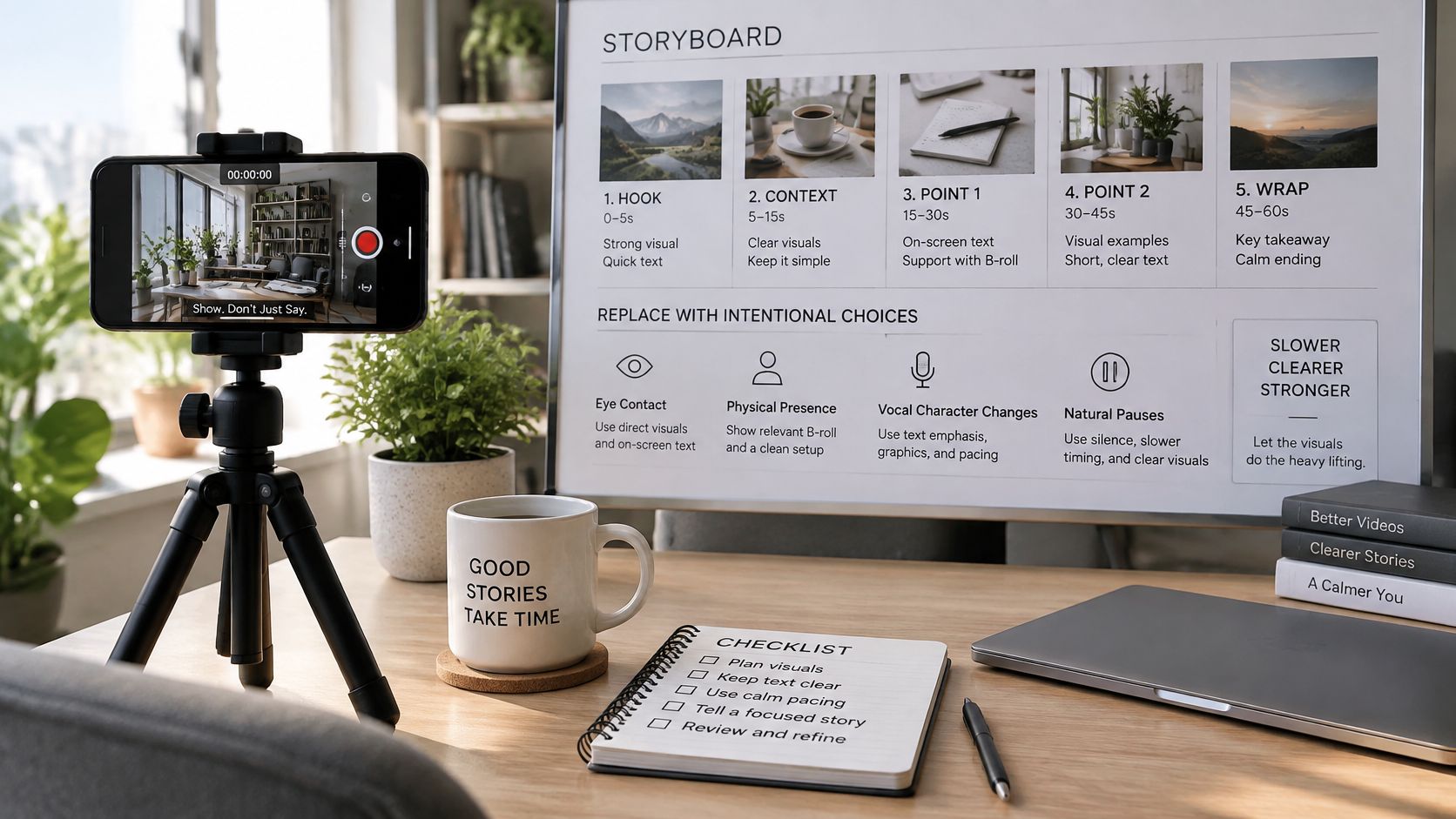
Giving each element one job
Slow the voiceover below normal speaking pace at the warning and the reveal. Speed signals safety, slowness signals that the narrator is looking at something. Then place a full second of silence, or a low sustained sound, just before the reveal. That silence does the work a pause does on stage, and viewers fill it with their own worst guess.
Treat captions as a second narrative track, not a transcript. Put short phrases on screen at the warning beat, such as "the door was locked," and let a caption land a half second after the voice says the unsettling line. The slight delay makes viewers read it twice in their heads. If you're planning both tracks on one page, an audio-visual script template keeps the spoken line, the caption, and the image change aligned beat by beat.
Change the image only when the wave changes. Cutting on every sentence trains viewers to expect novelty, so no single frame stays up long enough to become uncomfortable. Hold one frame and let the dread accumulate in it.
Watch how pacing and silence carry a story when there's no face on screen.

Reserve your one visual reveal for the moment the voice can't carry alone, a hand at the edge of frame or a face in a reflection during staged disclosure. If you spend it early, the ending has nothing left.
Final check: Voice slowed at the reveal, silence placed before the threat, captions carrying a clue, image changed at each wave, one visual reveal only.
Write and Test Your First Scary Story This Week
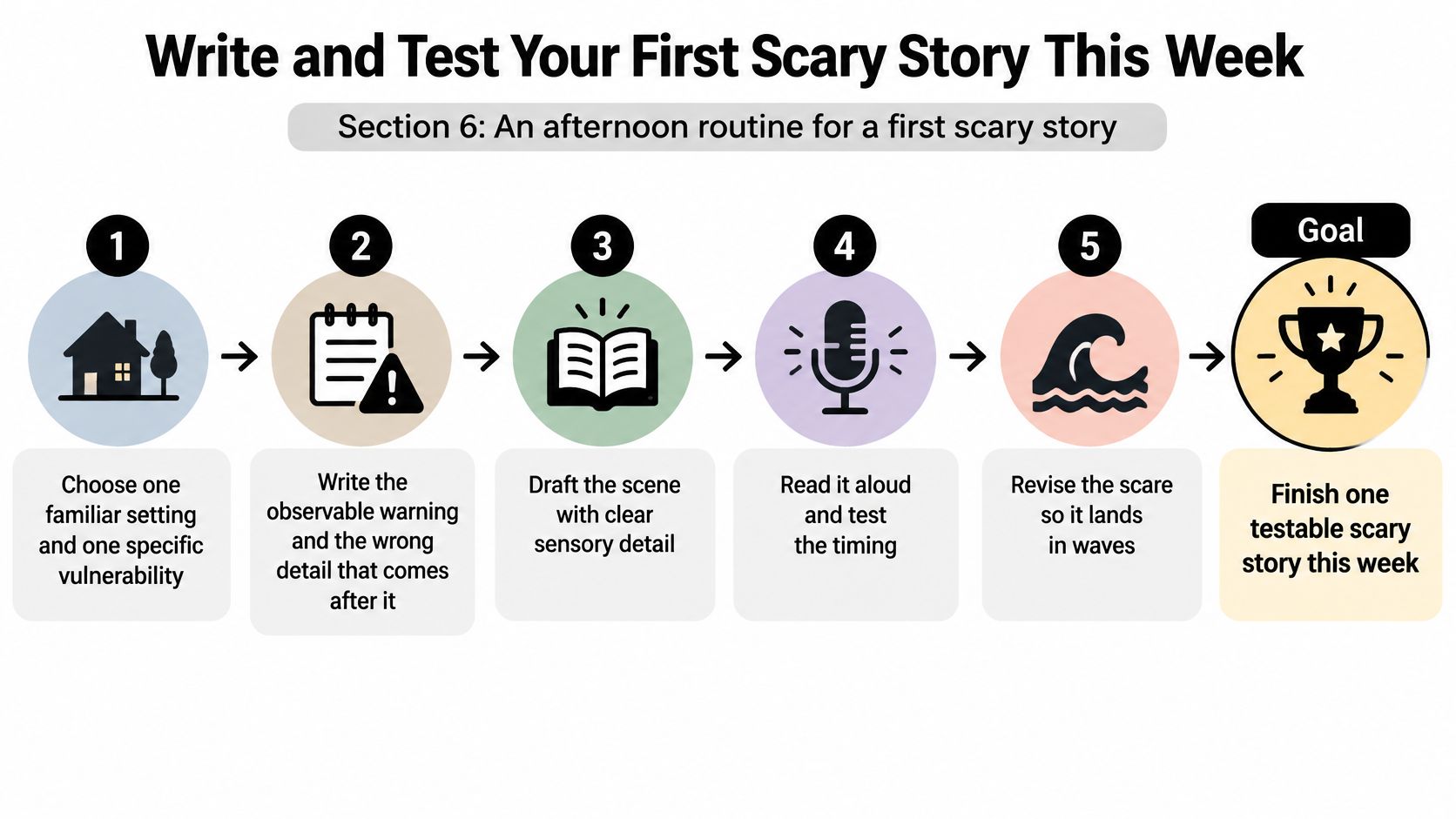
You can finish a testable draft in one afternoon with this routine.
- Choose one familiar setting and one vulnerability: A school corridor after the last bell, and a student whose phone is dead.
- Write the warning and the wrong detail: His locker is open, and the combination lock is hanging closed on the hasp.
- Draft all five steps with timestamps: Use the 60-second structure so each beat has a budget before you write dialogue.
- Read it aloud and time each wave: Your ear catches a rushed step three that your eye misses on the page.
- Write a 15-second and a 30-second version: Whatever survives both cuts is the premise.
- Post the shortest version first: Track whether viewers stay past the first three seconds and whether they reach the reveal.
Those numbers tell you if suspense is working, which is a different question from whether the story is scary enough. If viewers leave before the warning, your opening is spending too long on context. If they reach the reveal but don't comment, the reframe probably isn't changing anything.
If you'd rather not draft each beat by hand, ClipCreator.ai's AI-Powered Story Generation creates narratives from a pre-made viral story type or a custom prompt, and custom stories let you direct the AI with your own topics and style to reflect your brand identity. Writers who want broader background on drafting and revising with AI tools will find useful context in these AI writing and research articles from 1chat.
Your next decision is small. Pick the template that fits your runtime and the fear level that fits your audience, then write one version today.
Ready to turn your five beats into a finished faceless video with script, story-aligned images, lifelike voiceover, and subtitles handled for you? Start from the pre-made Scary Story type or bring your own custom prompt, set your topic and style, and publish a version this week. Visit ClipCreator.ai to build your first scary story video.

Create your first video in under 2 minutes
Pick a niche, and ClipCreator.ai generates and auto-posts faceless videos to your channels every day.
Join ClipCreator.ai