
Start with 2 to 4 YouTube Shorts per week if you already have a dependable production workflow; 1 per week is a valid baseline if you're still building one. Increase frequency only when the extra uploads support your channel goal without weakening retention or typical results per Short.
The opportunity is substantial even without daily publishing. In January 2024, artists active on Shorts, defined as posting weekly on average, received more than 60% of their new subscribers directly from Shorts, according to YouTube for Artists. That doesn't prove weekly posting caused their growth, but it challenges the assumption that discovery requires constant uploads.
Deciding how often to post YouTube Shorts means choosing what you want to optimize: total reach, performance per video, or an audience that returns for deeper content. Those aren't always the same objective.
Recommended Posting Frequency at a Glance
Two to four Shorts per week is a useful testing range, not an algorithmic requirement. A 2026 analysis of 799,718 videos from 71,177 accounts, described by Metricool, found that Shorts in that publishing band achieved the highest average views per post and interactions among the listed frequency bands.
The distinction matters: the analysis identifies an association across accounts, not a guaranteed result for your channel. Creators' topics, resources, and production skills may help explain both their schedules and their performance.
Weekly Shorts cadence bands and what each delivers
| Weekly cadence | Average views per Short | Total monthly reach | Best use |
|---|---|---|---|
| 1 per week | No comparable value established | Establish your own baseline | Setting a baseline and building a workflow |
| 2–4 per week | Highest of the listed bands | Can grow with additional output | Balancing quality and steady discovery |
| 4–7 per week | Lower than the 2–4 band | Can rise despite lower per-post performance | Expanding reach with a tested topic mix |
| 7+ per week | Lower performance than the leading band; exact gap not supplied | Highest reach isn't established | High-volume automated channels with quality controls |
The table deliberately avoids promising that the busiest channel gets the most reach. The evidence supports a possible volume benefit, not a reliable ranking of monthly results across every band.
Match the band to your production readiness
For a new workflow, begin at the baseline and learn what it takes to produce a useful, coherent Short. YouTube's official artist guidance recommends starting weekly and adjusting based on performance, while emphasizing a sustainable schedule rather than a minimum upload requirement.
Once production is predictable, test the middle band. Use the additional capacity for distinct questions, demonstrations, or story installments, not near-duplicates created to fill calendar slots.
Practical rule: Treat higher frequency as an investment that must earn its place, not a target you're obliged to reach.
For a team still establishing its process, a conservative starting schedule makes sense. Move toward the middle band once retention stays stable across several weeks, and test heavier output only when you can preserve the editorial attention each video needs.
Why More Shorts Do Not Always Mean More Views
A market stall can display more products without making each product more appealing. A larger selection creates more opportunities to sell, but a crowded display can also make individual items harder to notice.
That's a useful analogy for publishing, not a description of how YouTube allocates impressions. There's no established fixed pool of impressions that your uploads must divide among themselves.

More uploads can produce more total views while the typical upload performs worse. That isn't automatically a failure, but it becomes a poor trade when the extra production also weakens subscriber conversion, audience fit, or time available for your main content.
What the upload-growth evidence actually says
A 2025 vidIQ analysis of 5.08 million YouTube channels, summarized by SocialKit, found that channels uploading at least 12 times per month grew views nearly eight times faster than channels posting less than once per month.
That comparison concerns channel uploads generally, not a controlled Shorts-only experiment. It also compares active publishing with very infrequent publishing, so it doesn't establish that an already-consistent Shorts creator should publish daily.
Larger or more established teams may have more resources, stronger formats, and more reasons to upload. You can't isolate the effect of frequency from that comparison alone.
Where extra output can become expensive
Watch for these production mechanisms rather than assuming YouTube penalizes volume:
- Less useful feedback: When you release many experiments together, you may struggle to identify which change improved the result.
- Weaker topic discipline: Filling additional slots can push you toward subjects that attract viewers with little interest in the channel's central promise.
- Less revision time: A rushed schedule can leave weaker openings, unnecessary pauses, and inaccurate captions uncorrected.
Audience attention can also become a constraint if viewers repeatedly encounter content they consider interchangeable. Treat that as a hypothesis to check through audience behavior, not an explanation to apply whenever views fall.
For every increase, ask what the additional output contributed. Compare the change in total views alongside typical views and retention per Short, then decide whether that marginal benefit justified the work.
Choosing a Frequency for Your Channel Goal
A discovery-focused channel and a long-form teaching channel shouldn't automatically share a publishing schedule. The first may accept weaker average performance in exchange for more qualified reach; the second needs Shorts that help viewers take the next step.
Evidence summarized by AIR Media-Tech from an analysis of 18,000 English-language channels tracked from March 2025 to March 2026 suggests a sustainable mix may be 1–2 Shorts weekly alongside 3–5 long-form videos weekly. That's a correlational planning reference for channels with substantial long-form output, not a universal ratio.
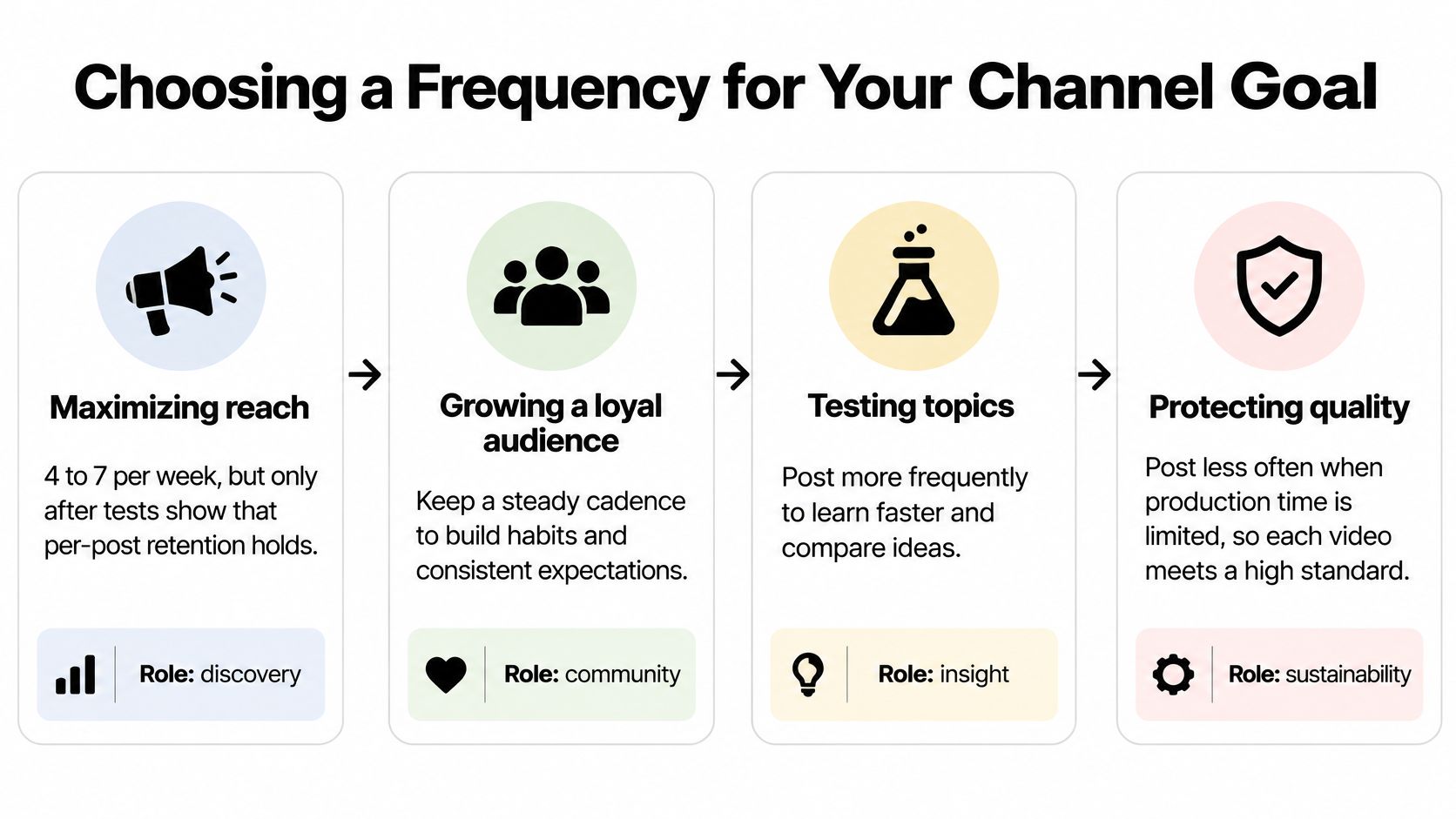
Shorts cadence and role by channel goal
| Channel goal | Suggested cadence | Role of Shorts | Signal to watch |
|---|---|---|---|
| Maximize reach | 4–7 per week after tests | Discovery volume | Total monthly views |
| Maximize quality per post | 2–4 per week | Hook testing and retention | Average percentage viewed |
| Grow long-form viewers | 1–2 per week alongside 3–5 long-form videos | Directing viewers to longer lessons | Long-form clicks and returning viewers |
| Sustain a small team | 1 per week, rising slowly | Consistent brand presence | Subscribers from Shorts |
These are test schedules, not proven optimal frequencies for every channel in each category.
Apply the goal before filling the calendar
For reach, an educator might publish standalone answers to related learner questions. A brand might demonstrate different uses of the same product category, but should still check whether those viewers become relevant subscribers or customers.
For long-form growth, choose excerpts or complementary explanations that create a logical reason to watch the longer video. A micro-lesson about a common mistake should point toward a lesson that resolves the next question, rather than an unrelated flagship upload.
For per-post quality, use the breathing room to compare opening approaches and remove unnecessary explanation. An educator can test whether a worked example is clearer than a definition; a brand can compare a demonstration with a problem-first introduction.
For a small team, protect a repeatable format before adding more publishing commitments. A recognizable series gives the editor a clear standard and helps avoid reinventing the entire production process for every upload.
Once the role is clear, choose consistent publishing windows. Use the guide to the best time to post YouTube Shorts to plan timing separately, rather than changing timing and frequency together and then guessing which mattered.
Metrics That Show Whether Your Cadence Works
Judge a schedule against your own previous schedule, not another channel's best screenshots. Compare equivalent reporting periods and give uploads a comparable amount of time to accumulate results.
YouTube's Shorts guidance for artists supports evaluating audience and subscriber outcomes alongside performance. For a cadence decision, combine those outcomes with measures that distinguish an appealing opening from a satisfying full video.
Cadence metrics and the action when each falls
| Metric | What it shows | Action if it falls |
|---|---|---|
| Median views per Short | Typical reach of one post | Revisit topics and hooks |
| Viewed-versus-swiped-away rate | Strength of the opening seconds | Rewrite openings |
| Average percentage viewed | Retention through the full video | Tighten pacing or shorten length |
| Subscribers per 1,000 views | Conversion of viewers into followers | Sharpen the series focus |
| Returning viewers | Audience loyalty | Test reducing frequency one step |
| Long-form clicks from Shorts | Handoff to longer videos | Add a clearer pointer to the long-form video |
Read the pattern before making the change
Start with median views per Short. If typical reach falls, inspect whether the added uploads cover weaker subjects before concluding that the schedule itself is wrong.
Next, separate the opening from the rest of the video. A weaker viewed-versus-swiped-away rate suggests testing a more immediate premise, while weaker average percentage viewed suggests examining pacing, repetition, or whether the promised answer arrives too late.
Read retention alongside video length. A shorter video and a longer explanation aren't interchangeable comparisons, so don't attribute every percentage change to frequency.
A schedule can generate more viewing without building a stronger audience. Check what viewers do after they watch.
Subscriber conversion helps assess whether the topic attracts people who want more of your channel. Returning viewers adds another perspective, but a decline isn't proof of fatigue: a change in discovery traffic or topic mix can also affect the pattern.
For a long-form objective, review the handoff itself. Make the destination relevant, use YouTube's related-video option where appropriate, and check whether viewers continue to the longer lesson rather than merely responding positively to the Short.
Keep these measures in a shared spreadsheet or reporting dashboard, with notes on topic and format. The guide to tracking content performance can help turn that review into a repeatable process rather than an occasional reaction to disappointing views.
How to Run a Four-Week Cadence Test
A useful cadence test changes the publishing commitment while keeping the content recognizable. It won't produce laboratory-level certainty, but it can give you a better decision than copying a successful creator's calendar.
An analysis of approximately 70,000 channels and 9.9 million Shorts published from January 2021 through December 2022 documented increasing adoption and distinct publishing patterns for Shorts. It supports studying Shorts as a separate publishing format, but doesn't establish a universally optimal upload frequency.
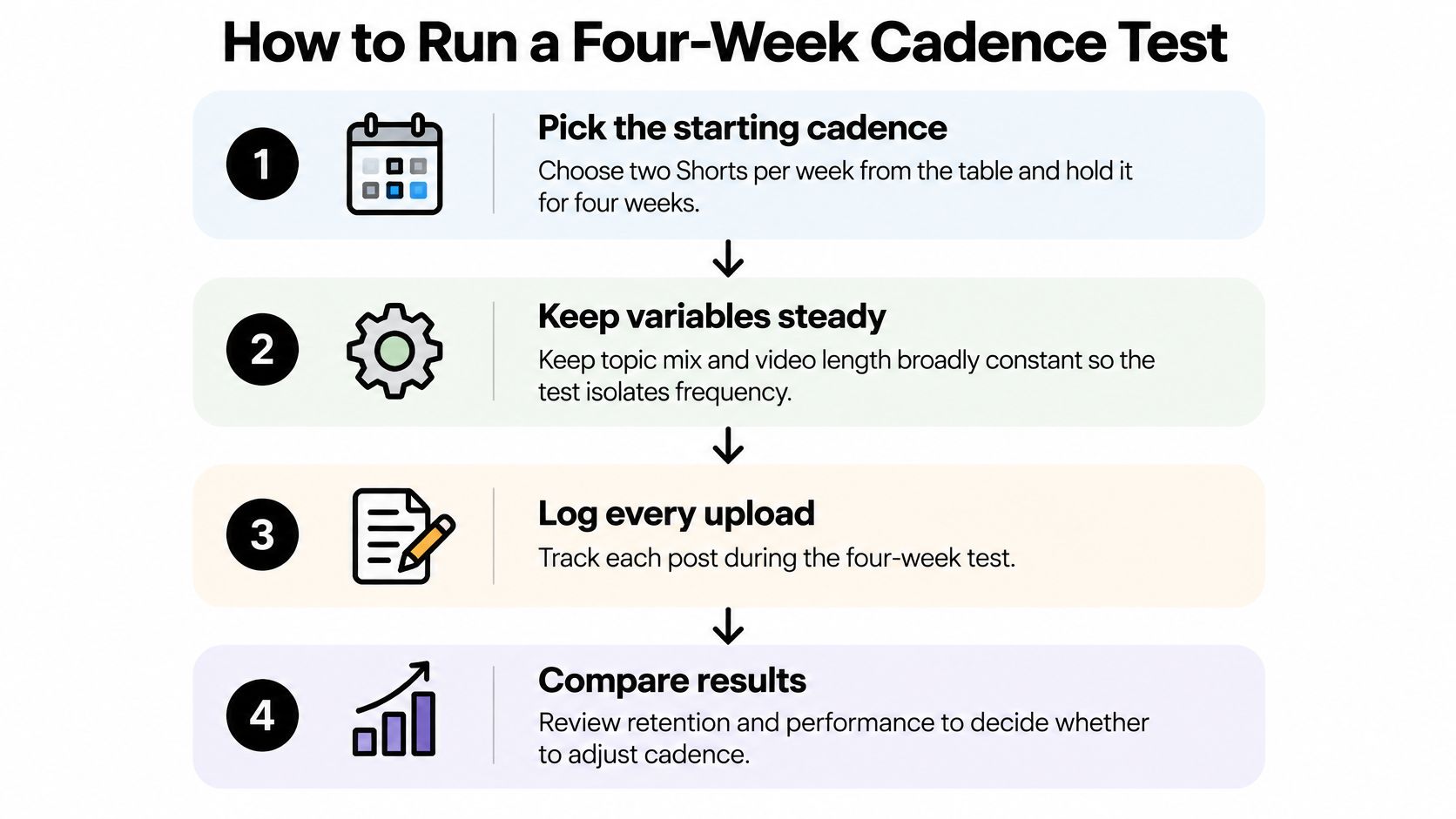
Set up a usable comparison
Use the following as a practical experiment design, not a promise that a short test can prove causation.
- Choose a schedule you can maintain throughout the test. For example, publish two Shorts weekly for four weeks, with the calendar fixed before you begin. Holding the schedule prevents a disappointing upload from prompting an immediate, unmeasured change.
- Keep the topic mix and video length broadly constant. If your baseline uses beginner tutorials, don't replace them with entertainment clips during the higher-frequency period, because you'd be testing a different audience proposition too.
- Log every upload in YouTube Studio and your spreadsheet. Record views, viewed-versus-swiped-away rate, average percentage viewed, and subscriber conversion, plus the topic and publication date. Record results at a comparable upload age so older videos don't gain an automatic advantage.
- At each weekly review, compare median views per Short and total weekly reach with the baseline. The median reduces the influence of an unusually successful upload, while the weekly total shows whether the extra publishing added meaningful discovery.
- Change frequency modestly, then repeat the observation period. In this example, add one or two weekly uploads rather than jumping immediately to multiple daily posts. A smaller adjustment makes it easier to sustain the content standards you're trying to preserve.
- Keep the higher cadence only if typical performance and retention remain acceptable for your goal. If reach rises while those measures deteriorate, step back and inspect the additional topics before committing to the busier calendar.
Protect the test from production surprises
Prepare enough material to avoid hurried substitutions. A batch content creation workflow can separate scripting, review, and scheduling, making it easier to keep the content mix steady.
Write down your decision criteria before examining the final results. Otherwise, it's easy to celebrate total views when they rise and switch to another metric when they don't.
A single test can't fully separate frequency from improving creator skill, seasonality, or changing audience interest. Judge the higher schedule by its marginal contribution, including the editing time it consumed and whether it displaced more valuable work.
Avoid These Cadence Mistakes and Set Your Plan
Copying a daily schedule without a baseline is the most avoidable mistake. You inherit another creator's workload without knowing their staffing, backlog, audience, or reason for publishing.
Choose the conservative band if your process is new, or the middle band if you already have stable retention. Your calendar should reflect what you can review and improve, not merely what your production system can generate.
Fix the editorial bottleneck first
- Raising volume before the opening works: Rewrite the openings in your next batch before adding slots. Remove greetings and setup that delay the subject, and make sure the first visual supports the premise.
- Publishing in bursts, then disappearing: Pick predictable days and prepare a reserve for busy periods. A quiet week is a reason to use the reserve, not to abandon the plan.
- Ignoring the long-form objective: Give relevant Shorts a clear destination when longer viewing is the goal. Don't force a pointer into unrelated content merely to claim every Short supports the main channel.
- Treating automation as editorial approval: Review the script, visual sequence, subtitles, and audience fit before publication. Generating a video and deciding it deserves publication are separate decisions.
Say an education team reduces a crowded publishing schedule so it can improve explanations and choose closer matches for its longer lessons. If retention holds and returning viewers improve during the next review period, the lighter schedule may be the better operating choice.
That's a hypothetical decision pattern, not evidence that reducing frequency causes loyalty. The useful question is whether the team improved its intended outcome while spending less production effort.
Separate scheduling capacity from publishing strategy
A scheduler helps execute your decision; it shouldn't make the decision for you. If you're comparing budget-friendly options, Creators Toolbox can help you find social schedulers with ongoing free plans, so you can evaluate how to maintain the calendar you've chosen.
With our scheduled video series, we generate and publish 3 videos per week, one per day, or two per day, depending on the subscription. You pick the publishing days and times, and you can download any generated video to publish manually to any social network.
Those options describe production and publishing capacity, not an evidence-based obligation to use the highest frequency. Select the arrangement that supports your test, and keep editorial review on the calendar alongside publication.
Decision checkpoint: Before adding another upload, name the outcome you expect it to improve and the signal that would make you reverse the change.
Commit to a review date
Choose your starting band, assign publishing days and times, and put the review date on the calendar before the first upload. Use the test period to collect comparable results rather than changing direction after every strong or weak post.
At the review, make a clear decision: hold, raise, or lower the cadence. Hold when results are promising but inconsistent, raise when additional output preserves the outcomes you value, and lower when the workload or audience response no longer supports the commitment.
The strongest plan isn't the fullest calendar. It's a schedule you can execute, measure, and revise without losing the reason viewers subscribed.
ClipCreator.ai automates the creation and scheduled publishing of short, faceless videos, helping you maintain a chosen cadence without manually assembling every upload. Visit ClipCreator.ai to explore a publishing workflow that fits your channel goal, then use your test results to decide how much to publish.

Create your first video in under 2 minutes
Pick a niche, and ClipCreator.ai generates and auto-posts faceless videos to your channels every day.
Join ClipCreator.ai