If you want to get more views on YouTube Shorts, you need to get inside the head of the algorithm. It all comes down to two things: audience retention and instant engagement. Your mission, should you choose to accept it, is to stop the scroll. Create something that grabs people immediately and doesn't let go. That’s the signal YouTube is looking for.
Decoding the YouTube Shorts Algorithm

Before you can really rack up views, you have to understand the machine you're feeding. The Shorts algorithm is a completely different beast than the one for long-form videos. It works in a rapid, two-step process: test, then push. Think of it as "explore and exploit."
When you hit publish, your Short isn't just sitting there waiting to be discovered. The algorithm instantly serves it up to a small, hand-picked "seed audience." This is your audition. How this initial group reacts determines everything. Do they watch it all the way through? Even better, do they let it loop? Or do they flick past it in a second?
Key Signals the Algorithm Cares About
The fate of your Short hangs on the data from this first audience. If the feedback is good, the algorithm kicks into the "exploit" phase, and your video gets pushed out to a much, much bigger crowd. This is how Shorts go viral. But if that first impression is weak, your video's reach gets cut off almost immediately.
Here are the metrics that make or break a Short:
- Audience Retention: What percentage of your video are people actually watching? You're shooting for a high number here. The gold standard is over 100%, which means people are watching it more than once. That’s a massive green flag for the algorithm.
- Viewed vs. Swiped Away: This is a stat you can now see right in your YouTube Analytics, and it’s critical. A high "viewed" percentage proves your content is doing its job and stopping the scroll.
- Engagement Velocity: How fast do the likes, comments, and shares start rolling in after you post? A quick burst of interaction tells YouTube you've struck a nerve.
At its core, the Shorts algorithm is designed to do one thing: keep people on the YouTube app for as long as possible. Every choice it makes boils down to a single question: "Will this video keep someone watching and scrolling?"
What This Means for Your Content Strategy
Once you grasp how this system works, you have a blueprint for success. You’re not just making a video; you're engineering a video to perform within this specific algorithmic framework. Every single second has to count, from the opening hook to the final frame that might just convince someone to watch it again. Many creators ask themselves what makes a video go viral, and the secret is almost always found in mastering these algorithmic triggers.
This forces you to be ruthless in your creation process. Is the very first second captivating? Is there a satisfying payoff or a seamless loop? Answering "yes" to these questions is the first real step toward making Shorts that the algorithm can't help but show to everyone.
Mastering the First Three Seconds to Stop the Scroll
You don't have a minute to make an impression in the Shorts feed. You barely have a second. That initial thumb-stopping power is everything. It's the one thing that decides if your Short gets swiped away or racks up millions of views. A weak start is a death sentence.
Your opening moments need to deliver an immediate jolt—intrigue, emotion, pure curiosity. It’s a silent promise to the viewer: "Stick around, what's coming next is absolutely worth your time." This is where a killer hook becomes your single most valuable asset.
The Anatomy of an Unskippable Hook
A powerful hook isn’t just about flashy edits; it’s pure psychology. It has to bypass the analytical brain and tap right into instinct. Your goal is to create an "open loop," a question or situation that the viewer needs to see resolved.
From what I've seen, the most effective hooks usually do one of these things:
- Pose a Relatable Problem: Kick things off with a pain point your audience knows all too well. A cleaning hack Short could open with a shot of a "hopeless" stain and bold text saying, "You've been cleaning this all wrong."
- Show the "After" First: Ditch the linear story. Show the incredible final result right away. A cooking video might start with a perfect slice of cake before ever showing a single ingredient.
- Create Visual Disruption: Use an unexpected sound, a weird visual, or a sudden camera movement. Anything to break that hypnotic scrolling pattern and force the viewer’s brain to snap to attention.
The core principle is simple: your opening has to create a knowledge gap. Give them a reason to wonder, "What happens next?" or "How did they do that?" If you can nail that, you've already won the most critical battle for their attention.
Making Every Millisecond Count
Crafting these hooks isn't an afterthought—it should be the very first thing you plan. A strong script is the foundation for a killer hook. If you need a little help there, we've put together a detailed guide on writing video scripts that grab attention from the very first word.
This intense focus on the intro is crucial. Why? YouTube Shorts have a 73% average percentage viewed, which is the highest in the short-form video game. In massive markets like the US and India, where Shorts pull in tens of billions of views every single day, failing to hook someone in those first three seconds means you're leaving massive potential on the table.
You can explore more fascinating Shorts statistics to see just how vital viewer retention is. Your ability to get views on YouTube Shorts is directly tied to your ability to master this initial, make-or-break moment.
Optimizing Your Shorts for Maximum Discoverability
Let's be real: a brilliant Short that nobody ever sees is just a video file taking up space. You've nailed the hook, but now comes the real challenge—making sure people actually find your content. This is where so many creators stumble, overlooking the simple, powerful steps that signal to the YouTube algorithm exactly who needs to see their work. Getting more views isn't about luck; it's about making it easy for the platform to find your perfect audience.
Think of your Short's title, hashtags, and audio choices as breadcrumbs for the algorithm. If they're vague or uninspired, your content gets lost in the digital wilderness. But when you get strategic, you're essentially giving YouTube a GPS, guiding your video straight to the viewers who will watch, engage, and hit that loop button.
Crafting Titles That Attract Clicks and Keywords
Your title is doing double duty: it has to be compelling enough to make a person stop scrolling, and it needs to be loaded with enough keyword data to inform the algorithm. A lot of people lean too hard into clickbait, using flashy titles that have no real substance. The smarter move is to blend genuine curiosity with clear, searchable terms.
For example, a title like "Coolest Life Hack Ever" is totally forgettable. But what about "This Kitchen Hack Saved Me 30 Minutes This Morning"? The first one is pure fluff. The second identifies a specific problem ("saving time") and a niche ("kitchen hacks"), giving the algorithm valuable context.
This concept of hooking the viewer early is crucial, and your title should set the stage for what happens in the first three seconds of the video itself.
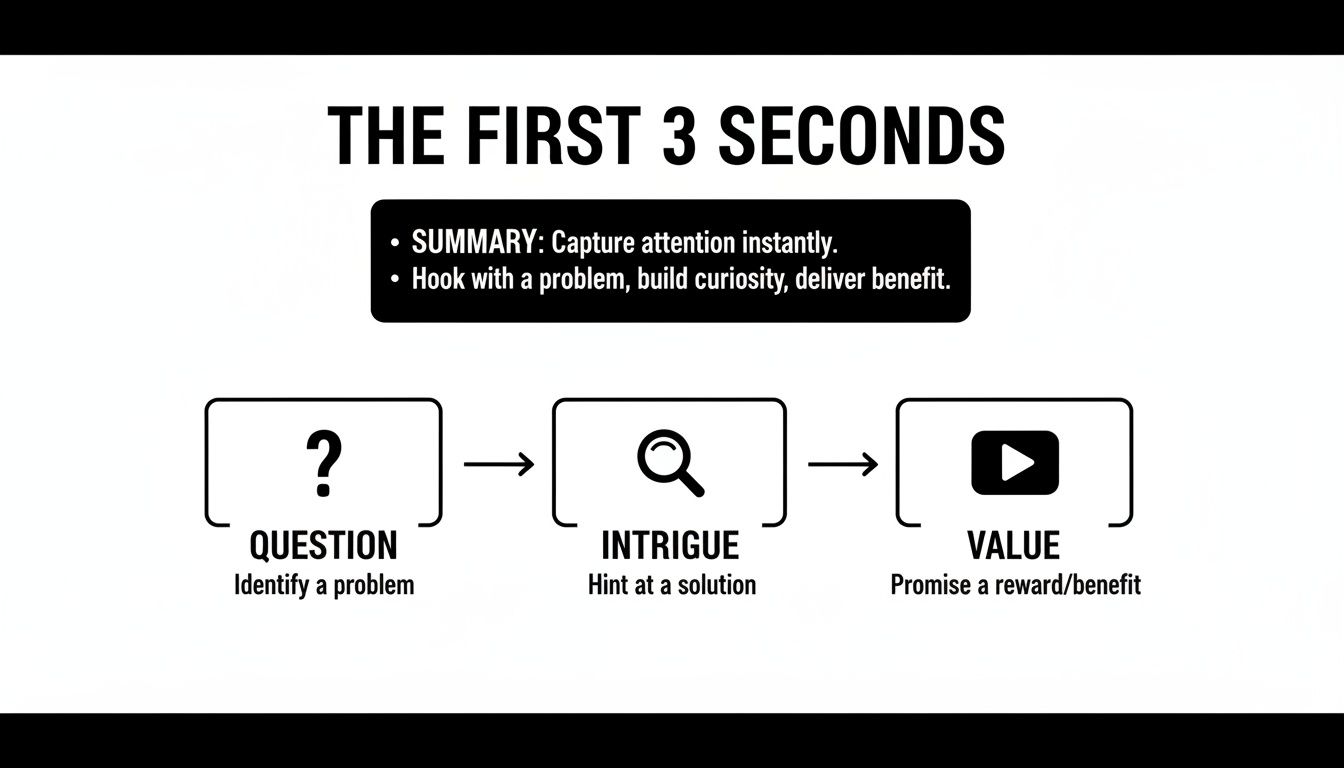
Ultimately, your title should make a promise that your video immediately begins to deliver on. Pose a question, create intrigue, or signal instant value—that's the winning formula.
Leveraging Hashtags and Trending Audio
Hashtags are not a decorative afterthought; they're vital categorization tools that YouTube relies on. I see two common mistakes all the time: creators either stuff their descriptions with dozens of irrelevant tags or use none at all. The sweet spot is a targeted mix that helps you get found without getting lost in an oversaturated tag.
Here’s a simple, effective hashtag strategy I always recommend:
- The Essentials: Always, always include #shorts so your video is properly indexed. I'd also add one other broad, high-level tag that fits your niche, like #diy or #gaming.
- The Niche-Down: Next, add 2-3 super-specific tags related to the video's content. If your Short is a quick recipe, you’d use something like #airfryerrecipes or #10minutemeals. This is how you connect with a highly motivated audience looking for exactly what you've made.
If you want to go deeper on this, we've put together an advanced guide on the https://clipcreator.ai/blog/best-hashtags-for-youtube-shorts that you should check out.
Beyond hashtags, trending audio is probably the fastest-moving cheat code for an algorithmic boost right now. When you use a sound that's blowing up, you're tapping into its existing momentum. The algorithm already knows who likes that audio and is way more likely to push your Short out to that same audience.
My Pro Tip: Don't just pick a song you personally like. Spend 10 minutes scrolling the Shorts feed and take note of the sounds you hear over and over. Using a sound that’s hot right now gives your content a massive, built-in discovery advantage.
To see the bigger picture of how Shorts fit into your channel's growth, it's worth taking the time for a deeper understanding the YouTube platform as a whole. Shorts optimization is just one powerful piece of a much larger puzzle.
Finding Your Ideal Length and Posting Cadence
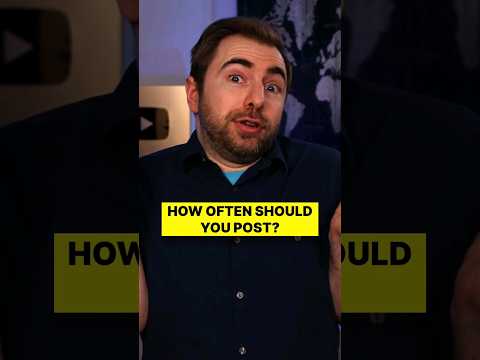
When it comes to winning with YouTube Shorts, two things really move the needle: how long your videos are and how often you post. A lot of creators are still stuck on the old idea that shorter is always better. But the data—and my own experience—paints a much different picture of what actually gets views.
The algorithm isn't just looking for quick hits; it's looking for retention. If you can hold a viewer's attention for a longer Short, you're sending a powerful signal to YouTube that your content is genuinely interesting. That's the metric that truly matters.
Rethinking the Perfect Shorts Length
Let's kill the myth that every Short needs to be under 15 seconds. Sure, snappy content has its place, but some of the best-performing Shorts I've seen are the ones that push right up against that 60-second limit. A great story, a useful tutorial, or a hilarious skit often needs a little more room to breathe.
You might be surprised to learn that the sweet spot for views isn't at the low end. In fact, an analysis from Inflow Network revealed something pretty stunning: Shorts in the 50-60 second range pulled in an average of 1.7 million views. That absolutely crushes the performance of shorter clips. You can read more about these YouTube Shorts findings for yourself, but the takeaway is clear: longer Shorts can mean more views.
So, what does this mean for you? It means you have permission to tell a full story. Give your video a real beginning, middle, and end. That structure leads to a more satisfied audience, which boosts your retention and tells the algorithm to show your video to more people.
Building a Sustainable Posting Rhythm
Once you've started making more substantial Shorts, the next piece of the puzzle is consistency. The Shorts algorithm thrives on frequency. This isn't like long-form video where you can post once a week. With Shorts, you need to be much more present.
The real aim here is to build a habit with your audience. When they know they can count on seeing fresh content from you every single day, they're far more likely to stick around. This creates a powerful feedback loop that drives serious growth.
Try to get into a rhythm of posting 3-5 Shorts per day. I know that sounds like a lot, but this high volume is a strategic move. Here's why it works:
- More Data for the Algorithm: Every upload is a new chance for the algorithm to test your content with a new audience. The more you post, the higher your odds of one of your Shorts taking off.
- Sets Viewer Expectations: A consistent schedule trains your followers to look for your videos, turning passive viewers into an active community.
- Faster Feedback Loop: Posting this often lets you see what's working—and what's not—in near real-time. You can quickly pivot your strategy based on what resonates with your viewers.
Creating this much content might feel overwhelming, but the key is building an efficient workflow. Try batch-creating your videos—film a bunch on one day and schedule them to be released throughout the week. This combination of making longer, more engaging Shorts and posting them consistently is a battle-tested strategy for blowing up your channel.
Driving Views with Cross-Promotion and Engagement
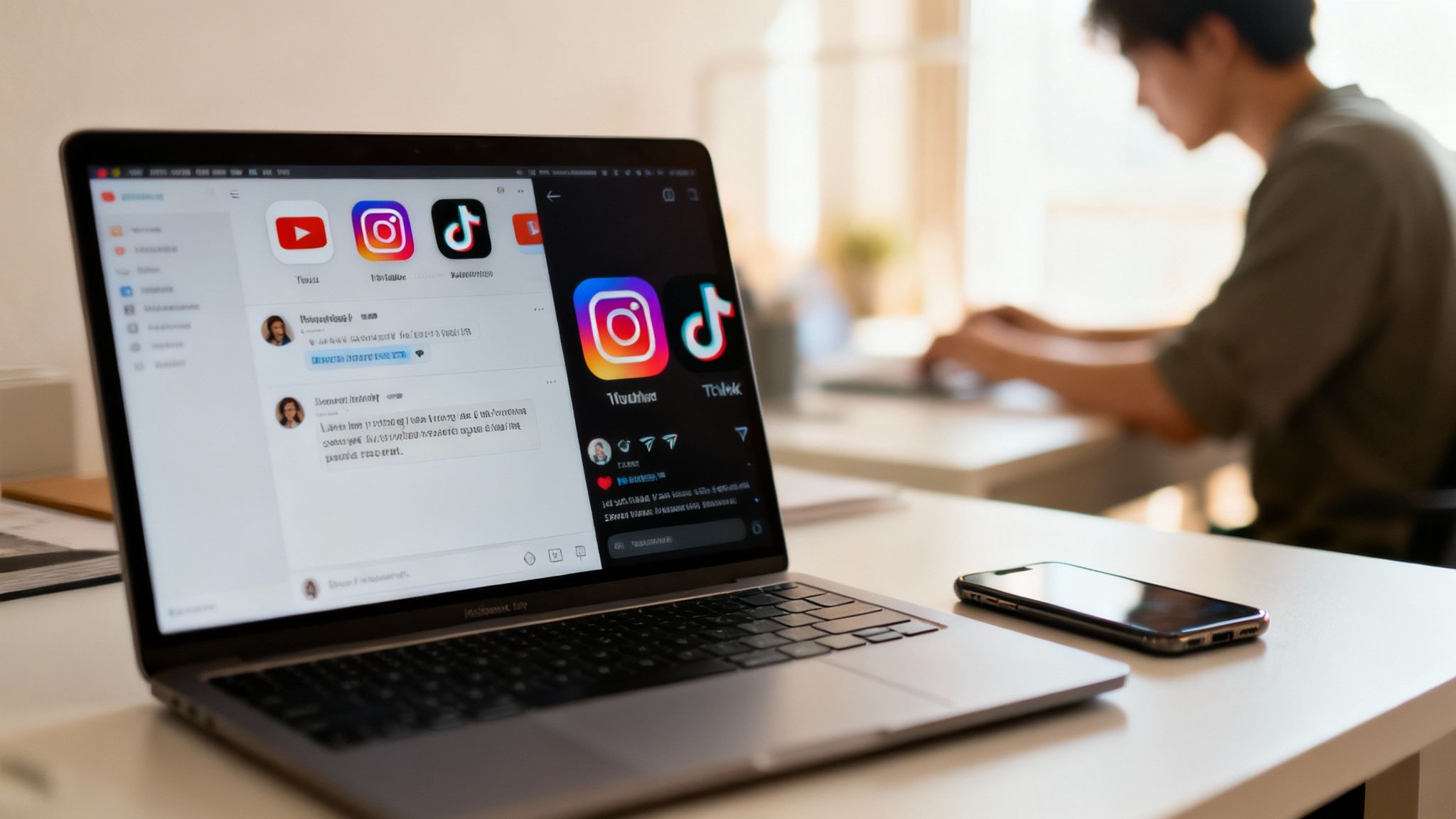
Hitting "publish" on a fantastic Short is only half the battle. If you really want it to take off, you can't just let it sit in the Shorts feed and hope for the best. Your content shouldn't exist in a vacuum. The smartest creators treat every new Short like a mini-launch event, promoting it across every single platform where they have an audience.
Think of it as creating an instant feedback loop. When you send followers from your other social media accounts over to your new Short, you kickstart its performance with a burst of views and engagement. That initial velocity is a huge green light for the YouTube algorithm, signaling that your video is worth showing to a much broader audience.
Building Your Promotion Engine
The goal here is to develop a simple, repeatable system you can follow every time a Short goes live. Don't just post and pray. Give your content the push it needs right out of the gate by using all the channels you have at your disposal.
A solid cross-promotion checklist might look something like this:
- Instagram & TikTok: Share a short teaser or a watermarked snippet of your Short to your Stories, as a Reel, or on TikTok. The key is a clear call-to-action. Something like, "Full video is live on YouTube now!" with a link sticker is perfect.
- YouTube Community Tab: If you have access to the Community tab, it's pure gold. Post a compelling GIF or a still from your new Short, link directly to it, and ask your subscribers what they think.
- Long-Form Video Callouts: Don't forget to mention your Shorts in your regular, long-form videos. You can give a quick verbal shout-out telling people to check out your Shorts tab or, even better, drop a link in a pinned comment.
To really get the most out of your efforts, it's worth digging into effective cross-platform growth strategies that help your Shorts find an audience far beyond YouTube itself.
Mastering the Art of Comment Engagement
Promotion gets the first wave of people to your video, but it's the engagement that keeps the momentum going. Your comment section is so much more than a place for feedback—it's a powerful signal to the algorithm. A lively, active comment section tells YouTube that your content is sparking a real conversation, which is one of the strongest indicators of a quality video.
Your job isn't just to read the comments; it's to actively nurture that community. That means responding thoughtfully, asking follow-up questions, and doing whatever you can to encourage more interaction.
A simple "Thanks!" is a wasted opportunity. Instead, try replying with a question that encourages another response, like, "Thanks, glad you enjoyed it! What other topics should I tackle next?" This keeps the conversation alive and boosts your engagement signals.
Pinning a strategic comment is another killer tactic. You could pin your own comment to add some extra context or ask a thought-provoking question to get the discussion started. Or, you can find a really insightful comment from a viewer and pin it to reward them and show others what kind of interaction you value. It's a small action that can turn your comment section from a passive feature into a dynamic part of the experience.
Common Questions About Getting More Shorts Views
Even when you're doing everything right, the YouTube Shorts game can throw some curveballs. It's totally normal to have questions and hit a few snags along the way. I've heard the same concerns from countless creators, so let's clear up some of the most common ones.
My goal here is to give you straight answers, drawing from real-world experience, so you can stop second-guessing and get back to making amazing content.
Does Deleting and Re-uploading a Short Hurt My Channel?
I get why this is so tempting. You pour your energy into a video, you know it's good, and it just… flops. But trust me on this, deleting and re-uploading is not the answer. The algorithm can see this as spammy behavior, which is the last thing you want. Honestly, it’s just a poor use of your time.
Instead of hitting delete, do a quick post-mortem. Figure out why it didn't connect.
- Was the hook in the first three seconds flat?
- Did your title fail to spark any curiosity?
- Maybe the topic just wasn't a good fit for your audience right now.
Take what you learn and pour that energy into making a new, better Short. The platform rewards fresh content and consistent effort, not trying to force a video to work when it just isn't landing.
How Long Does It Take for a Short to Go Viral?
This is the million-dollar question, and the honest answer is… there's no set timeline. It’s completely unpredictable. I’ve seen some Shorts blow up within a couple of hours. Others will get a trickle of views for weeks and then, out of nowhere, the algorithm finds the perfect audience and it takes off like a rocket. This randomness is exactly why consistency is your best friend.
Don't get fixated on the performance of a single video. It's a recipe for burnout. Your job is to focus on a sustainable creation rhythm. The next Short you post could be the one, or it could be one you uploaded a month ago that suddenly catches fire.
Think of every Short you publish as another lottery ticket. You're giving the algorithm another chance to match your content with millions of potential viewers. Just keep feeding the machine.
Should I Use AI Tools to Create YouTube Shorts?
One hundred percent, yes. If you're serious about posting frequently without completely draining yourself, AI tools can be your secret weapon. They're incredible for getting past the "blank page" problem—use them to brainstorm ideas, rough out a script, or generate some simple visuals. This can save you a massive amount of time.
They handle a lot of the grunt work, which frees you up to produce more content and stay consistent.
But—and this is a big but—the Shorts that truly connect are the ones with a human soul. Let AI build the foundation, but always be the one who injects your personality, your humor, your unique point of view. That’s the stuff that makes people want to subscribe.
Do Hashtags Really Matter for Getting Views on Shorts?
They definitely still play a role. Hashtags are one of the key signals you give YouTube's algorithm to help it understand what your Short is about and who to show it to. From what I’ve seen, the magic number is around 3-5 super-relevant tags. Anything more is just noise.
A solid strategy is to use a mix of broad and specific tags.
- Start with 1-2 broad ones that cast a wide net, like
#shortsand#tutorial. - Then, get specific with 2-3 niche tags that nail down your topic, like
#ikeahacksor#ketorecipes.
This approach helps you show up for people browsing general categories while also getting in front of the audience that's searching for exactly what you made.
Ready to stop guessing and start creating? ClipCreator.ai automates your entire Shorts production, from AI-powered scripts to voiceovers and scheduling. Build a high-frequency posting schedule without the burnout and watch your views grow. Start creating viral-style faceless videos in minutes at https://clipcreator.ai.

Create your first video in under 2 minutes
Pick a niche, and ClipCreator.ai generates and auto-posts faceless videos to your channels every day.
Join ClipCreator.ai