You have a podcast idea, a microphone, and three evenings a week. The hard question isn't just whether the idea sounds interesting. It's whether you can produce it consistently, and whether its best moments still make sense when cut into a 45-second video.
That matters because people don't discover shows in one place or consume them in one format. Edison Research's Infinite Dial 2025 found that YouTube was the most-used service among U.S. weekly podcast listeners, selected by 33%, and nearly half of Americans had both listened to and watched a podcast, according to the 2025 Infinite Dial. A show with clear, self-contained moments has more ways to reach an audience.
The ideas below pair each podcast format with episode prompts, a repeatable structure, and a practical way to turn its strongest moments into faceless short videos. A “faceless” clip doesn't have to hide the story: captions, narration, simple visuals, and careful pacing can carry the point without putting a host on camera. Choose a format you can sustain, not just one that sounds exciting in a pitch.
1. Serialized True Crime Narrative Series
A serialized investigation gives listeners a reason to return: each episode adds evidence, context, or a new perspective to a single case. The trade-off is the research burden. A compelling cliffhanger can't compensate for a claim that isn't well-sourced, so verify details against public records and identify sources in the show notes.
Try prompts such as “What did the first witness leave out?” or “Which piece of evidence changed the investigation?” Build each episode from a quick recap, a focused question, sourced reporting, and a reveal that opens the next chapter. Keep the story clear enough that new listeners can follow without hearing every installment.
For faceless clips, take one unresolved question or verified detail and make it the opening line. Add restrained captions, a case timeline, and narration that ends with a genuine point of tension. Don't imply guilt or present speculation as fact to manufacture a hook.
Practical rule: Make the clip intriguing, not misleading. The full episode should deepen the story, not correct the short.
2. Horror Fiction Anthology
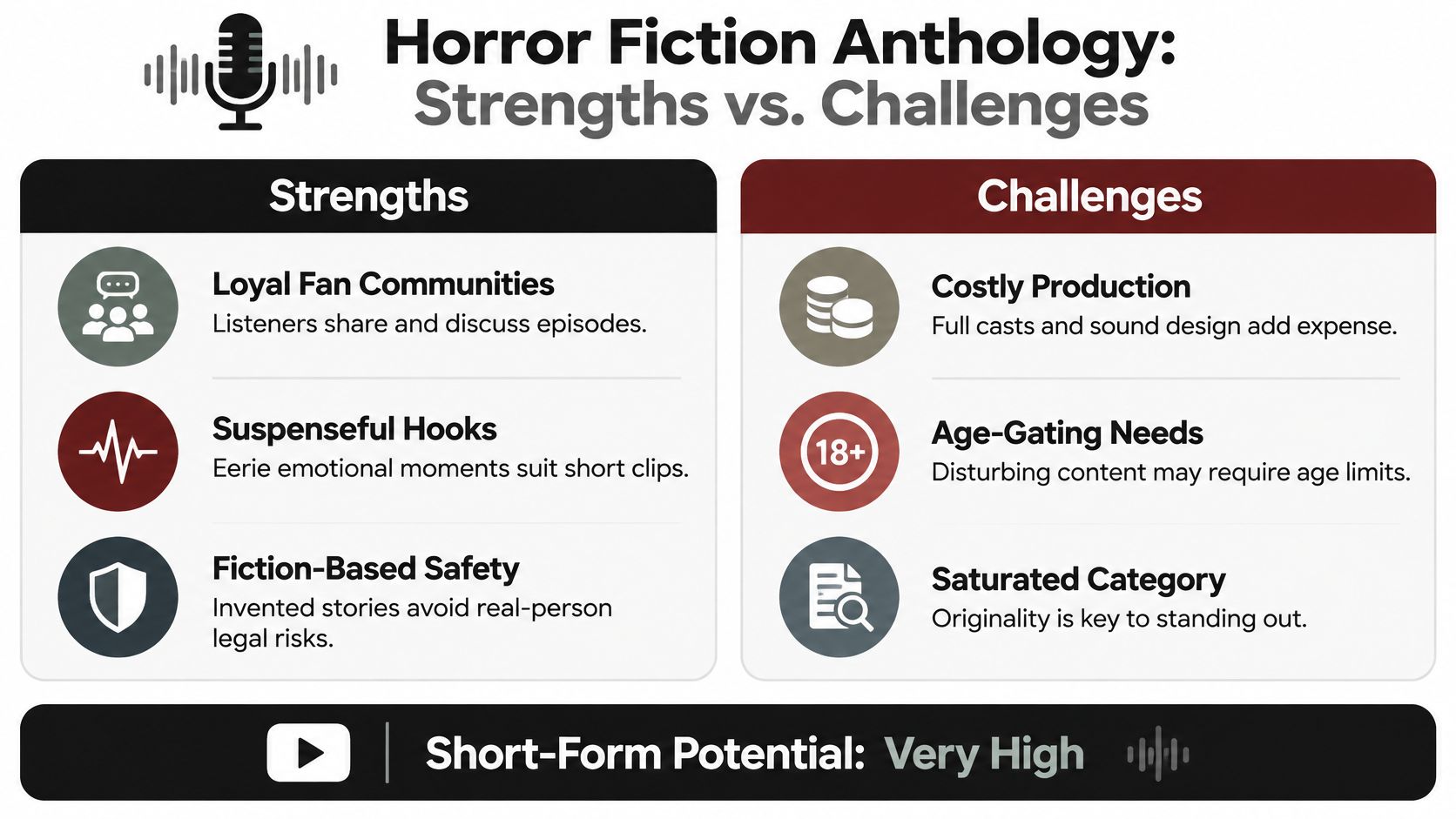
A standalone horror story is easier to sample than a long-running plot, but each episode needs its own atmosphere and payoff. A recurring sound sting helps tie different stories together. You can invite listener submissions or adapt community stories, but secure permission before producing or publishing anyone else's work.
Starter prompts could include a late-night call from an empty house, a familiar voice coming through a disconnected radio, or a routine task that starts to feel wrong. Shape each story around an unsettling setup, a small escalation, and an ending that lands. For inspiration when developing story premises, browse these horror short story prompts.
For a faceless teaser, isolate the 30 to 45 seconds when an ordinary detail turns disturbing. Pair close captions with a slow-moving hallway, a dark window, or another image that supports the story without competing with the narration. Check platform rules before posting graphic or disturbing material.
3. Sleep Stories and Bedtime Narratives
A sleep story should make it easy to drift off, not keep listeners waiting for a twist. Write with soft narration, gentle repetition, and little plot tension. That means less dramatic variety than horror or mystery, but the production can be simpler once you establish a calm, consistent sound.
A useful starter prompt: a quiet walk through a greenhouse after rain, or a slow train journey through a sleepy countryside. Start with a soothing welcome, settle into sensory details, and let the story gradually soften rather than building toward a climax. Keep volume steady and avoid sharp sound effects that could jolt a listener awake.
For a faceless short, select a self-contained calming passage and match it with unhurried visuals, readable captions, and the same visual and audio identity used in full episodes. The clip should feel like a gentle sample, not a loud ad. These bedtime story video ideas can help translate a narrated scene into a visual sequence.
4. Narrative Explainer and Educational Micro-Lessons
Start with a relatable problem, then explain the idea through a story. An episode about why people forget new information, for example, can follow a learner trying to remember a new skill and show how spaced practice for curious learners gives them a way to revisit it. Radiolab, Brains On!, and Wow in the World show how sound and narrative can make abstract subjects easier to follow.

Use a repeatable structure: hook, problem, story, takeaway. Give each episode one concept and one concrete example, rather than stacking definitions until the listener loses the thread. A clear series title can help listeners recognize the promise from one episode to the next.
The short-video cut can use that same sequence in miniature: open with the question, illustrate the problem, explain the key idea, and end with one useful takeaway. Use voiceover, subtitles, and simple story-aligned images or diagrams. If you want to build those clips from narrated lessons, explore AI explainer videos.
The episode can go deeper than the short, but the short should still teach something on its own.
For an example of pacing and visual storytelling, watch this explainer:

5. Short Daily News Briefing
A daily briefing wins on usefulness and predictability, but it leaves little room for late research or inconsistent publishing. A three-story format keeps the task focused: tell listeners what happened, explain why it matters, and identify what remains uncertain. The Daily and Up First are examples of shows built around reporting and timely context.
One episode might cover a local policy decision, a technology announcement, and a change affecting workers. Keep each item self-contained, distinguish confirmed facts from analysis, and link sources in the episode description. A clear script and a steady recording routine are more valuable than trying to cover every headline.
For the faceless short, choose one story rather than compressing the whole briefing. Put the central development in the first line, then use concise captions and a simple visual such as a headline card or location image. A short recap can point viewers to the full episode, while on-screen source details help them see where the claim came from.
6. Long-Form Historical Storytelling
Historical storytelling rewards research and careful pacing. It also takes time: a rich topic can become a tangle of names and dates if the host doesn't give listeners a clear question to follow. Choose a moment, decision, or person as the spine of the episode, then use chronology and interpretation to explain why the story matters.
Try a prompt such as “Why did this expedition turn back?” or “What changed after this overlooked invention?” Build the narrative around the setting, the decision at its center, the consequences, and what historians still debate. Shows such as Hardcore History and Revisionist History demonstrate different ways to bring historical material to life.
A short clip shouldn't try to summarize a sprawling episode. Pull one surprising, well-supported detail, explain its context, and use a clean timeline or map as the visual anchor. A series trailer can introduce the central question before listeners commit to a longer arc.
7. Interview-Driven Conversational Show
A guest's name can help attract interest, but the conversation still needs a direction. Strong interviews rely on preparation and listening, not a list of questions read in order. Ask for a specific story, decision, or turning point, then follow up when the guest reveals something concrete.
For example, interview a chef about the dish they nearly removed from the menu, or a teacher about a lesson that changed how they work. Start with the guest's context, explore the challenge, and finish with what they learned. Armchair Expert, SmartLess, and WTF with Marc Maron each put personality and conversation at the center.
For faceless clips, select a moment that stands on its own without the question that prompted it. Add the guest's name and topic in on-screen text, then use captions and uncluttered supporting visuals. Don't cut off the setup if it changes the meaning of the answer.
8. Comedic Review or Panel Show
A review or panel show needs a repeatable subject and room for disagreement. Choose a topic your hosts can discuss with energy, whether that's a film, a television episode, or a cultural trend. The risk is that inside jokes and overlapping chatter can make a clip hard to follow for anyone who wasn't in the room.
A sample episode might ask why a supposedly serious film made an odd creative choice. Give the panel a shared premise, let each person offer a different reading, and build toward a verdict or recurring bit. Shows such as How Did This Get Made?, Judge John Hodgman, and Comedy Bang! Bang! illustrate how host chemistry can shape the format.
For a short video, cut the exchange around one clear joke or disagreement. Preserve the pause before the punchline, caption the speakers distinctly, and avoid using copyrighted film or television footage without permission. A recurring phrase or visual cue can make clips recognizable without requiring viewers to know the show.
9. Relationship and Advice Show with Recorded Sessions
Advice shows can offer listeners empathy and practical perspective, but real people's stories require careful handling. Get written consent before publishing a recorded session, remove details that could identify someone, and tell listeners what to expect if an episode covers sensitive material. Don't treat a guest's private struggle as raw material for a dramatic reveal.
A starter prompt could ask how partners can discuss an uneven division of household work, or how someone can set a boundary with a relative. Let the person explain the situation, ask clarifying questions, then offer a possible reframe or next step. Shows such as Where Should We Begin? and Dear Sugar Radio demonstrate the appeal of conversations rooted in personal concerns.
For a faceless clip, select one practical insight rather than a vulnerable disclosure. Add a brief content note when needed, and make sure the excerpt preserves the speaker's meaning. A useful clip offers a standalone thought, not a sensational fragment.
How the nine podcast formats compare on episode length, short-form potential, and main production risk
| Format | Typical Episode Length | Short-Form Potential | Main Production Risk |
|---|---|---|---|
| Serialized True Crime Narrative Series | Often 40–60 minutes per episode, with some series running longer | High | Ethical and legal risks involving real people |
| Horror Fiction Anthology | Often under 30 minutes | Very high | Production costs and age restrictions |
| Sleep Stories and Bedtime Narratives | 20–60 minutes | Moderate | Slow pacing limits clip suitability |
| Narrative Explainer and Educational Micro-Lessons | 5–30 minutes | High for e-learning | Research demands and accuracy requirements |
| Short Daily News Briefing | 10–20 minutes | Strong for niche briefings | Requires fast, accurate daily sourcing |
| Long-Form Historical Storytelling | Often 2–5 hours or more | Moderate | Short clips can lose context |
| Interview-Driven Conversational Show | 45–90 minutes | High | Reliance on host and guest quality |
| Comedic Review or Panel Show | 60–90 minutes | High | Copyright and fair-use concerns when clipping media |
| Relationship and Advice Show with Recorded Sessions | 30–60 minutes | Moderate to high | Strict privacy and consent requirements |
Episode length shapes both the production workload and the clips a format can deliver. A long historical episode may need a complete setup to make a short excerpt clear, while a concise explainer can often yield a self-contained tip. Short-form potential depends on whether a moment makes sense outside the full episode, not on runtime alone.
For faceless clips, use a focused excerpt with captions and simple supporting visuals. A news briefing can cut around one clear update; an interview can center on a concise answer; a horror anthology can use a suspenseful passage. Sleep stories need gentler excerpts, while advice sessions call for a practical insight that preserves context. Each format has a different editing trade-off: tighter cuts can improve clarity, but removing too much context can distort the point.
Choose One Format and Test Five Episodes Before Scaling
Pick the format that fits your time, budget, and expertise. A daily news briefing needs a dependable research and publishing routine; a historical series demands deep preparation; an interview show depends on finding guests and asking questions that draw out specific stories. The best idea isn't automatically the biggest or most ambitious. It's the one you can make well without exhausting your available time.
Publish five episodes before deciding whether the workflow is sustainable. That's enough to test whether your premise generates fresh prompts, whether your segments flow naturally, and whether recording and editing fit your schedule. It won't guarantee that a show will find an audience, but it will expose practical problems early: a niche that runs out of questions, a script that takes too long to research, or an interview format that depends on guests you can't reliably book.
Plan each episode before you record. Write a one-sentence promise for the listener, choose a starter question, and outline the segments in order. Mark two or three moments that could stand alone as short clips, but don't force every episode into the same emotional shape. A funny panel exchange, a useful explanation, and a quiet bedtime passage need different pacing and visuals.
The clip plan can also help sharpen the podcast itself. If you can't identify a clear moment worth sharing, the episode may need a stronger opening, a more specific example, or a sharper takeaway. Conversely, a strong clip should make sense without requiring viewers to hear the entire episode first. Keep captions readable, use visuals that support rather than distract from the point, and check that a short edit doesn't distort what a guest or source said.
Once the recording and editing process feels stable, a tool like ClipCreator.ai can help turn selected moments into faceless short videos and schedule them alongside podcast releases. That can make promotion part of the production routine instead of a separate daily task. Choose the format for its fit with your skills and available time, then use those early episodes to refine both the audio show and the clips that introduce it.
ClipCreator.ai turns prompts or story scripts into faceless short videos with generated visuals, voiceovers, and subtitles for TikTok, YouTube, and Instagram. Use it to adapt podcast ideas into clip-ready stories or educational videos, then schedule posts across platforms. Visit ClipCreator.ai to plan a repeatable short-form workflow for your show.

Create your first video in under 2 minutes
Pick a niche, and ClipCreator.ai generates and auto-posts faceless videos to your channels every day.
Join ClipCreator.ai