You've watched a TikTok that explains a market collapse, breaks down an AI tool, or tells a surprisingly effective story. You finish the video, tap follow, and then notice something unusual. The creator never appeared on camera. Across dozens of posts, there's no talking head, lifestyle vlog, or personal brand built around a visible personality.
That's the operating idea behind a faceless TikTok channel. The creator removes their physical appearance from the production and replaces it with narration, screen recordings, animation, text, stock footage, or carefully edited visuals. The result isn't a shortcut. It's a different content system, one that depends more heavily on scripting, visual rhythm, retention, and repeatable production.
TikTok's scale makes this model commercially relevant. A 2026 benchmark reports approximately 1.9 billion monthly active users globally, about 1.12 billion daily active users, and an average of 95 minutes per day spent in the app, creating a large environment for topic-led channels that don't depend on a creator's face (Kapwing's 2026 short-form video benchmarks). The important question isn't whether you can hide your identity. It's whether you can build a format viewers recognize and want to watch repeatedly.
What a Faceless TikTok Channel Actually Is
A viewer finishes a two-minute TikTok about a stock market collapse. The narration has explained the timeline, the screen shows historical charts, and the captions highlight the turning points. The viewer taps the profile and discovers forty videos with the same visual identity, but not one shot of the person behind the account.
That account is faceless because the creator's physical identity stays outside the content. The channel might use a human voice, an AI voice, text-to-speech, screen recordings, animated diagrams, licensed footage, or a mixture of these elements. The audience follows the topic, editorial angle, and viewing experience, not the creator's appearance.
What counts as faceless content
A faceless format generally avoids:
- Talking-head videos: The creator doesn't speak directly to the camera while showing their face.
- Lifestyle presentation: The channel isn't built around daily routines, personal updates, or visible personal identity.
- Face-led commentary: The main point of attention isn't the creator's expressions or on-camera charisma.
A narrated history story with archival visuals counts. A screen-recorded tutorial about a software tool counts. A text-based list with animated backgrounds can count too.
A POV skit may not fit if the creator's body, identity, or performance is still the central attraction. Lifestyle vlogs, face-led duets, and creator-centered reaction chains usually belong to a different production model, even when the person's face appears only briefly.
Faceless doesn't always mean anonymous
Faceless is a production choice, not necessarily an identity choice. A business may operate a branded account while its team remains publicly known elsewhere. One creator might run several topic accounts, each with its own name, voice, and visual system, without appearing on any of them.
That distinction matters because anonymity isn't the product. The product is the content experience. Viewers need a reason to stay, whether that reason is a compelling explanation, a useful tutorial, a tense story, or a visual sequence that creates curiosity.
Industry reporting cited in 2025 placed faceless YouTube channels and TikTok accounts at 38% of new creator monetization ventures, compared with 12% in 2022, a 26-percentage-point increase over that period (AutoFaceless's 2026 creator statistics overview). The same source reported that faceless content represented over 30% of viral videos across YouTube, TikTok, and Instagram in 2023. These figures don't mean every anonymous account succeeds. They show that scripting, editing, and repeatable storytelling have become mainstream production assets.
A faceless channel works when it replaces the face with a recognizable promise. That promise might be “one useful AI workflow,” “the history behind ordinary objects,” or “a strange story explained in under a minute.” The creator's job is to engineer that promise into every frame.
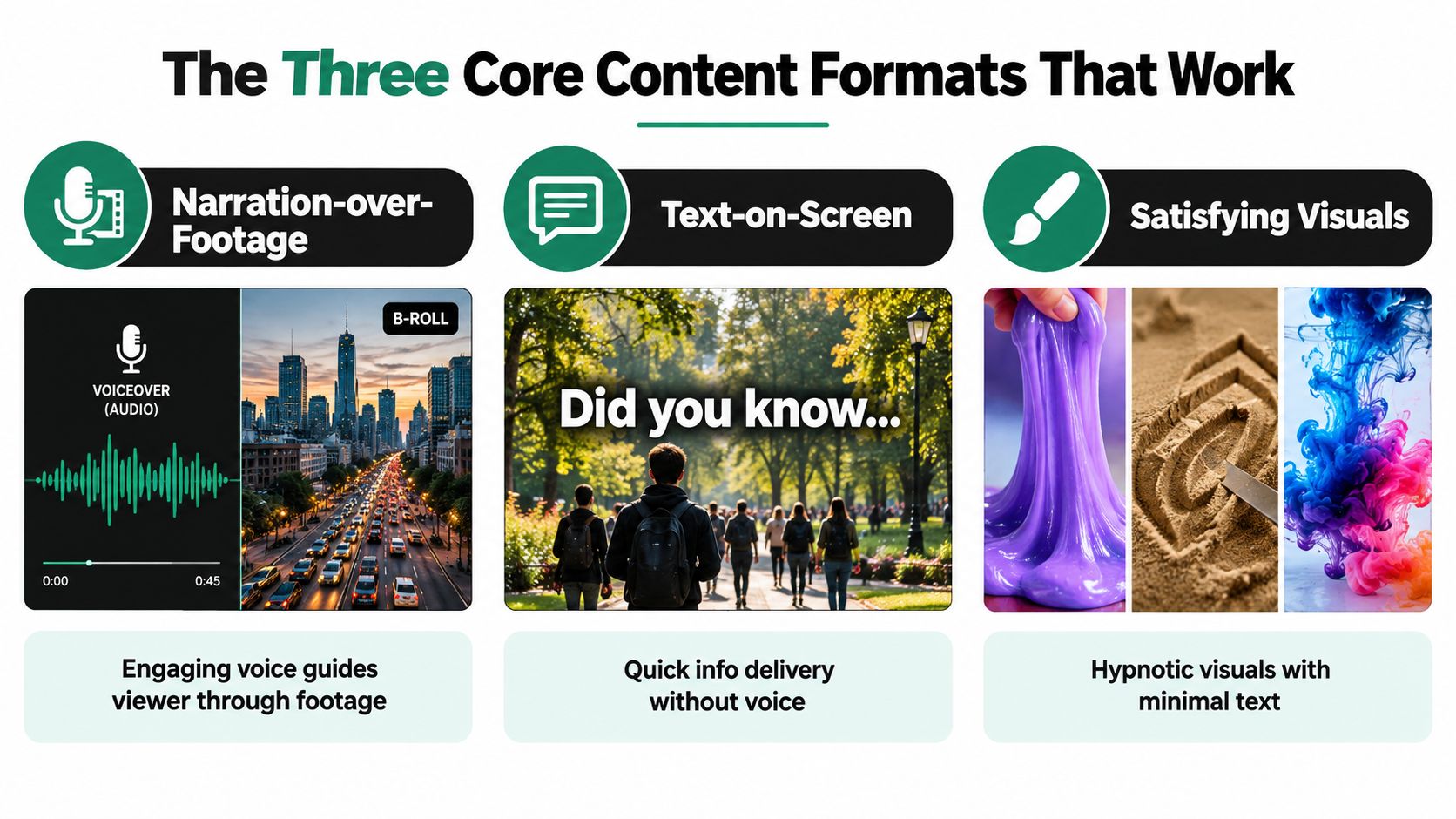
The Three Core Content Formats That Work
A faceless channel becomes easier to manage when you choose a primary visual language before publishing. The format affects your tools, script structure, pacing, and the type of viewer likely to finish the video.
Narration over footage
This format places a recorded voice over B-roll, screen recordings, product demonstrations, maps, screenshots, or stock footage. A finance channel might narrate how a market collapse unfolded while charts and headlines change on screen. A history account might use archival images and animated maps. A Reddit-style story channel might pair narration with atmospheric footage and highlighted captions.
The production stack usually includes a script editor, a microphone or voice generator, a video editor, a captioning tool, and a library of licensed or original visuals. The voice carries the argument, so the script needs clear transitions and a reason to keep listening. The footage shouldn't merely decorate the narration. Each visual change should clarify, intensify, or reset attention.
This format suits viewers who want an explanation but don't need to see the teacher. It's especially useful when the subject itself provides visual material, such as software demonstrations, historical documents, charts, or product features.
Animation and motion graphics
Animation turns abstract ideas into movement. Kinetic typography can emphasize a key phrase, a simple character can demonstrate a workflow, and animated diagrams can show how a system operates. This is a strong fit for technology explainers, educational micro-lessons, AI tool tutorials, and financial concepts that are difficult to show with ordinary footage.
You'll need a motion-graphics editor, visual templates, illustration assets, and a voice track if the video uses narration. The strength of animation is control. You can show exactly what the viewer needs, rather than searching for a stock clip that only loosely matches the sentence.
The trade-off is production complexity. A channel using animation should build reusable scenes, transitions, and typography rules. Otherwise, each post becomes a custom project that's difficult to publish consistently.
Text on screen and satisfying visuals
Text-led videos use captions, sound, and simple footage to deliver information without spoken narration. A list of useful browser extensions might show screen recordings with large text. A motivational account might pair a short statement with a changing background. A satisfying-visuals channel can use minimal text while relying on movement, texture, and sound to hold attention.
This approach has a low recording burden, but it still needs editorial judgment. Large text must be readable, the first frame must establish the subject, and every caption should arrive quickly enough for a viewer to follow without pausing.
| Format | Useful stack | Best fit |
|---|---|---|
| Narration over footage | Voice recording, B-roll, screen capture, captions, editor | Storytelling and explanations |
| Animation and motion graphics | Templates, diagrams, animated text, voiceover | Education and abstract concepts |
| Text on screen | Caption templates, music, simple footage, transitions | Lists, quick tips, and visual hooks |
Most durable channels blend formats. A software account might use screen recordings for demonstrations, narration for context, and animated text for the key takeaway. That hybrid structure gives you variety without forcing you to rebuild the entire production system for every post.

Why Hook and Retention Matter More Without a Face
A viewer opens a faceless video with no visible host to read. There is no expression to signal surprise, credibility, or urgency. The first frame, opening sentence, voice, and movement must create that connection deliberately. Treat the video like a small engineered system: the hook starts attention, the script maintains tension, and each visual change supports the next idea.
Earlier data showed that short and longer clips can serve different purposes. Short videos may encourage engagement, while longer shorts can accumulate more views. The useful lesson is not to copy one length. Choose the duration that gives your idea enough room to create interest, explain the point, and deliver a satisfying result.
Design the opening as a promise
“Today we're talking about productivity” gives viewers little reason to stay. “This study habit feels efficient, but it wastes your best hour” creates a specific problem and an unanswered question. The viewer knows the subject and can anticipate a payoff before deciding whether to swipe.
Build the opening from three connected parts:
- A written promise: Put the central question, result, or tension in the first caption.
- A visual interruption: Change the image, zoom into a detail, reveal an outcome, or introduce an unexpected object immediately.
- A spoken entry point: Begin with the consequence instead of background information.
The rest of the script should create small reasons to continue. Change the visual pattern when the explanation becomes predictable. Bring in a new example before the current one feels complete. State the payoff clearly, then connect it to a broader question or the subject of a future video.
This guide to writing short scripts can turn that sequence into a repeatable drafting process. It gives a faceless channel a production rule rather than relying on inspiration for every post.
Read the retention curve as a production brief
Fastlane's short-form video benchmarks report that sub-15-second TikToks can reach 60% to 70% average retention, while 30-to-60-second clips fall to 40% to 50% in its retention benchmarks (Fastlane's short-form video benchmarks). Use these figures as directional guidance, not promises. Your audience, topic, narration, and opening will change the curve.
The curve also tells you what to edit. Early exits point to a weak hook or first visual. A drop during a repeated explanation suggests that the setup needs shortening. Strong completion with few follows usually means the channel promise is unclear, so the next video does not feel like a natural continuation.
Practical rule: Before asking whether a faceless video looks polished, ask whether every second earns its place.
A camera-facing creator may recover a slow moment with an expression or spontaneous comment. A faceless creator has to build that recovery into the hook, script, pacing, and automation-ready edit. That discipline lets one person publish consistently without turning every upload into a fresh production problem.
Choosing a Faceless Niche That Lasts
A niche isn't durable because people are interested in it today. A workable niche gives you a repeatable supply of ideas, a format that fits the subject, and a believable path to revenue.
| Niche | Durability | Commercial intent | Content supply | Saturation risk |
|---|---|---|---|---|
| Reddit-style storytime | Evergreen when stories vary | Moderate, often indirect | High, with strong scripting | High if narration feels copied |
| Finance and money explainers | Evergreen topics with news-driven spikes | High, but trust and accuracy matter | Moderate to high | High and sensitive to platform rules |
| AI tool tutorials | Strong while tools and workflows evolve | High through software referrals and leads | High if you test tools | High because trends move quickly |
| Productivity and study content | Evergreen with recurring seasonal interest | Moderate to high for templates and tools | High | High without a specific audience |
| Facts and history | Evergreen | Moderate, depending on the topic | High | Moderate to high |
Match the niche to the production system
Storytime channels need strong narration, emotional pacing, and visuals that support atmosphere. Finance explainers need careful research, clear disclaimers where appropriate, and a voice that doesn't overstate uncertain claims. AI tutorials depend on current screens and workflows, so the creator has to update content when tools change.
Productivity content becomes more distinctive when it serves a defined person, such as remote workers, university students, or small business owners. Facts and history channels need a recognizable editorial angle, perhaps forgotten design decisions, overlooked local history, or the origins of ordinary technology.
Trend coverage has described productivity, finance, AI tools, and faceless POV scripts as prominent faceless categories, but trend language isn't the same as durability evidence (UniLink's 2026 TikTok trend coverage). The safer choice is a narrow format with a clear audience and an obvious reason someone might eventually buy, subscribe, click, or inquire.
Run a small validation test
Start with one niche and one repeatable format. Prepare several distinct hooks around the same audience problem, publish them across a short testing window, and compare comments, saves, follows, and retention rather than views alone. Keep the concepts that generate specific viewer questions, because questions reveal what the audience wants explained next.
Don't commit months to a broad category before testing its production demands. A niche that sounds attractive but takes all day to research won't support a sustainable publishing habit.
Monetization Paths Beyond the Creator Fund
Platform payouts can be useful, but they shouldn't be the entire business model. Eligibility for TikTok's Creator Rewards program is commonly described as requiring an account in good standing, 10,000 followers, 100,000 authentic views in the last 30 days, and videos longer than one minute, with guides also identifying age eligibility requirements (ShortsFast's 2026 faceless monetization guide). Requirements can vary by market and program terms, so check TikTok's current rules before building a forecast.
That creates an important format question. A channel built around very short clips may grow attention effectively but may not fit every long-form eligibility condition. Build the audience first, then choose a monetization route that matches what viewers already want.
Layer revenue onto the viewer journey
Affiliate marketing works when the recommendation naturally belongs inside the content. An AI tutorial can demonstrate a software tool and direct interested viewers to a tracked link. A study channel can recommend a planning app or equipment. The video should explain the use case rather than announce a product.
TikTok Shop and product commissions follow a similar principle. Show the product in use through screen recordings, close-ups, animated callouts, or hands-only demonstrations when appropriate. The faceless format doesn't prevent product-led content. It changes the way you demonstrate it.
Digital products give the channel a product it controls. A productivity account might sell a Notion template. An AI channel might package prompt libraries or workflow checklists. A storytelling channel could offer writing prompts or a structured script pack.
Other routes include lead generation for software companies, sponsored UGC-style videos that don't require an on-camera appearance, and brand deals for themed video series. A company may care more about a consistent audience and reliable delivery than about hiring the creator as a personality.
This overview of creator monetization provides additional context for combining platform income with owned offers.
Commercial principle: A video earns more strategically when it moves the right viewer toward a relevant next step, not merely when it collects another view.
Earnings vary by region, audience, subject, offer, and conversion quality. The durable advantage comes from owning part of the funnel, such as an email list, product, referral relationship, or qualified lead flow.
How Automation Tools Scale Production
A solo creator can publish consistently only when production stops feeling like a fresh project every time. The useful goal isn't to automate judgment. It's to automate repetitive handling around judgment.
Build one loop from idea to publish
The workflow starts with idea sourcing. Use TikTok search suggestions, recurring audience questions, relevant trending sounds, comments, and competitor gaps. Don't copy a post. Identify the underlying question and restate it for your audience.
Next, draft the script against a known structure:
- Hook: State the tension, question, or surprising result.
- Context: Give only the background needed to understand the point.
- Escalation: Add examples, steps, or a contrast that keeps curiosity active.
- Payoff: Answer the opening promise clearly.
- Continuation: Give the viewer a reason to follow or watch the next related post.
A voice generator can produce narration, while an editing system assembles B-roll, screenshots, captions, and transitions. Tools such as ClipCreator.ai can turn a topic prompt and script into a faceless short with generated visuals, voiceover, subtitles, scheduling, and publishing workflows. Its product information states that videos can be produced up to 90 seconds long and scheduled for TikTok, YouTube, and Instagram.
Keep human review at the center
Automation handles assembly. You still need to choose the idea, sharpen the hook, check factual accuracy, reject awkward visuals, listen for unnatural narration, and review captions for errors. A fast system that publishes weak ideas only scales weak ideas.
The production loop should also preserve a feedback step. After publishing, inspect where viewers stop watching, which opening lines generate comments, and which visual choices make the explanation easier to follow. Feed those observations back into the next batch of scripts.
The practical benefit is consistency. Instead of treating every post as a separate editing challenge, you create templates for recurring scenes, caption placement, narration style, and export settings. That gives one person a manageable operating system while leaving the creative decisions where they matter most.
An AI video generator workflow for TikTok shows how script, visual, voice, and publishing steps can fit into one process.
Common Mistakes That Kill Faceless Channels
Faceless content looks simple from the outside because the creator isn't standing in front of a camera. The hidden work is substantial. A channel can fail because the scripts sound borrowed, the visuals don't change with the narration, or the niche gives viewers no reason to remember one account over another.
Copying removes the reason to follow
A Reddit thread can provide a starting point, but reading it back with minor wording changes creates a familiar copy-paste smell. The same problem appears when a creator publishes an unedited AI draft or imitates another account's hook, visuals, and pacing.
Add an original angle. Explain why the event matters, compare it with a different example, question a popular assumption, or organize the information for a specific audience. Your voice doesn't require your face. It can appear through word choice, standards of evidence, humor, sequencing, and the questions you choose to answer.
Broad niches disappear into crowded feeds
Generic motivation, unspecific fun facts, and recycled list content can attract occasional views while building little loyalty. Narrow the promise. “Productivity tips” is broad. “Study systems for students who work part-time” gives you a clearer audience, vocabulary, and product direction.
Before committing, study the first 50 videos in the niche as a qualitative exercise. Note recurring hooks, visual patterns, unanswered questions, and formats that look overused. Then create a variation that serves a recognizable viewer rather than an undefined mass audience.
Automation can make weak content faster
Ultra-long AI lectures, static slideshows, robotic narration, and stock footage loops often lose attention because the visual track doesn't respond to the script. Captions may arrive late, sound may remain flat, and the first frame may offer no clear reason to watch.
Use batch scripting to keep the editorial standard consistent. Test five hooks for an important idea, choose the one that creates the clearest tension, and review analytics for watch-through dips. Replace the weak section instead of blaming the niche.
A failed post is production data. It tells you which promise, transition, visual, or payoff didn't earn enough attention.
A faceless TikTok channel grows through iteration. Improve one variable at a time, keep the format recognizable, and let audience behavior guide the next script rather than treating every low-performing post as a verdict on your ability.
ClipCreator.ai helps creators turn prompts and scripts into short faceless videos with aligned visuals, lifelike voiceovers, subtitles, scheduling, and multi-platform publishing. If you want to test a repeatable faceless TikTok workflow without assembling every production step manually, visit ClipCreator.ai and build your first video system around a niche you can sustain.

Create your first video in under 2 minutes
Pick a niche, and ClipCreator.ai generates and auto-posts faceless videos to your channels every day.
Join ClipCreator.ai