You've got the idea for a channel, maybe even a niche, but the gap between “I should start” and “I can post consistently” still feels huge. That's the common state most aspiring content creator YouTube channels live in, not a lack of ambition, but a lack of a system that can survive competition, repetition, and the pressure to be perfect.
The good news is that YouTube in 2026 is big enough to reward both personality-driven channels and faceless formats. It's also crowded enough that random posting won't carry you far, especially with about 69 million active creators worldwide in 2025-2026, an audience of 2.6 to 2.7 billion monthly active users, and 500 hours of video uploaded every minute according to industry compilations and platform-scale estimates (TechRT). The creators who last are the ones who treat YouTube like a repeatable business, not a lottery ticket.
What Is a YouTube Content Creator in 2026
A few years ago, “YouTube creator” could mean someone filming a vlog in their bedroom, a gamer streaming live, or a teacher explaining algebra on a whiteboard. In 2026, it means something broader and more practical. A creator is someone who uses video to build attention, trust, and eventually income, whether the face on camera is theirs or not.
That shift matters because the modern creator isn't just making clips. They're building a content system around a clear promise, like teaching a skill, entertaining a specific audience, or summarizing information people want fast. A cooking channel, a finance explainer, and a faceless story channel all work differently, but the job is the same, make viewers care enough to click, watch, and come back.
For new creators, that can feel intimidating because YouTube looks like a giant competition. It also looks more structured than it really is. The people who win are usually not the ones with the fanciest gear, they're the ones who can define what they make, who it's for, and how they'll publish it again next week.
Practical rule: if you can explain your channel in one sentence, you're closer to being a creator than most beginners think.
This guide is for the creator who wants a scalable path, not just a motivational pep talk. That includes faceless videos, AI-assisted workflows, and practical decisions about monetization, retention, and production pace. If you're trying to build a channel that can keep going, that's the lens to use.
The Modern YouTube Creator Environment
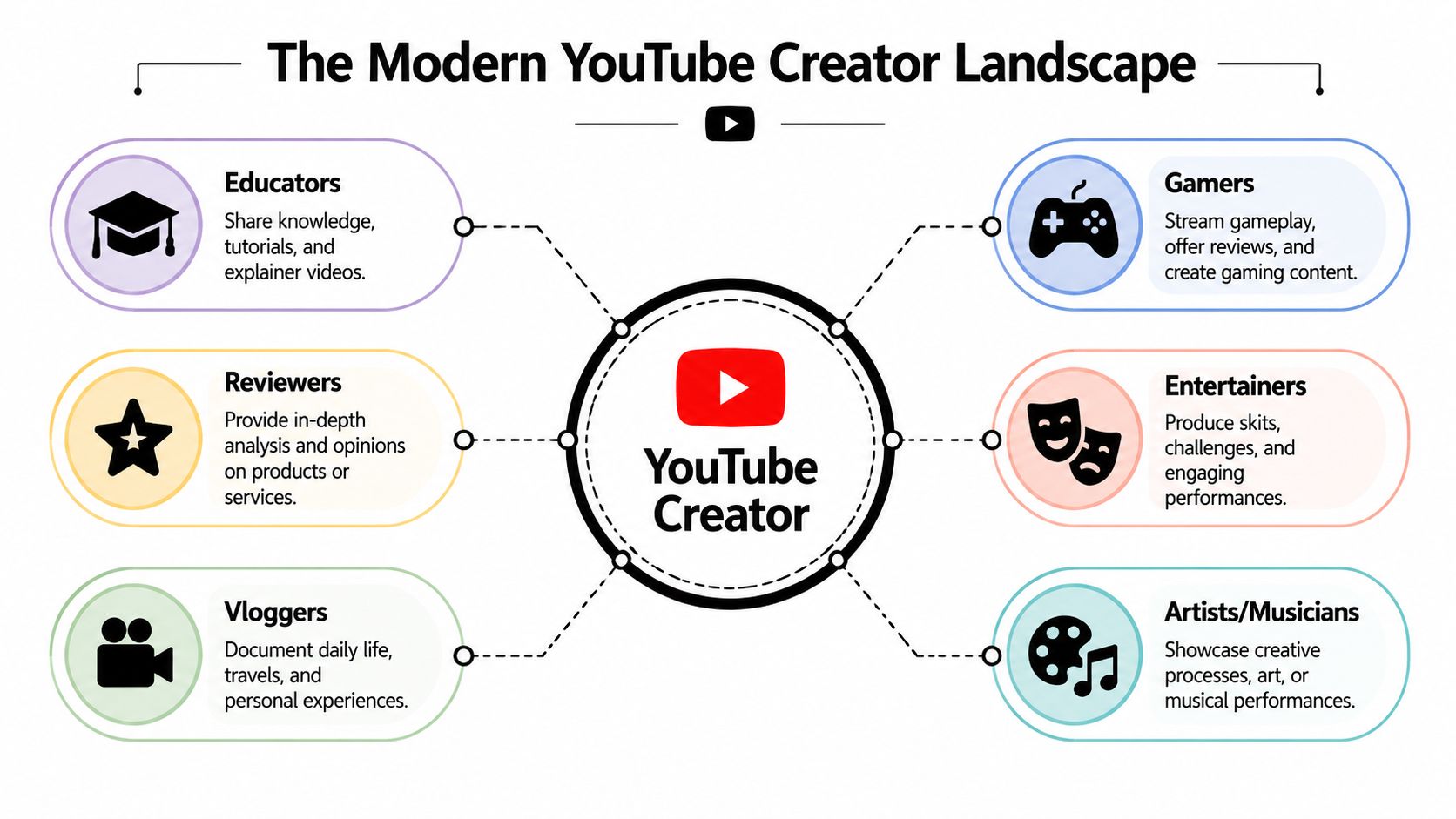
A creator opening YouTube today sees a crowded field, but the crowd is organized. One channel teaches, another reviews, another builds around personality, and another publishes at high volume with a faceless format. That mix exists because the platform is huge, with about 69 million active creators worldwide publishing for an audience of 2.6 to 2.7 billion monthly active users, while 500 hours uploaded every minute keeps new videos entering the system constantly. In that kind of environment, broad positioning gets buried fast, while a clear role gives viewers a reason to remember you.
Where different creator types fit
An educator answers a question clearly and repeatedly. These channels usually work best when the viewer has a problem to solve, a skill gap to close, or a need that cannot wait. A reviewer helps people choose between options, which makes this format a strong fit when trust, comparison, and purchase decisions matter more than pure entertainment.
A vlogger sells continuity and personality. Viewers return for the person as much as for the topic. Gamers and entertainers rely heavily on community, reactions, and repeatable formats. Artists and musicians bring process, identity, and creative performance into the channel.
That split is useful because it points to the actual trade-off behind format choice. If your topic depends on explanation, educational content gives you the cleanest path. If your strength is taste, comparison, or buying guidance, reviews fit naturally. If your strongest asset is presence, personality, or on-camera comfort, vlogging or entertainment gives you room to build loyalty over time.
A channel can also mix forms without becoming confused. A faceless channel can still teach, entertain, or review products and ideas. The format matters less than whether each video meets a specific viewer expectation and delivers on it consistently.
Trend awareness helps too, especially if you want a scalable channel that can adapt without rebuilding from scratch. A practical place to check what's trending on YouTube is useful because viewer demand moves faster than new creators usually expect, and the topics that fit your format can change from week to week.
The real decision behind niche choice
The best niche is rarely the one that sounds most creative. It is the one you can keep producing without stalling out. A good creator lane has enough depth for repetition, enough audience interest to justify the work, and enough room for formats you can sustain with your available time and tools.
If you are still deciding, use a simple order. First, identify what you can make consistently. Second, identify what viewers will repeatedly search for or binge. Third, look for a series structure, because a channel built around a repeatable series is easier to maintain than a string of one-off ideas.
How YouTube Creators Make Money
YouTube money usually starts with ad revenue in people's minds, but that is only one lane. The platform's ad business was estimated at over 40 billion in 2025**, and top creator earnings can reach extraordinary levels. MrBeast has been reported at **424 million subscribers** and around **85 million annually in one compilation, according to Twinstrata. That scale is real, but it does not mean every channel should think about money the same way.
The four revenue paths that matter
The first path is the YouTube Partner Program. For most creators, this is the first formal milestone, and the threshold serves as a practical assessment. You need 1,000 subscribers and 4,000 public watch hours or 10 million Shorts views to qualify, and that is only the starting line, not the finish.
The second path is affiliate marketing. This works best when your audience is already making purchase decisions, because you are helping viewers choose software, gear, books, or tools. It is usually stronger for review channels, tutorial channels, and niche educators.
The third path is brand sponsorships. These tend to favor channels with trust, a defined audience, and content that matches a company's message. Sponsorships can be powerful, but they are often inconsistent if your channel does not have a clear niche or dependable viewer profile.
The fourth path is products or services. That can mean digital downloads, templates, consulting, coaching, courses, or a membership layer. This model is often the most controllable, because you own the offer instead of waiting on ad rates or sponsor budgets.
Practical rule: do not wait for one income stream to save the channel. Build a sequence, not a wish.
YouTube Monetization Models Compared
| Monetization Model | Requirements | Earning Potential | Best For |
|---|---|---|---|
| YouTube Partner Program | Monetization eligibility, watch demand, and channel compliance | Scales with watch volume and format mix | Channels with steady publishing and strong retention |
| Affiliate marketing | Clear product fit and viewer trust | Depends on relevance and click intent | Reviews, tutorials, educational channels |
| Brand sponsorships | Audience clarity and brand-safe content | Varies by niche and channel strength | Established creators with predictable topics |
| Products or services | A valuable offer and audience problem fit | Can be highly flexible | Experts, educators, consultants, and niche creators |
Short-form has changed the money conversation too. YouTube Shorts now generate over 200 billion daily views in industry reporting, which means discovery is huge even if revenue per view often feels different from long-form. That is why many creators use Shorts for reach and longer videos or offers for monetization.
For a practical breakdown of short-form income mechanics, YouTube Shorts revenue is worth reading alongside your own channel numbers.
Your Step-by-Step Creator Launch Roadmap
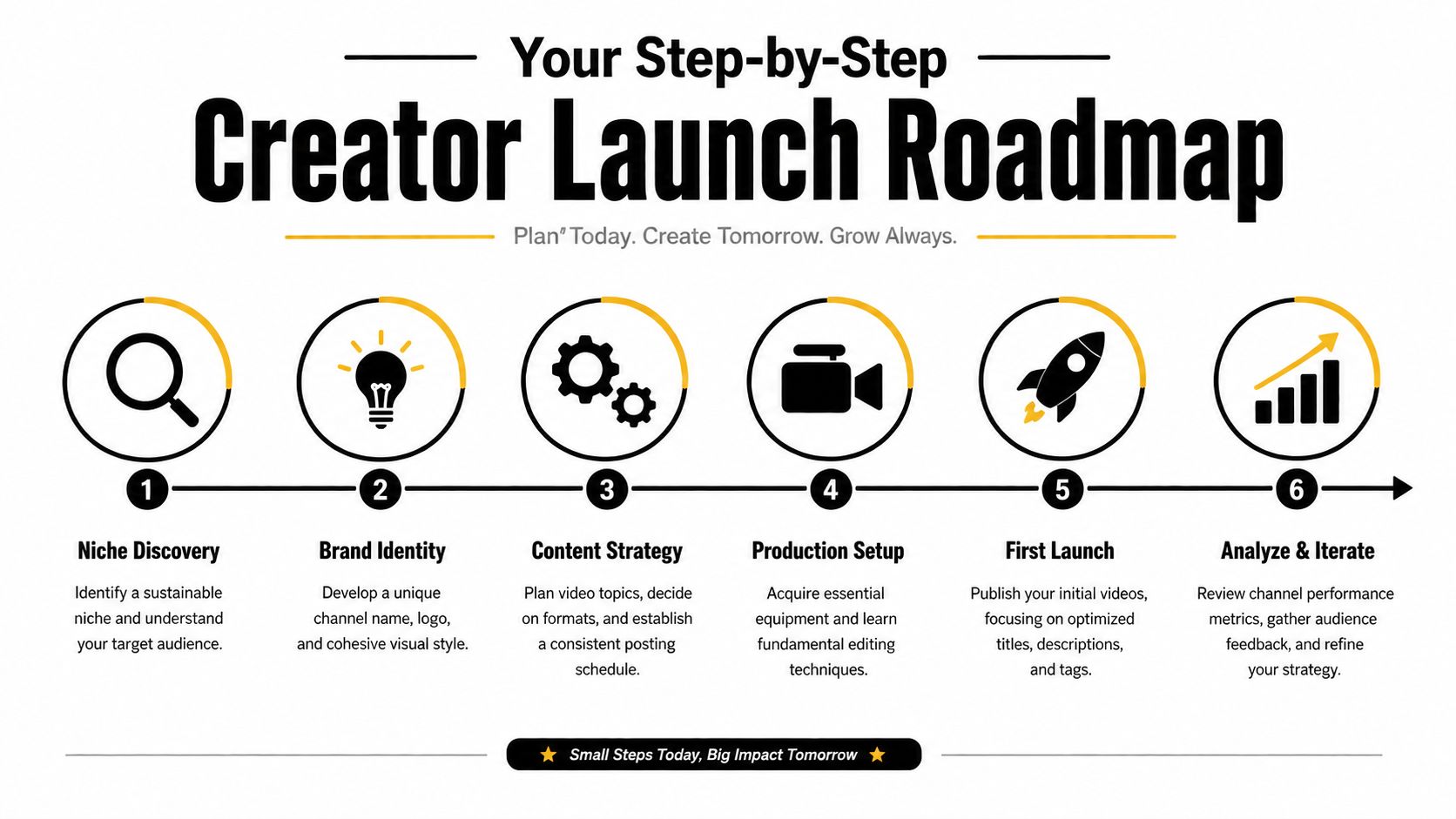
The first month on YouTube gets messy fast if you try to do everything at once. A better launch plan keeps the scope tight enough to finish, then simple enough to repeat while you learn what viewers respond to.
Start with one clear viewer problem
Choose a niche that gives you at least ten usable video ideas without forcing fake enthusiasm. The goal is a workable topic, not a perfect one. If the topic can support tutorials, commentary, summaries, or stories, it is usually strong enough to test.
Then define the viewer with precision. Do not write for “everyone who likes videos.” Write for the person who has a specific reason to click, whether that is a busy beginner, a hobbyist, a professional, or a collector. The more clearly you can name that person, the easier your titles, hooks, and offers become.
Build a channel that looks intentional
Your name, banner, and description should all point in the same direction. Keep the design simple and readable. Viewers should understand the channel topic within seconds.
Set up structure before polish. Create a basic upload template, decide your video length range, and outline the first batch of topics. That gives you enough direction to start without re-deciding the format every time you sit down to publish.
Use the simplest production stack that works
A smartphone is enough to start. Faceless channels can work without a camera at all if the scripts, voice, visuals, and pacing are strong. The real test is not how polished the setup looks, it is whether the format lets you publish again and again without friction.
For channels built around search, topic choice and packaging matter as much as the video itself. A practical approach to YouTube and Google video SEO helps you line up the subject, the title, and the viewer intent before you record.
The fastest way to stall is to keep “improving” before you publish. Put out the first version, learn from it, and fix the weak point in the next one.
A practical first-month checklist
- Choose one niche: keep it narrow enough to generate ideas, wide enough to avoid boredom.
- Write ten video ideas: pick the easiest three to make first.
- Create one channel identity: use one style for banner, thumbnail, and title voice.
- Publish on a repeatable schedule: consistency beats bursts of perfection.
- Review feedback after each upload: track what viewers respond to, not what you hoped they would.
If you want a concrete example of turning that workflow into a video pipeline, this walkthrough on content creation automation is directly relevant.

The Art and Science of YouTube Growth
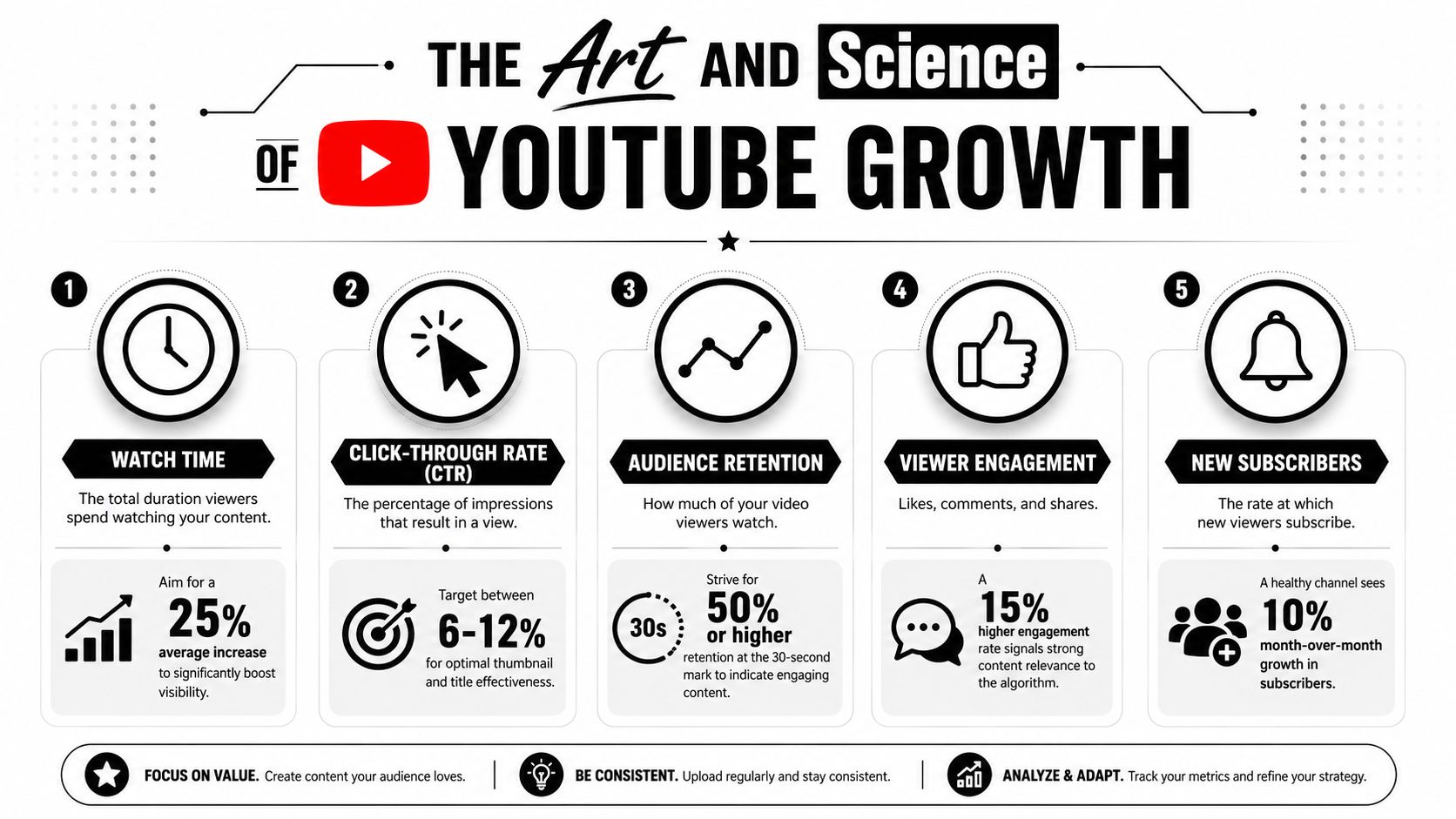
Growth on YouTube is not mysterious once you stop obsessing over subscriber count as the main signal. Viewers click because the promise looks relevant, then they keep watching because the delivery matches the promise. That's why the most useful numbers are the ones tied to attention.
Clicks get you in the door
Your title and thumbnail create the first test. If they don't make sense together, the viewer hesitates. If they oversell the video, the click may still happen, but the session collapses early.
Think of the thumbnail as the front of the store and the title as the sign on the door. Both need to promise something specific. The best creators don't use either as decoration, they use them as positioning tools.
Retention tells you if the video actually worked
Once someone clicks, the job is to keep them there. For Shorts, creators should target over 70% percentage viewed for strong performance, while captions can retain viewers 30 to 40% longer, and the first 0 to 3 seconds matter most for the hook (Fluxnote). Those are useful benchmarks because they shift your focus from “Did people see it?” to “Did people stay?”
The same logic applies to long-form, even if the exact pacing changes. Cut the intro fluff, show the payoff early, and remove any section that delays the reason people clicked.
Practical rule: if the opening doesn't earn attention fast, the rest of the edit is fighting uphill.
For deeper title, description, and metadata work, a solid resource on YouTube and Google video SEO can help you connect packaging with search intent.
Use YouTube Studio like a feedback loop
YouTube Studio should not feel like a scoreboard. It should feel like a diagnostic tool. If viewers click but leave fast, the packaging may be stronger than the content. If viewers stay but don't click, the video may be valuable but under-positioned.
The key is to compare videos against each other instead of chasing one perfect number. A channel grows when each upload teaches the next upload something specific.
Scaling Production with Workflows and Automation
The biggest bottleneck for most creators is throughput. A strong idea can still stall if every upload starts from zero and runs through the same exhausting cycle of brainstorming, scripting, voice recording, editing, captioning, and scheduling.
Treat production like an assembly line
A scalable workflow breaks production into separate stages. One stage handles research, another handles scripting, another handles voice, another handles visuals, and another handles publishing. That structure matters because repetition gets easier when each step has a clear owner, even if that owner is a tool rather than a person.
AI-assisted and faceless formats become practical, not trendy. The goal is not to make content look automated. The goal is to automate the repetitive parts so the creator can spend more energy on topic selection, voice, and audience fit.
Quality still decides whether the system works. For creators using AI, the key question is whether the output survives quality checks and viewer skepticism. Top-performing automated channels usually rely on narrative Shorts, micro-lessons, or templated storytelling, not recycled filler, because YouTube penalizes content that feels low-effort or reused (Subscribr).
A useful next step is to map the pieces you can standardize, then look at content creation automation as a way to reduce manual handoffs without flattening the channel's voice.
Use tools that reduce friction, not judgment
A workflow tool can help with scripting, subtitles, voiceover, and video assembly, but it should still leave room for human choices. That balance matters because YouTube audiences notice when a channel feels empty, even if the edit is clean.
If you want a wider view of the tool stack, AI software for content workflows can help you compare scripting and production support without turning the channel into generic output.
For creators who want one system instead of a stack of disconnected tools, ClipCreator.ai is one example of a platform that automates short, faceless video creation and scheduling for social channels. That kind of setup can help creators test repeatable formats without rebuilding the same workflow every time.
Build for consistency, not heroic sprints
Automation should lower the cost of making one more good video. It should not turn the channel into faster garbage. When the process is easier, you can test more angles, learn faster, and keep the channel active without spending every weekend on production.
That matters for Shorts, where rapid testing is part of the job and format repetition is normal. A strong workflow keeps the creative decisions in your hands while removing the most tedious steps.
Avoiding Burnout and Staying Consistent
The creator economy can make patience feel optional, but it isn't. A small share of channels capture most earnings, and reaching YouTube's monetization threshold, 1,000 subscribers and 4,000 watch hours or 10 million Shorts views, is only the first gate on a longer path to real financial stability (YouTube Creator commentary). That reality changes how you should think about pace.
The creators who burn out fastest usually do three things. They check metrics too early, they compare their beginning to someone else's highlight reel, and they build a process they can't sustain for more than a few weeks. None of that means the channel is failing. It usually means the system is too heavy.
Keep your standard high, but keep your expectations realistic. A channel grows through repeated publishing, not a single lucky upload. If a format drains you every time, simplify it before your motivation disappears.
A sustainable channel is one you can still run on an average week, not just on a good one.
The strongest mindset is practical: publish, observe, adjust, repeat. When you stop treating every upload like a verdict on your talent, the work gets lighter and the results get clearer.
If you're ready to turn an idea into a repeatable YouTube system, start building your next faceless or AI-assisted video today with ClipCreator.ai.

Create your first video in under 2 minutes
Pick a niche, and ClipCreator.ai generates and auto-posts faceless videos to your channels every day.
Join ClipCreator.ai