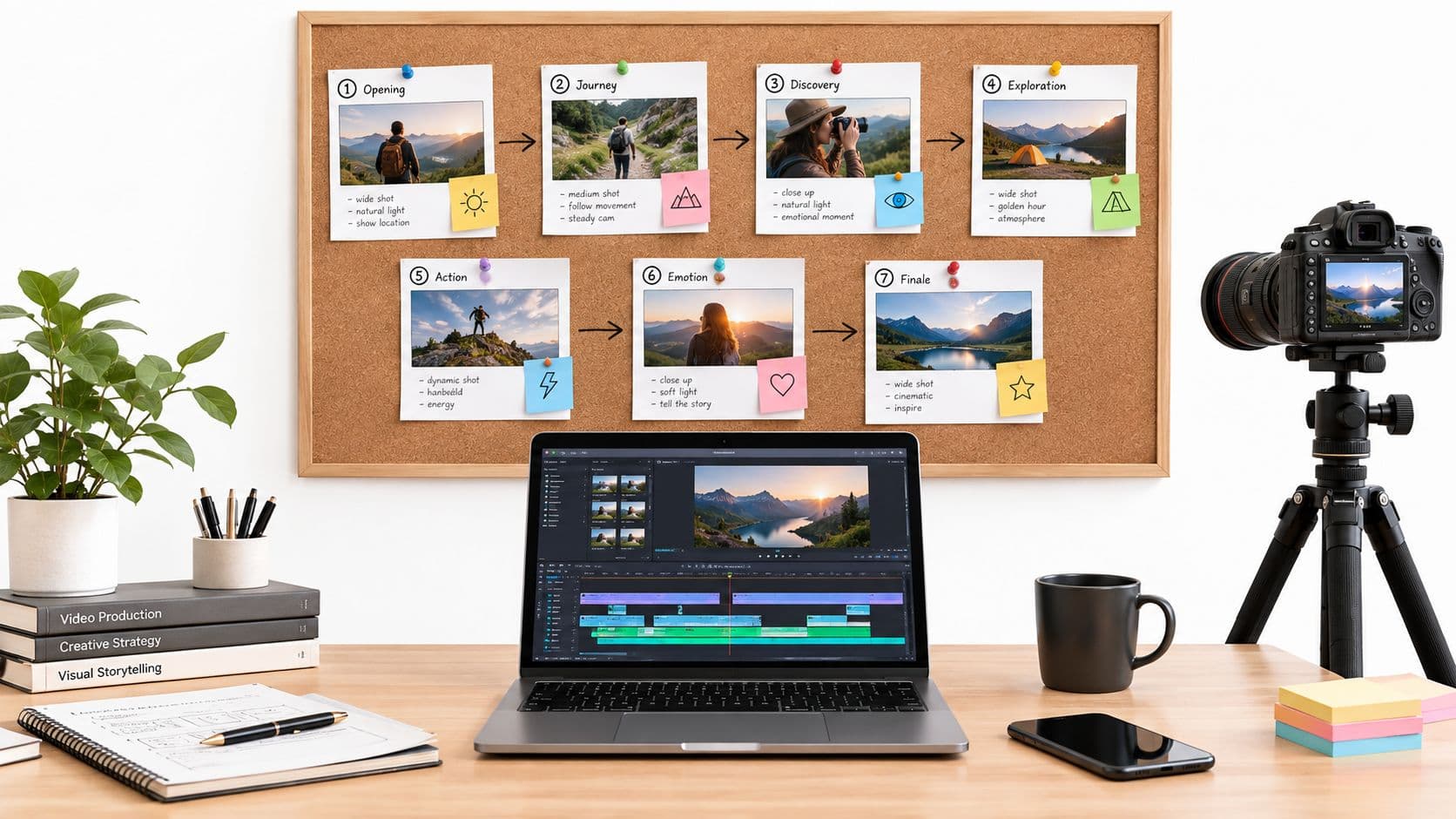
You've probably had this moment already. A dumb, very specific joke pops into your head, maybe “Napoleon as a food delivery app courier” or “a toaster recording breakup-vlog confessionals,” and for ten seconds it feels like a perfect short. Then the work shows up. You'd need footage, a voice, captions, cuts, sound, and enough patience to wrestle a vertical edit into something that doesn't feel dead on arrival.
That's where most funny short-form ideas get abandoned.
The reason AI video has become such a practical shift for creators isn't just speed. It's that the entire chain, script, visuals, voiceover, captions, and publishing, can now be treated like one workflow instead of five separate jobs. By October 2025, AI video generators like Sora 2 and Google Veo 3 had evolved into tools that turn text prompts into polished, lifelike 1080p funny videos optimized for vertical formats such as Instagram Reels and YouTube Shorts, according to Boreal Times on AI video generators in 2025.
The catch is that most AI funny video tutorials stop at “type a prompt.” That's not where good comedy happens. Funny clips win on premise, rhythm, and structure. The generation step matters, but the key difference between a clip people watch twice and one they swipe past is whether the joke escalates properly and lands on time.
From Funny Idea to Viral AI Video
Most creators don't fail because they lack funny ideas. They fail because the workflow is annoying enough to kill momentum.
A typical sequence goes like this. You think of a joke during lunch, save it in Notes, tell yourself you'll film it later, then realize later means setting up lighting, recording bad takes, trimming pauses, hunting for music, and adding captions one by one. By then the joke feels colder than it did in your head.
An AI funny video workflow changes that equation. Instead of asking, “Can I film this?” you ask, “Can I describe this clearly enough for the machine to build it?” That's a much better question for short-form creators, especially if your humor relies on impossible scenes, surreal reactions, or character concepts that would be expensive or awkward to shoot.
What the efficient workflow looks like
The practical version is simple:
- Start with one joke engine. Not a whole universe. One repeatable comic format.
- Write a short script with a clear turn. Setup, escalation, punchline.
- Generate visuals that support the bit. Don't let the images wander away from the joke.
- Choose a voice that adds contrast. Deadpan often beats “funny acting.”
- Edit for rhythm. Most creators skip this and wonder why the clip feels flat.
- Post in a platform-native format. Vertical, readable, and fast.
If you already publish short-form content, this should feel familiar. The principles don't change just because the footage is synthetic. Strong hooks, readable subtitles, clean openings, and clear endings still matter. If you want a grounded refresher on the distribution side, these video marketing best practices are worth reviewing before you push clips live.
Practical rule: AI saves production time. It doesn't save weak comedy.
What works and what doesn't
Here's the trade-off in plain terms.
| Approach | What happens |
|---|---|
| Random funny prompt | You get novelty, but not a memorable format |
| Repeatable premise | You build expectation, then reward it |
| Visual spectacle only | Viewers watch once and forget it |
| Structured joke | Viewers recognize your pattern and share it |
The creators getting traction with AI funny video aren't just generating “weird stuff.” They're building recurring comedic frames. Historical figures in normal office jobs. Household objects with emotional monologues. Animals behaving with corporate seriousness. Those ideas are easier to script, easier to prompt, and easier to turn into a series.
Finding Your Comedic AI Concept
The strongest AI comedy formats are narrow on purpose. Broad humor gets mushy fast. A specific premise gives you constraints, and constraints are useful because they force cleaner jokes.
A good concept answers one question immediately: what kind of funny is this? If the viewer can't tell within the first seconds, the clip usually drifts.
Use formats that repeat cleanly
Start with a container, not a one-off joke. Good containers are easy to explain and easy to remake with fresh situations.
Some reliable examples:
- Historical figures in modern life. Lincoln ordering cold brew. Cleopatra running a skincare channel.
- Inanimate object diaries. A microwave explaining burnout. A stapler documenting office politics.
- Animals with human stakes. A raccoon defending its side hustle. A goldfish acting like a startup founder.
- Over-serious narration of absurd events. Documentary tone over nonsense behavior.
This works because the format does half the comedic labor. The audience understands the tension before the punchline arrives.

If you need raw idea prompts, a video topic generator for short-form niches is useful for pressure-testing whether your premise can become a series instead of a single post.
Build a tiny story, not just a joke
A lot of bad AI comedy is just a visual oddity with no movement. It may be weird, but it doesn't go anywhere.
Use this compact story arc:
- Setup. Establish the unusual premise quickly.
- Conflict. Introduce the problem, contradiction, or social tension.
- Resolution. End on a line or reveal that reframes what came before.
Example:
| Beat | Example |
|---|---|
| Setup | “Abraham Lincoln tries to order from a modern coffee menu” |
| Conflict | He keeps asking what “single-origin oat milk foam” means |
| Resolution | He orders plain drip coffee and calls it “a union-approved beverage” |
That's enough to support a sub-minute AI funny video.
Don't brainstorm “funny content.” Brainstorm friction. Comedy appears when a character's worldview collides with the setting.
Choose concepts that fit AI's strengths
AI excels at visual incongruity, heightened realism, and impossible pairings. It's weaker when your joke depends on subtle facial acting over a long scene or detailed continuity across many shots.
That means these concepts tend to work best:
- Short scenes
- Clear visual contrast
- One central character per beat
- Strong point of view
- A payoff that doesn't require perfect continuity
Bad fit:
- Long dialogue scenes
- Crowd blocking
- Tiny emotional shifts
- Complex action sequences that must remain visually consistent
Good fit:
- Fake interviews
- Character confessionals
- Diary formats
- News reports
- Micro-sketches with a single comic turn
Writing an AI Script That Lands the Punchline
The script carries the joke. If the writing is vague, the visuals can't rescue it.
This matters even more for branded humor. According to Funnel Gator's guide to funny AI videos for content marketing, only 25% of current guides address the tension between brand-aligned humor and viral, internet-native comedy, and humor misaligned with brand voice can reduce engagement by 40% for B2B audiences. That's the actual scripting challenge. Not “can AI write something funny,” but “can it write something funny that still sounds like us?”
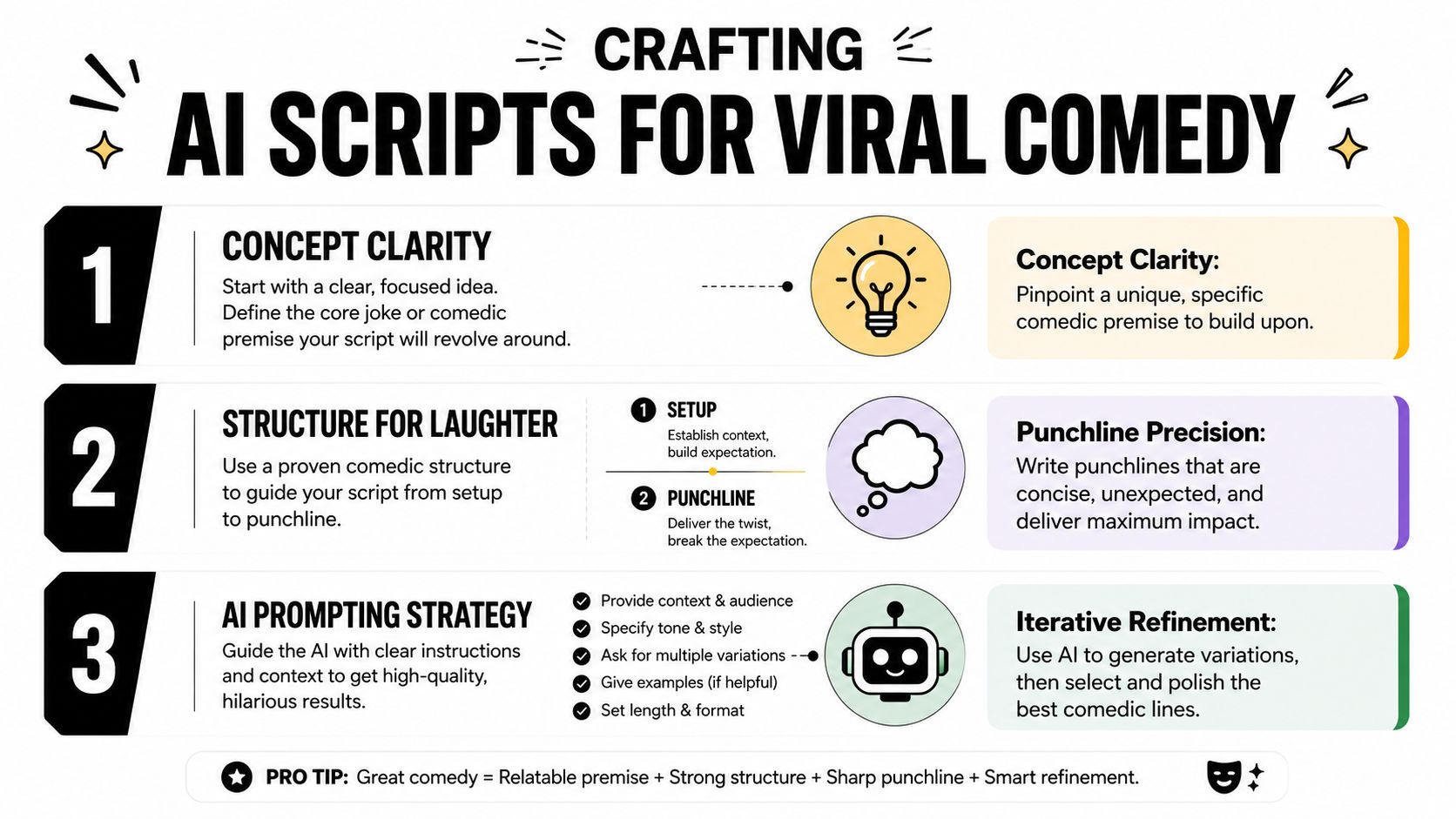
If you want a stronger drafting process before you generate visuals, a dedicated AI script writing tool for short-form video helps tighten structure before you move into production.
The three-part script pattern that usually works
For short AI comedy, I keep scripts built around three beats:
- Open on the premise immediately
- Escalate once or twice
- Exit as soon as the joke peaks
That last point matters. Overwritten comedy dies in the last ten seconds.
Here's a simple prompt template you can paste into a scripting model:
Write a 45-second vertical short comedy script.Premise: A Roman emperor is trying to understand app notifications.Tone: Dry, observational, smart but internet-native.Structure: Fast setup, two escalating misunderstandings, one concise punchline.Voice: Deadpan narrator plus the emperor's lines.Avoid: Slang overload, cheesy jokes, long exposition.End with a final line that feels caption-worthy.
That prompt works because it specifies premise, tone, structure, voice, and constraints. Most weak outputs come from leaving one of those five blank.
How to keep the humor on-brand
If you're creating for a business, educator account, or client, don't ask the model for “viral humor.” That usually produces generic meme tone. Ask for brand-safe tension.
Try this instead:
- State the brand voice plainly. Calm, authoritative, witty, playful, academic, skeptical.
- Define the red lines. No sarcasm, no insult comedy, no trend slang, no chaotic tone.
- Name the comic device. Irony, exaggeration, deadpan contrast, misunderstanding, role reversal.
- Specify who's speaking. Narrator, mascot, customer archetype, historical character, object.
Example prompt:
Write a humorous 30-second script for a small accounting brand.Use dry irony, not absurd randomness.The joke should come from a spreadsheet acting like an overworked employee.Keep the language simple, brand-safe, and useful for a professional audience.End with a line that feels relatable, not edgy.
A strong joke script has one job per line. Setup, pressure, turn, payoff. If a line does none of those, cut it.
Script mistakes that flatten the video
Here's what usually doesn't work:
- Too much setup. If it takes too long to explain the world, the viewer scrolls.
- No escalation. One funny idea repeated three times isn't a structure.
- Verbose punchlines. The best closing line is usually shorter than you want.
- Voice mismatch. Hyperactive writing paired with dead visuals creates drag.
- Brand overcorrection. If every line sounds approved by committee, nobody laughs.
A cleaner approach is to write three candidate punchlines for every concept, then build the video around the strongest one. Reverse engineering the ending often produces better pacing than writing from the start and hoping the joke arrives.
Generating Story-Aligned Visuals and Voiceovers
Once the script is working, your visuals should do one thing: reinforce the joke without stealing focus from it. That sounds obvious, but many AI clips often devolve into chaos. The image generator starts improvising a different comedy style than the script.
In 2025, generative AI drove a significant surge in absurdist and surreal comedy, with hyper-realistic AI-generated parodies and satires becoming a dominant force in online funny videos globally, according to Reelmind's review of funny video trends in 2025. That trend is useful, but only if the surrealism is attached to a clear comedic point.
For creators comparing narration options, this guide to an AI voice generator is a useful reference point, especially when you're deciding whether the joke needs deadpan delivery, documentary polish, or character energy. If you want to go deeper on narration strategy, this breakdown of AI text-to-speech voices for video is also worth reading.
Prompt visuals for tone, not just objects
A weak visual prompt says:
“A cat in an office.”
A better one says:
“Photorealistic office cat in a tiny wrinkled button-down shirt, sitting at a cluttered desk under harsh fluorescent lighting, looking quietly disappointed, cinematic framing, vertical composition.”
The second prompt adds comic information. It tells the model what emotional register the image should hold.
Use this structure:
| Prompt part | What to specify |
|---|---|
| Subject | Who or what is in the frame |
| Setting | Where the scene happens |
| Tone | Deadpan, dramatic, sincere, corporate, documentary |
| Comedic contrast | Why the image is funny |
| Camera direction | Close-up, interview shot, handheld, security cam |
| Format | Vertical, centered, readable for captions |
Keep each shot loyal to the script beat
Don't generate all visuals with one giant prompt. Generate by beat.
For a three-beat joke, create:
- Shot 1 for setup
- Shot 2 for escalation
- Shot 3 for payoff or reaction
That gives you more control over pacing and keeps each image from becoming visually overloaded.
A practical set of prompts for “toaster breakup diary” might look like this:
- Setup“Photorealistic chrome toaster on a kitchen counter at night, close-up, soft moody light, filmed like a confessional interview, vertical format.”
- Conflict“Same toaster, slightly burnt toast beside it, dramatic kitchen lighting, emotional documentary style, subtle absurdity.”
- Punchline“Extreme close-up of toaster slot with one untouched bagel nearby, serious cinematic framing, visual tone of betrayal.”
Voiceover should create contrast
Most creators overact the voice. That weakens the joke.
The funniest delivery is often:
- calm over chaos
- sincere over absurdity
- instructional over nonsense
- corporate over emotional meltdown
If your script is already ridiculous, a restrained voice gives the viewer space to process the mismatch. That's where laughter usually appears.
The best AI voice for comedy often sounds like it doesn't know it's in a joke.
Pick one vocal identity and keep it consistent across a series. If every clip sounds different, your format feels less intentional. A recurring narrator, even in faceless content, becomes part of the brand memory.
Assembling Your Video for Perfect Comedic Timing
This is the part most tutorials skip, and it's the part that decides whether the clip succeeds.
According to Crepal's analysis of AI funny video creation, the underserved angle of comedic timing and rhythm is a critical gap, and 60% of AI-generated comedy fails because it lacks the pacing and jump-cut rhythm human editors instinctively apply. That matches what you see in the feed. Plenty of AI clips look polished. Far fewer feel funny.
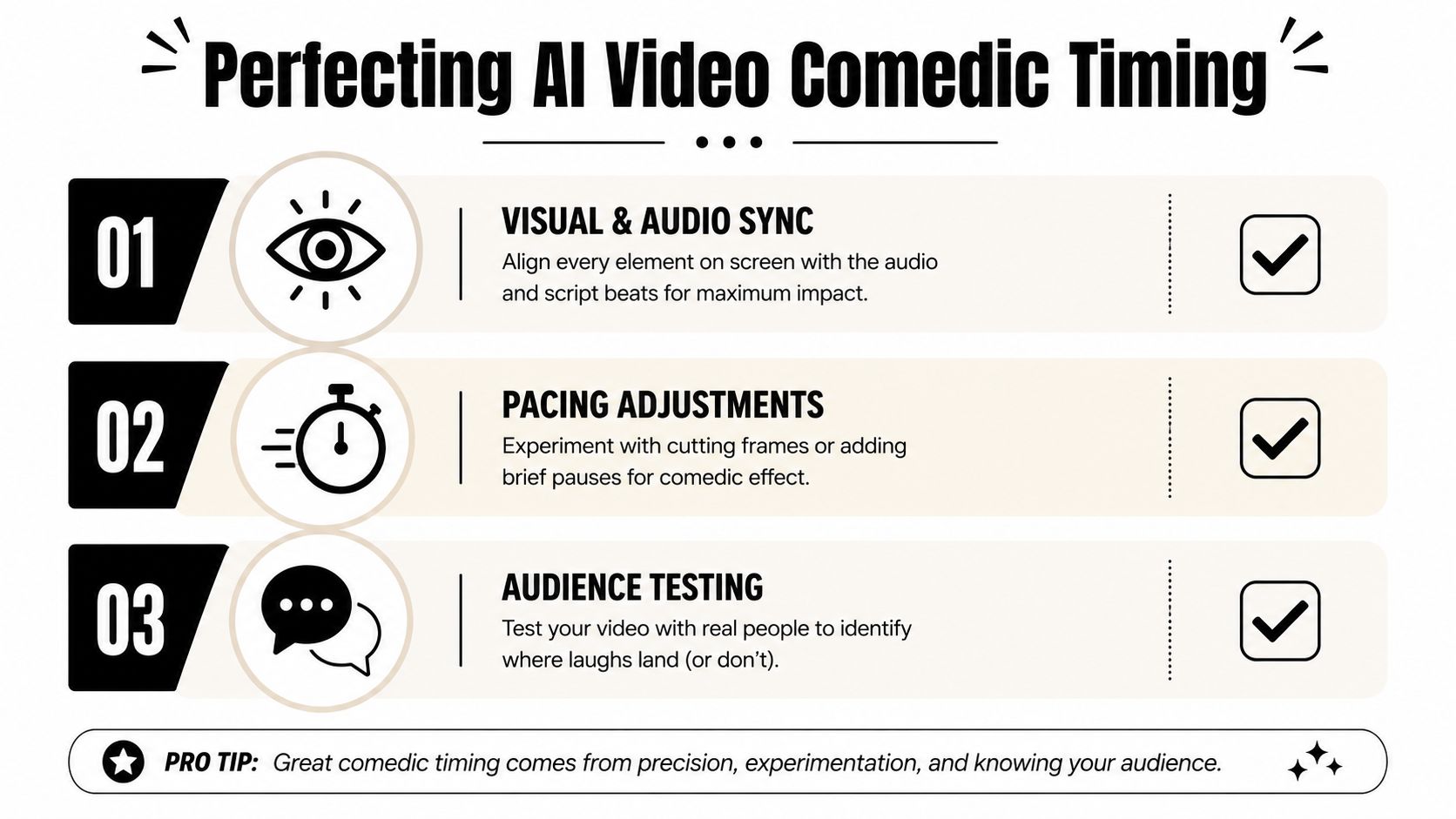
A quick visual breakdown helps if you want to study how pacing changes the same material from flat to sharp.

If you work with clients or ad teams that care about polished short-form execution, these Video advertising solutions in NYC show the level of production thinking worth borrowing, even when your footage is AI-generated.
Rhythm beats realism
The mistake is assuming smoothness equals quality. In comedy, smooth can be worse.
Good comedic edits often include:
- abrupt cut-ins
- short reaction holds
- a micro-pause before the payoff
- captions that hit on the stressed word, not just the spoken word
- visual interruption right after a serious line
Think in beats, not scenes.
A simple timing map:
| Beat | Editing move |
|---|---|
| Hook | Open on the strangest clear image immediately |
| Setup line | Keep the shot stable long enough to establish context |
| Escalation | Cut faster as the absurdity increases |
| Punchline | Insert a brief pause before the final line |
| Aftershock | Hold the reaction just long enough to register |
Captions are part of the joke
In an AI funny video, captions aren't accessibility garnish. They're timing tools.
Use captions to:
- isolate one key phrase
- enlarge the reveal word
- delay visual emphasis by a fraction
- create a second layer of deadpan
For example, if the line is “He didn't want breakfast. He wanted closure,” don't style both clauses equally. Let “closure” arrive with emphasis. That's where the laugh turns from possible to likely.
Editing note: If the joke feels almost funny, trim frames before rewriting lines. Timing problems often masquerade as writing problems.
Where automation helps and where it doesn't
Automation helps with sequencing, subtitle generation, and keeping a repeatable format. It doesn't replace judgment about where the laugh should happen.
The best workflow is hybrid thinking:
- let AI generate assets fast
- let templates handle recurring structure
- make deliberate timing decisions on the moments that matter
That's the overlooked skill. Not “using AI,” but directing rhythm inside the AI workflow.
Posting and Optimizing for Social Media
A strong clip can still disappear if the packaging is sloppy. Social platforms don't reward effort. They reward clarity, retention, and repeatable output.
Your caption, title framing, on-screen text, and posting cadence should all support the same question: why should someone stop for this specific joke right now?
Platform habits that help
On TikTok, the opening frame matters most. Lead with the visual contradiction, not a branded intro or scene-setting text. If the joke is “Victorian ghost gives productivity advice,” the first frame should already show that character.
On Instagram Reels, clean visual composition and readable subtitles matter more than people admit. Reels gets watched with and without sound, so the premise needs to read instantly.
On YouTube Shorts, a more explicit setup can work if the hook is still fast. Shorts viewers often tolerate a slightly more narrative opening when the payoff is clear.
A practical posting checklist
- Use broad and niche tags together. Pair category tags like funny video or AI video with premise tags tied to your format.
- Write captions that invite a response. Ask who should be in the next episode, or which version of the character people want next.
- Keep cover text simple. One premise, one joke frame. Don't summarize the whole video.
- Post in series, not isolated experiments. Audiences remember recurring formats faster than random one-offs.
- Review retention manually. Rewatch your own opening three seconds and ask whether the joke is visible before the explanation starts.
What to change when a clip underperforms
Don't rebuild everything at once. Diagnose the actual weak point.
If viewers don't stop, the problem is usually the premise presentation.If they stop but don't finish, the problem is often pacing.If they finish but don't share, the concept may be amusing but not distinct enough to repeat.
That's why consistency matters. A single AI funny video can be luck. A repeatable comedy format tells the platform, and your audience, what you make.
The creators who grow with AI aren't the ones generating the most clips. They're the ones refining one format until it becomes recognizable.
If you want to turn funny concepts into finished vertical videos without stitching together separate tools for scripts, visuals, voiceovers, subtitles, scheduling, and posting, ClipCreator.ai is built for that exact workflow. It's especially useful when you've already figured out your comedic format and want to produce faceless short-form content faster, more consistently, and with less manual editing friction.

Create your first video in under 2 minutes
Pick a niche, and ClipCreator.ai generates and auto-posts faceless videos to your channels every day.
Join ClipCreator.ai