You open YouTube, search Toy Story videos, and immediately see the trap. Familiar characters. Huge view counts. Endless clips, fan edits, toy skits, recaps, and AI-made story variations. If you're a new creator, it's easy to think the path is obvious: make something close enough to what already works, publish fast, and ride the search demand.
That instinct makes sense. The problem is that popular intellectual property doesn't behave like a normal content niche. It pulls viewers in, but it also pulls automated enforcement, policy risk, and monetization problems right behind it. A lot of creators figure that out only after they've built a channel around assets they don't own.
The better play is to study why Toy Story-style content works, then build something original that captures the same emotional hooks without borrowing protected characters, designs, names, or audio. That's where faceless formats and AI-assisted production become useful, not as a shortcut to copy a franchise, but as a system for producing your own repeatable story world.
The Allure and Risk of Toy Story Fan Content
The temptation usually starts with a simple observation. Toy-based stories are everywhere, kids' content performs consistently, and recognizable characters lower the friction for clicks. A creator sees that demand and thinks, "If audiences already love toy adventures, why not make one more?"
That logic is fine until the content stops being inspired and starts being derivative. In the kids and story niche, over 60% of new YouTube channels face copyright strikes or monetization rejections due to unlicensed brand usage, according to the verified 2024 to 2025 industry data provided in the brief. That's the part most beginner guides skip. They either tell you where to watch the movies, or they give a vague "be careful with copyright" warning and move on.
What new creators usually get wrong
Most creators don't fail because they picked a bad topic. They fail because they confuse audience demand with permission to use the underlying IP.
A better way to think about it is this:
- View demand is real: audiences clearly like toy adventures, animated friendships, and recognizable archetypes.
- Ownership still matters: the fact that viewers search for a franchise doesn't give creators the right to reuse it.
- Sustainable channels need original assets: if you don't control the characters and story world, you're building on borrowed ground.
If you're trying to understand where community-driven formats fit into this, Gainsty's guide on what is user generated content is useful because it separates audience participation from actual rights ownership. Those are not the same thing.
Practical rule: Borrow the emotional formula, not the protected elements.
The safer mindset from day one
The strongest faceless channels don't ask, "How close can I get to Toy Story without getting caught?" They ask, "What do people love about Toy Story, and how do I turn that into something I own?"
That shift changes everything. Instead of copying characters, you build toy archetypes. Instead of using franchise search terms as your whole strategy, you build a repeatable content system around bedtime stories, toy adventures, mystery shorts, or preschool-friendly narratives. If you're still choosing a channel angle, this breakdown of best faceless YouTube niches helps frame toy-inspired storytelling as one niche among several scalable options.
Mapping the Toy Story Universe on YouTube
Search results for Toy Story videos on YouTube usually break into a few clear buckets. Understanding those buckets matters because each one attracts viewers for a different reason.
The franchise itself has enormous cultural weight. Toy Story has generated over $374.6 million worldwide from its original and re-released theatrical runs as of September 21, 2025, which helps explain why related fan content remains so active on YouTube (Toy Story franchise overview). When a brand sits that deep in audience memory, every trailer, recap, theory, and toy reenactment gets a head start on attention.
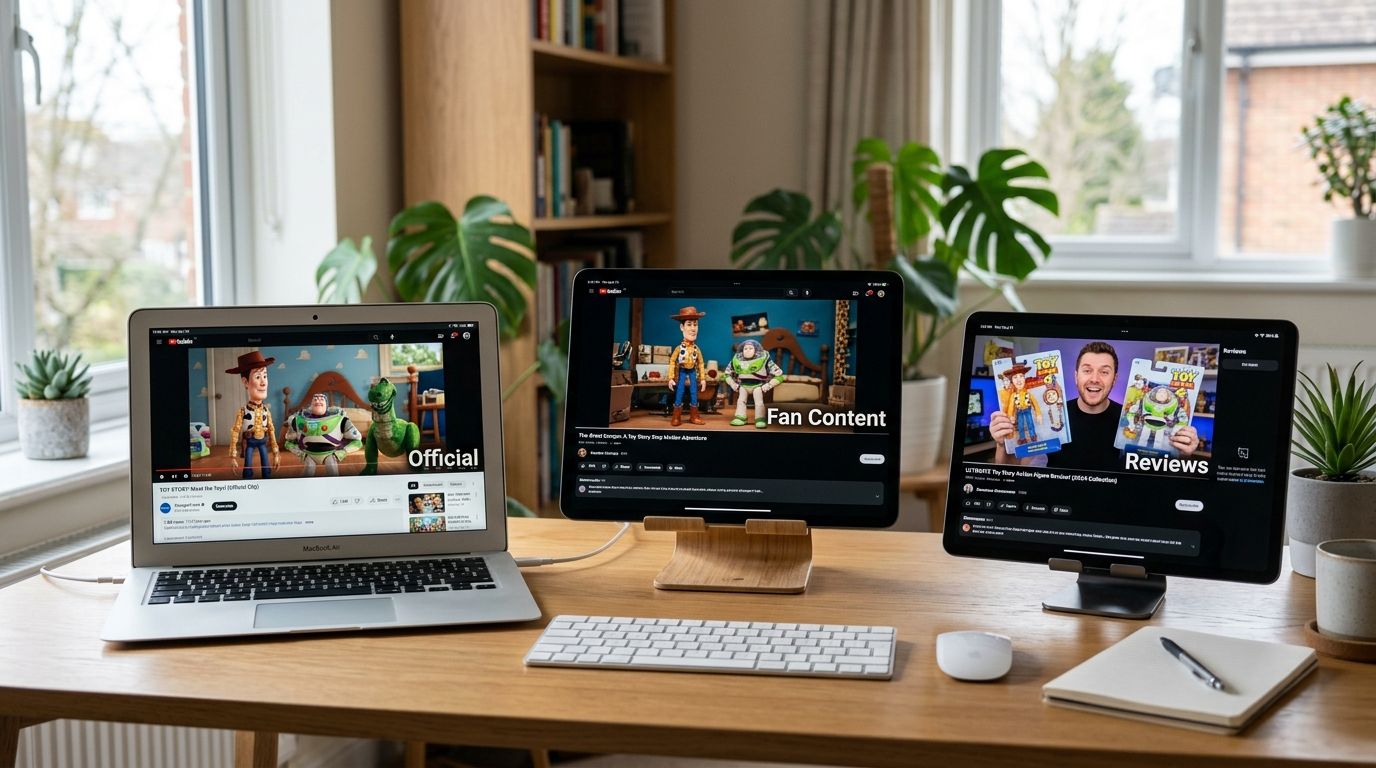
The three content buckets
Here's the competitive space most creators are competing in:
| Type | What viewers expect | Why it works | Risk level for creators |
|---|---|---|---|
| Official uploads | Trailers, promos, clips, franchise announcements | Built-in brand trust and nostalgia | Not a model most creators can replicate legally |
| High-effort fan work | Original animation, commentary, theories, parody | Fans want more time in the universe | Depends heavily on execution and legal exposure |
| Low-effort derivative content | Reuploads, clip edits, toy reenactments using brand elements | Fast click recognition | Highest long-term fragility |
Why these videos keep pulling attention
The keyword isn't strong just because people like a movie. It works because the content combines several proven audience triggers at once:
- Nostalgia: parents recognize the franchise instantly.
- Clear character roles: cowboy, space hero, comic sidekick, nervous friend.
- Built-in story tension: toys have goals, conflicts, and hidden lives.
- Merchandise overlap: toys themselves become props, products, and characters.
That's why toy review channels matter here too. The channel Kids Toy Story is described as a popular destination focused on unboxing and testing children's toys, which shows the enduring pull of toy-centered content even without on-camera personality as the main hook. That category remains a strong signal that audiences don't just want films. They want toy worlds, toy narratives, and toy-centered entertainment.
The useful lesson isn't "copy the franchise." It's "identify the repeatable ingredients that made the franchise compelling."
What to legally extract from the pattern
A creator can safely take the structure without taking the IP:
- Friendship under pressure
- Adventure from a small-scale world
- Distinct toy personalities
- Child-safe suspense
- A strong visual contrast between characters
Those are creative principles, not protected assets. If you learn to separate those two, your content strategy gets much stronger.
Understanding the Copyright Minefield for Creators
Most creators hear "Content ID" and think it's mainly about music. In practice, the risk is broader. Visual references, scene composition, character likeness, and recognizable voice lines can all create problems when the rights holder has a strong reference library.
Toy Story-themed YouTube videos face a 65 to 80% higher risk of automated copyright takedowns under YouTube's Content ID system compared to original animations, because Disney and Pixar's asset library includes exact matches for character models, voice lines, and scene compositions that trigger flags (copyright risk analysis).
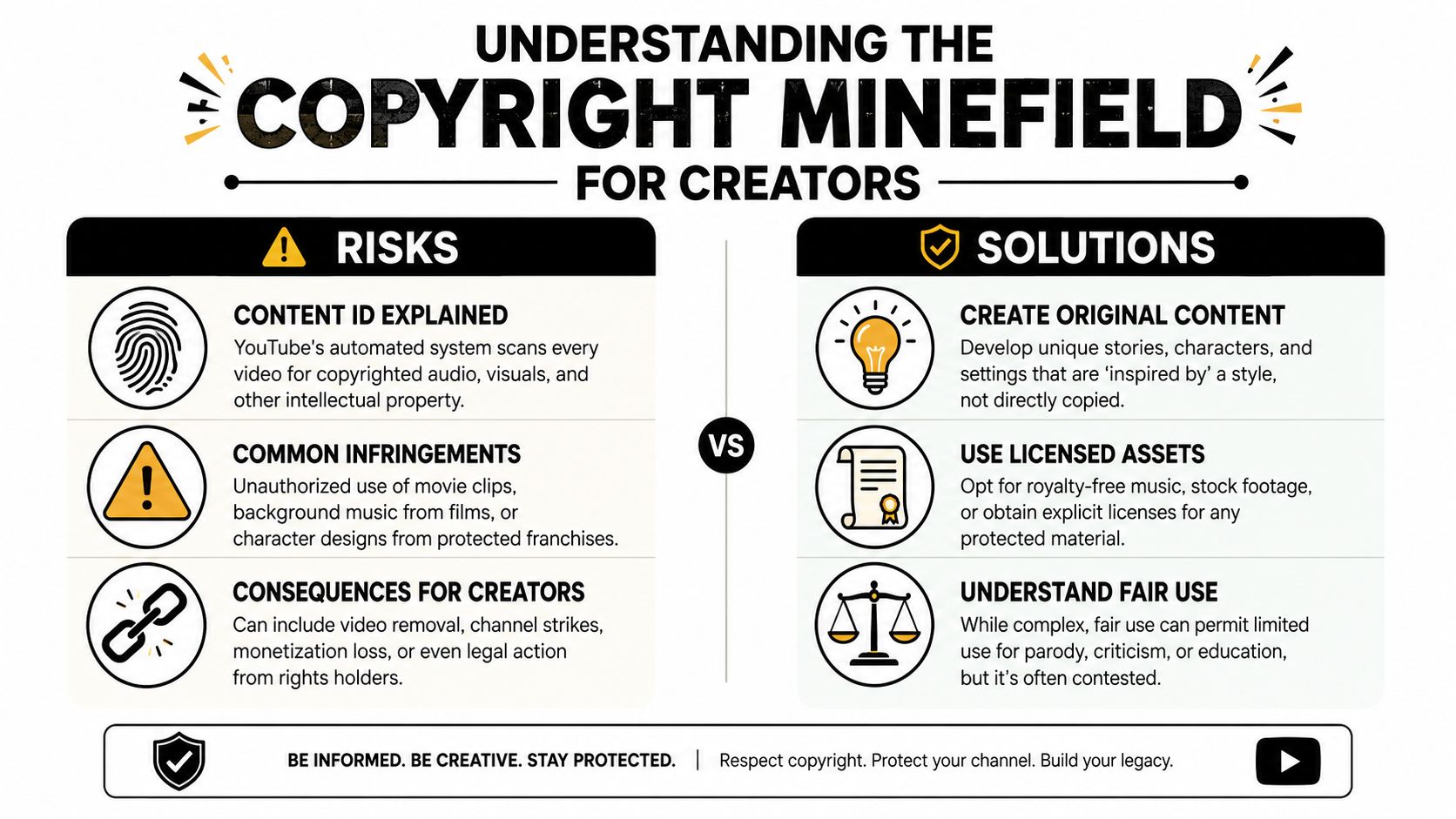
What triggers problems in practice
Creators usually think they're being creative when they're getting too close. Common examples include:
- Recognizable character design: changing a color or accessory doesn't automatically make a character original.
- Lifted audio cues: famous voice patterns, soundtrack clips, or recreated lines can still trigger enforcement.
- Scene recreation: copying the framing or sequence of a known movie moment can make the derivative link obvious.
- Brand-name dependence: using the franchise name as the core identity of the video invites review.
A lot of people also overestimate fair use. Commentary, criticism, and parody can sometimes qualify, but "I changed it a bit" isn't a legal standard. If you want a plain-English primer, ClipCreator's article on fair use guidelines is a practical place to start.
What enforcement actually looks like
It doesn't always arrive as a dramatic channel shutdown. More often it starts with friction:
- A video gets claimed.
- Revenue gets restricted or redirected.
- Distribution weakens because the upload becomes risky.
- The creator hesitates, edits around the problem, then repeats the same mistake on the next upload.
That loop kills momentum. For faceless channels, consistency matters, and copyright friction destroys consistency faster than almost anything else.
If your production system depends on content you can't safely own, your publishing schedule isn't stable.
The myth that "everyone else is doing it"
This is one of the most expensive assumptions on YouTube. You can find lots of infringing uploads in search results. That doesn't mean they're safe, monetized, or durable. It often means enforcement hasn't hit yet, or that the creator is tolerating a channel model with weak long-term value.
The channels that last don't build around what they can borrow. They build around what they can keep publishing for years.
The Smarter Path Producing Inspired Content Legally
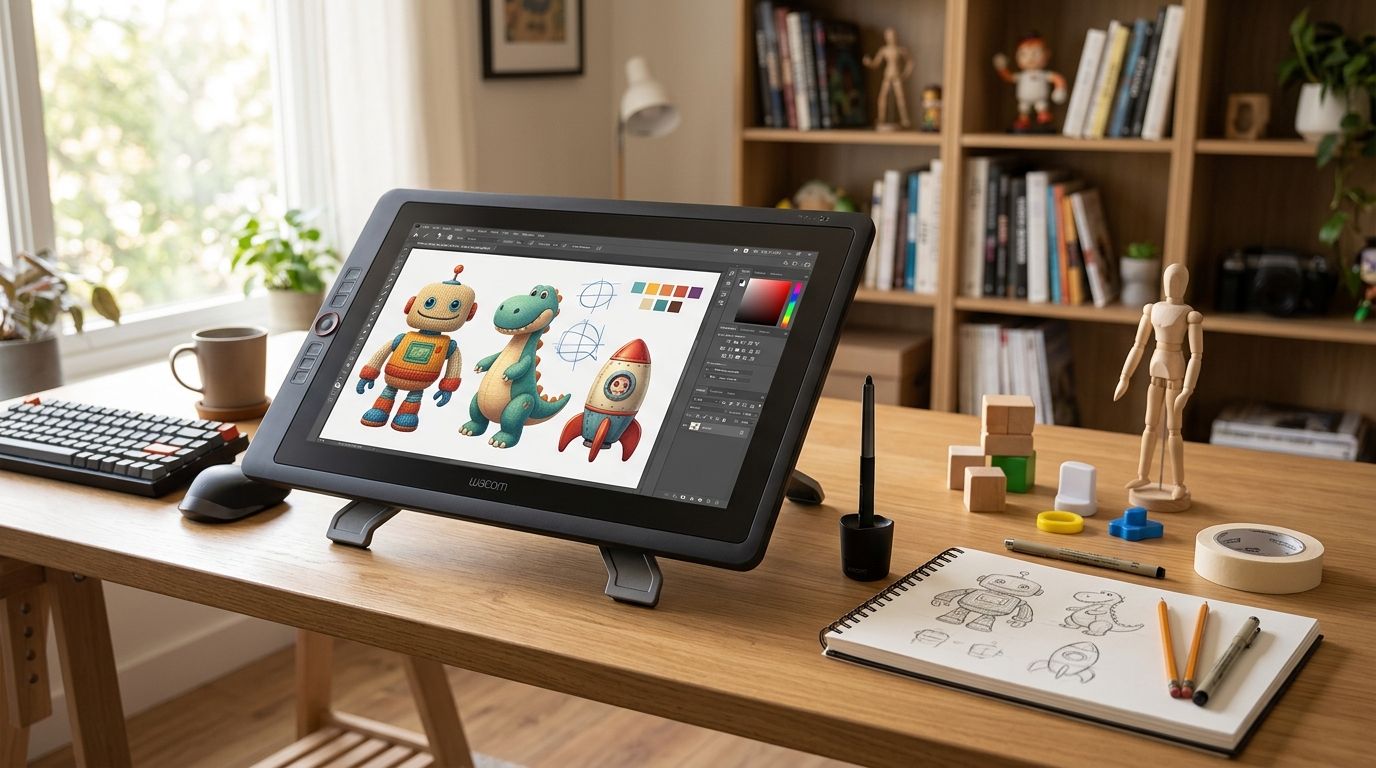
The better strategy is to make content that's inspired by toy adventure storytelling, not dependent on a famous franchise. That means using original characters, original names, original dialogue, and your own visual language while keeping the emotional mechanics that viewers already like.
This isn't a compromise. It's a business upgrade.
What inspired-by content actually looks like
A strong original toy story video might include:
- a brave wind-up astronaut who acts before thinking
- a cautious plush dinosaur who worries about every new place
- a forgotten playroom, a lost backpack, or a dark hallway as the setting
- a conflict built around loyalty, fear, or teamwork
None of that requires franchise characters. It just requires clear archetypes and a sharp premise.
Why this works better over time
The toy niche already proves that people will watch content centered on play, objects, and imaginative scenarios. The channel Kids Toy Story focuses on unboxing and testing toys and is described as a major player in that niche, which reinforces a simple point: audiences don't need a movie clip to care about toys. They need engaging presentation and a format that holds attention (Kids Toy Story channel profile).
That opens several lane choices for creators:
- Toy adventure shorts: mini story episodes with recurring original characters.
- Bedtime toy tales: softer pacing, gentle stakes, comforting endings.
- Funny object dramas: household items and toys interacting in small-world situations.
- Educational story hybrids: colors, routines, feelings, or problem-solving told through toy characters.
The key trade-off
Direct franchise imitation may bring faster clicks at the start. Original inspired content gives you something much more valuable:
| Approach | Short-term appeal | Long-term value |
|---|---|---|
| Franchise-dependent uploads | Easier initial click recognition | Weak ownership, policy friction |
| Original toy-inspired series | Slower brand build at first | Reusable characters, safer monetization, stronger identity |
Build the channel around your own cast. Then every upload strengthens your brand instead of someone else's.
If you're serious about a faceless channel, that's the real turning point. Once your characters are yours, every thumbnail, short, compilation, and playlist becomes an asset instead of a liability.
A Practical Workflow for Faceless Toy-Inspired Videos
A workable faceless workflow needs to do two things at once. It has to move fast enough for short-form publishing, and it has to keep your ideas far enough from protected IP that the content remains your own.
Start with a narrow creative brief, not a broad fandom prompt.
Step 1 Choose a premise that stands on its own
Bad prompt: "Make a Toy Story-style video with a space ranger and cowboy."
Better prompt: "Write a short bedtime story about a brave astronaut toy and his nervous dinosaur friend trying to get back to the toy shelf before sunrise."
The second prompt gives you a setting, relationship, and conflict without leaning on protected names or visuals.
Step 2 Script for short-form retention
For YouTube Shorts, keep the story movement immediate. A simple structure works well:
- Hook: a problem appears in the first line.
- Relationship beat: show who wants what.
- Obstacle: introduce tension quickly.
- Resolution: finish with a satisfying turn or emotional payoff.
Avoid lore dumps. Kids' and family-friendly short videos work best when each sentence changes the situation.
Step 3 Design characters as silhouettes first
Before you think about details, define each character by shape and role.
- Astronaut toy: rounded helmet, compact body, bright optimistic palette
- Dinosaur plush: soft edges, larger head, slower movement style
- Villain or obstacle: vacuum robot, toy chest lid, dark hallway corner
If the character can be confused with a famous design at a glance, redesign it.
Step 4 Treat voiceover as a trust signal
Voice quality matters more than many creators assume. 2025 Meta and YouTube transparency data show that 42% of viewers can detect AI-generated voices in children's story videos, and engagement drops 28% when synthetic narration lacks emotional variance, according to the verified data in the brief. That means flat delivery hurts both trust and watchability.
Use a narrator voice that changes pace, emphasis, and emotional tone across the story. If the fear beat, joke beat, and comforting ending all sound identical, viewers notice.
A practical companion read on this production side is ClipCreator's guide to social media video production, especially if you're trying to standardize output across platforms.
Here is the embedded demo requested for this workflow context:

Step 5 Edit for clarity, not complexity
For toy-inspired faceless videos, strong editing usually means:
- Readable subtitles early: don't make viewers wait to understand the premise.
- Consistent visual style: one world, one lighting logic, one character language.
- Simple camera motion: enough movement to feel alive, not so much that it becomes chaotic.
- A clean ending frame: useful for loops, replays, and channel identity.
Your workflow should remove friction, not originality. Automation helps most when the underlying concept is already clear.
Scaling Your Channel Beyond a Single Story
A single toy-inspired short can work. A channel grows when viewers recognize the world, the character dynamics, and the upload rhythm.
That's the hidden advantage of staying original. You can turn one good concept into a series. The astronaut toy doesn't have to appear once. He can become the lead in bedtime episodes, rescue stories, rainy-day stories, holiday shorts, and longer compilations. The same goes for side characters, settings, and recurring problems.
Build around repeatable character roles
Don't try to invent a whole universe every time. Most durable channels rely on a small cast with clear jobs:
- The brave one who moves the plot
- The cautious one who creates tension through doubt
- The funny disruptor who adds surprise
- The helper who resolves emotional friction
When those roles stay stable, viewers understand the story faster. That matters on YouTube, where every second of confusion lowers the chance of a complete watch.
Turn publishing into a system
The creators who last usually standardize more than beginners expect. They lock in:
| Channel element | What stays consistent |
|---|---|
| Character set | Same names, personalities, and visual identity |
| Story format | Similar runtime, pacing, and structure |
| Thumbnail style | Recurring color language and framing |
| Upload cadence | Predictable posting rhythm |
Effective analytics discipline is key. Don't just ask which video got the most views. Track which character pairings hold attention, which openings lead to stronger comments, and which titles attract the right audience. If you want a practical framework for monitoring that side of growth, Riff Analytics has useful modern video rank tracking tips that fit short-form creators well.
The long-term asset most creators overlook
When you build around borrowed IP, you can get spikes. When you build around original toy-inspired stories, you can build equity.
That means:
- you can compile episodes into playlists without worrying about ownership conflicts
- you can revisit characters months later without legal uncertainty
- you can adapt the same story world across YouTube Shorts, TikTok, and Instagram Reels
- you can improve your production pipeline without changing the brand every week
A borrowed trend can get attention. An owned story world can become a real channel.
The creators who win this niche aren't always the ones who mimic the most recognizable franchise. They're the ones who understand the appeal, remove the legal fragility, and publish a version of it that belongs to them.
If you want to produce original, faceless toy-inspired videos faster, ClipCreator.ai gives you a practical way to turn prompts into short story videos with scripts, visuals, voiceovers, subtitles, scheduling, and auto-posting in one workflow. It's built for creators who want consistent output without building their channel on someone else's IP.

Create your first video in under 2 minutes
Pick a niche, and ClipCreator.ai generates and auto-posts faceless videos to your channels every day.
Join ClipCreator.ai