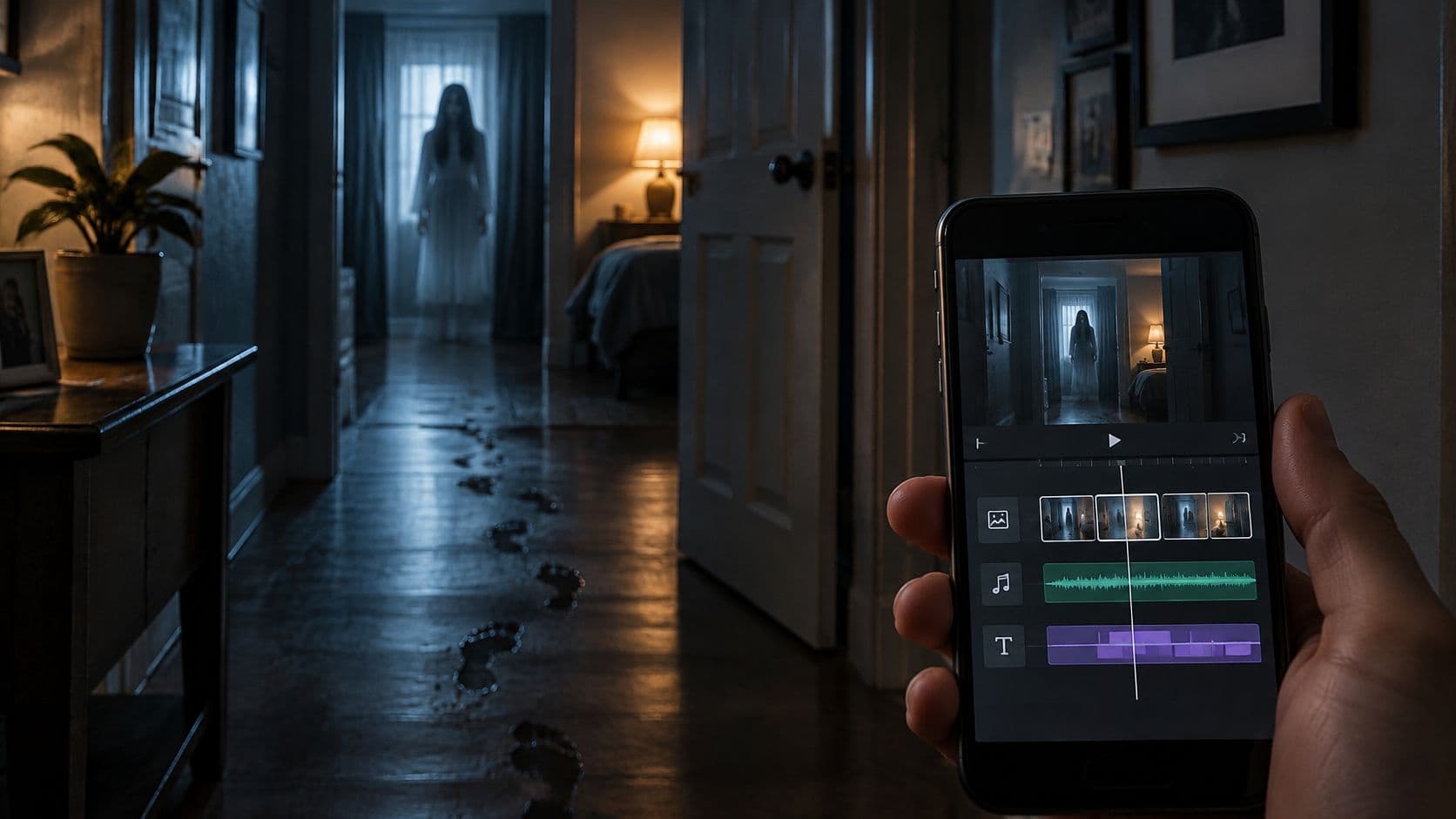
You've got a hallway image, a whispering voiceover, and a twist you like. But when you play the draft, the middle feels empty. The character keeps looking frightened, nothing changes, and the ending needs an explanation to make sense.
Effective ghost story telling starts before you generate the visuals. Give the protagonist something to lose, make every clue change their next decision, and decide how you'll label the source. Then test whether viewers follow the whole story, not just whether they notice the scare.
The 75-Second Beat Sheet Behind Scary Shorts
Build the timeline before polishing the opening line. You need a familiar situation, an unexplained disturbance, mounting evidence, a consequential choice, and an ending that changes how viewers understand what they saw.
A 2017 media experiment on suspense structure found that suspense generated through events inside the story produced stronger felt suspense and narrative absorption than delay imposed outside it. Keep the character doing something while you withhold the explanation.
A working timeline
The following is an illustrative edit plan, not a measured formula. Its timings are production choices for this particular story.
Beat timing for a 75-second ghost story short
| Beat | Single job | Example detail |
|---|---|---|
| Hook and anomaly, opening to 15 seconds | Show one wrong detail in a familiar setting | Hallway lamp switches off although nobody touched it |
| First escalation, 15 to 25 seconds | Add sensory evidence | Cold air comes under the door; footprints become visible |
| Second escalation, 25 to 35 seconds | Make the disturbance personal | A voice uses the protagonist's childhood nickname |
| Third escalation, 35 to 45 seconds | Show deliberate interference | A photo frame turns toward the bed |
| Irreversible choice, 45 to 60 seconds | Make the protagonist commit | They open the door despite the warning |
| Reveal and aftershock, 60 to 75 seconds | Reinterpret the evidence | The footprints match those left during their own earlier visit |
The lamp establishes wrongness without identifying a ghost. The draft and footprints give the protagonist evidence they can investigate, while the nickname removes the comfort of coincidence.
The photograph directs attention toward the bed. Opening the door turns observation into responsibility, and the footprint reveal connects the haunting to the protagonist's past.
Editing check: Name what changed in every row. If adjacent beats repeat the same information, merge them or cut the weaker one.
A long stare at an unchanged door is padding. A stare interrupted by a familiar voice gives the character a new reason to stay, flee, or open it.
How to Write the Script Beat by Beat
Write the character's decision before writing atmospheric narration. You'll know which details belong when you know what the protagonist must eventually do.
A 2025 scoping review of fear and empathy in reading identified delayed disclosure and multisensory description as recurring mechanisms associated with those responses. Use them to shape action, rather than adding frightening adjectives.
Draft the causal chain
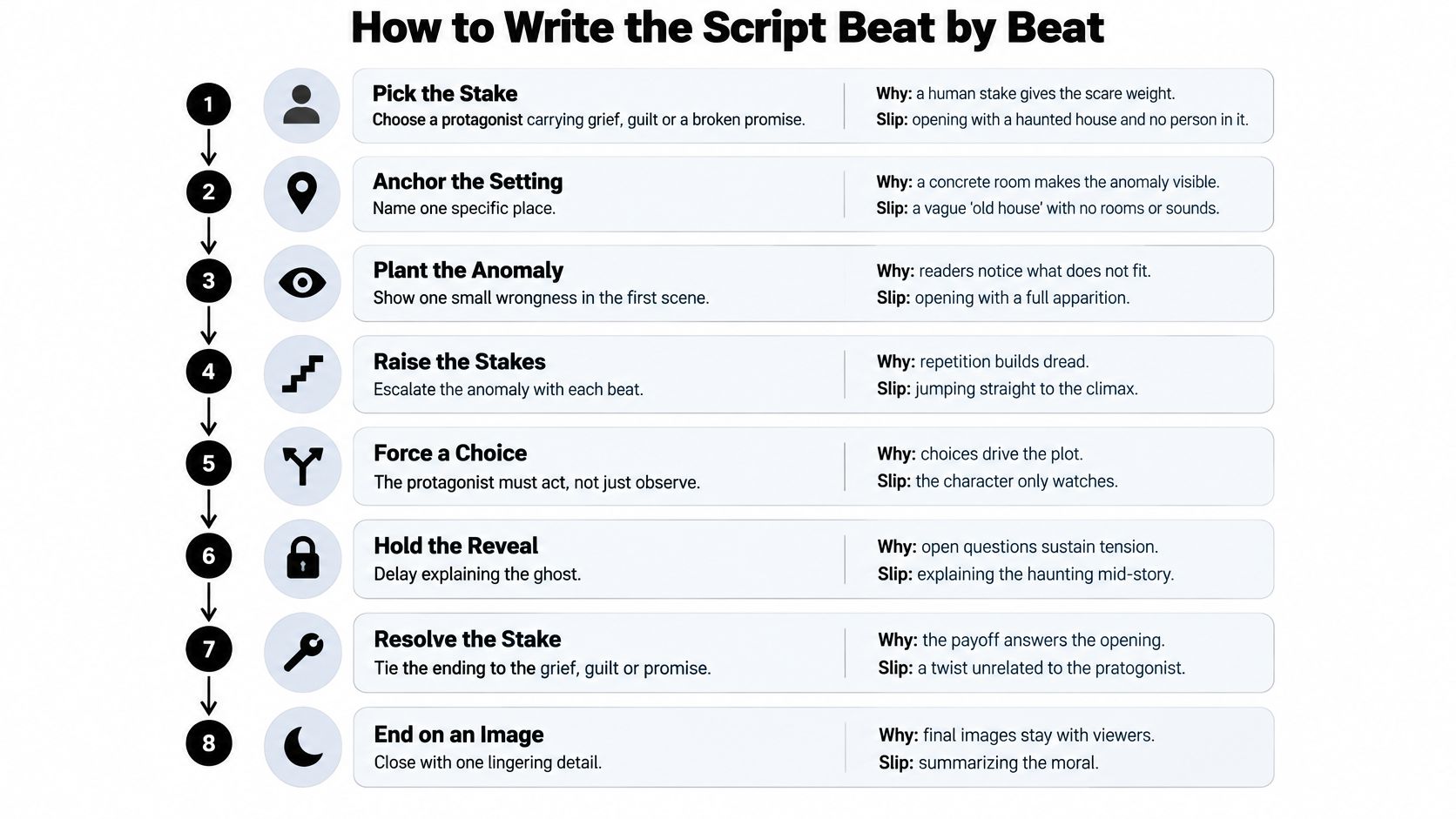
- Pick a protagonist with a stake. A daughter clearing her late father's flat has a reason to remain somewhere uncomfortable. Give her an unfinished promise. The common slip is introducing a disposable victim whose past has no bearing on the ending.
- Anchor a concrete setting. Choose the flat's narrow hallway, the sticking bedroom door, and the photograph beside it. Viewers need stable objects against which to notice change. A vaguely creepy house gives you atmosphere but little usable geography.
- Plant an ambiguous anomaly. Let the lamp go dark while the kitchen stays lit. There's an ordinary explanation available, but it's not confirmed. Opening with a fully visible apparition spends the mystery before the character can investigate.
- Disclose the necessary rule. Perhaps her father's note says to leave the bedroom closed after hearing his voice. Reveal enough to make the next decision understandable. Don't interrupt the opening with a complete explanation of the haunting.
- Escalate through sensory channels. Start with a scrape, let the handle turn cold beneath her hand, then show the photograph facing a different direction. Each sensation should cause an action. Cold and terrible describes a mood without changing the scene.
- Keep a contradictory clue. The voice sounds like her father, but it uses a nickname he never knew. That gives viewers something specific to question. Uncertainty fails when every clue contradicts every other clue.
- Force an irreversible choice. She opens the door because the voice offers forgiveness. Test the warning at this moment. If she can close it again and restore the situation, the choice needs a clearer cost.
- Resolve the emotional stake through the reveal. Connect the final image to the promise she broke. Don't have the narrator explain what viewers have already understood. Leave uncertainty about the ghost, not confusion about what happened.
Use the visual checklist to inspect the draft's overall progression.
Check the finished draft
Keep one emotional centre and one reversal. Read the script aloud and remove any sentence that neither changes the situation nor clarifies the character's motive.
For a complementary production checklist outside horror, SubmitMySaas's video production tips for SaaS launches can help you review a tightly scoped video brief. Keep the horror-specific decisions, especially withheld information, in your own script.
Labelling Real, Legend and Dramatized Stories
Calling an unverified haunting real creates a problem before the story begins. Viewers may assume your invented dialogue, alleged crime, or reconstructed scene came from a record.
Label the material before scripting it. A documented event and a supernatural explanation aren't the same claim.
Source types, labels and risks for ghost-story narration
| Source type | How to label it | Sample narration line | Main risk |
|---|---|---|---|
| Documented record | Name the archive or court report | The cited report records that the door was found open. | Treating an invented detail as part of the record |
| Local legend | Name the community and identify it as a legend | A legend told in this valley describes a figure at the bridge. | Flattening a living tradition into a generic trope |
| Personal account | Attribute it and mark it unverified | The witness described the door opening; the account remains unverified. | Presenting testimony as established fact |
| Dramatization | State which scenes or dialogue are reconstructed | This scene is imagined from the record, not transcribed from it. | Viewers mistaking invention for documentation |
These sample lines are wording patterns, not accounts of actual events. Replace general references with the source's proper name before publishing.
Add a verification layer
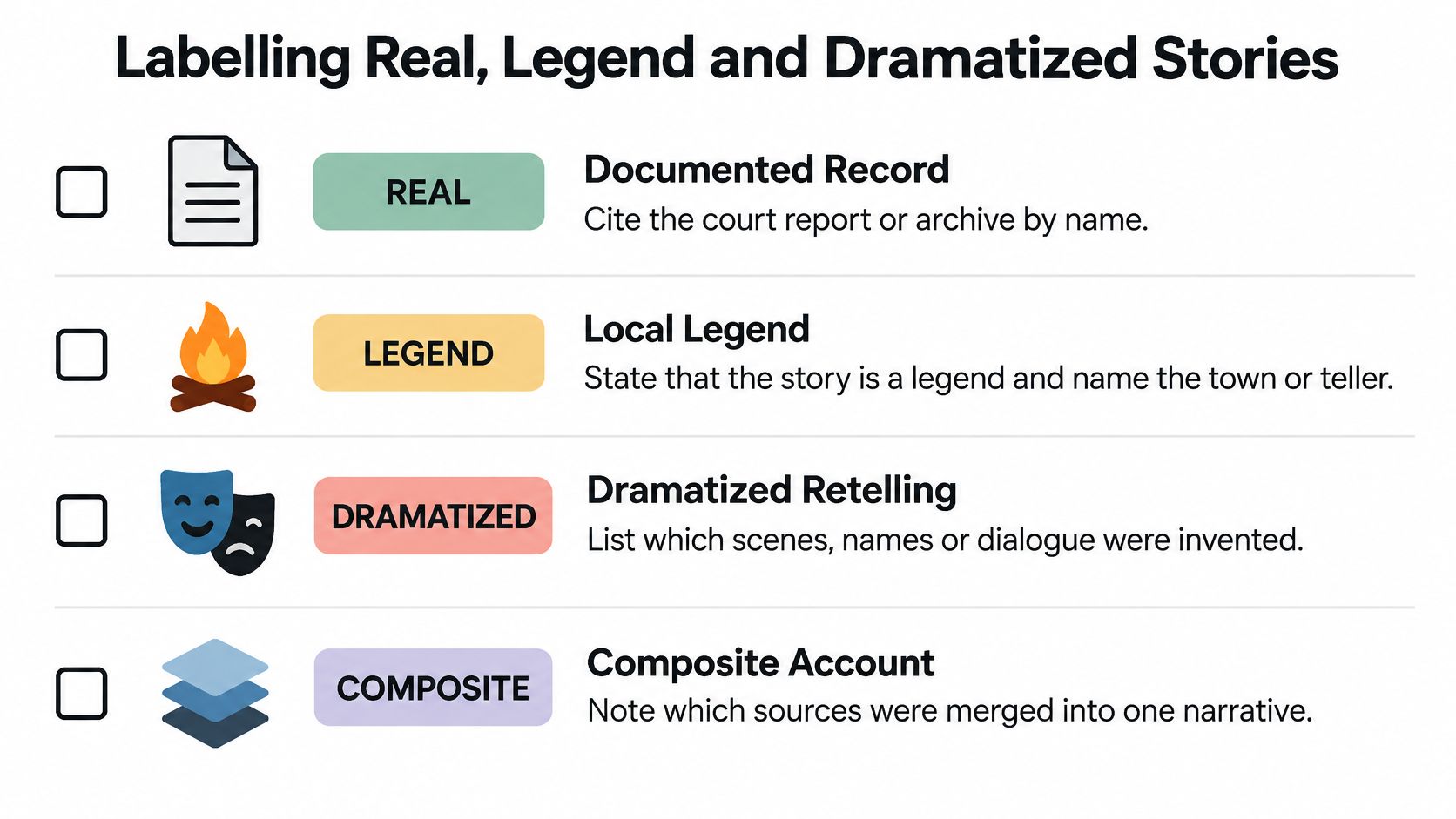
Keep a source note beside the script, separating supported details from additions made for the adaptation. If you combine accounts, label the result composite rather than implying that everything happened to the same person.
- Protect private people. Remove identifying details that aren't necessary, particularly when allegations involve living people.
- Check the location. Obtain permission before filming in sensitive places such as cemeteries or places of worship.
- Handle trauma deliberately. Don't turn a recent death into an opening scare. Add a brief content warning when violence, harm to children, or bereavement warrants it.
- Keep uncertainty visible. Put the label where viewers encounter the claim, not only in a buried description.
This checklist gives you a compact pre-publication reference.
The folklore teaching approach in Hunting Ghosts in a College Classroom focuses attention on how people tell and use ghost stories rather than proving ghosts exist. That's a useful editorial position: preserve a community's interpretation without presenting belief as verified paranormal evidence.
Prompts That Build Each Beat in ClipCreator.ai
Start with a scary-story template or a custom brief. Treat the prompt as production instructions, not a request for something spooky.
Use a storyboard to keep the room, objects, and character consistent across the generated scenes.
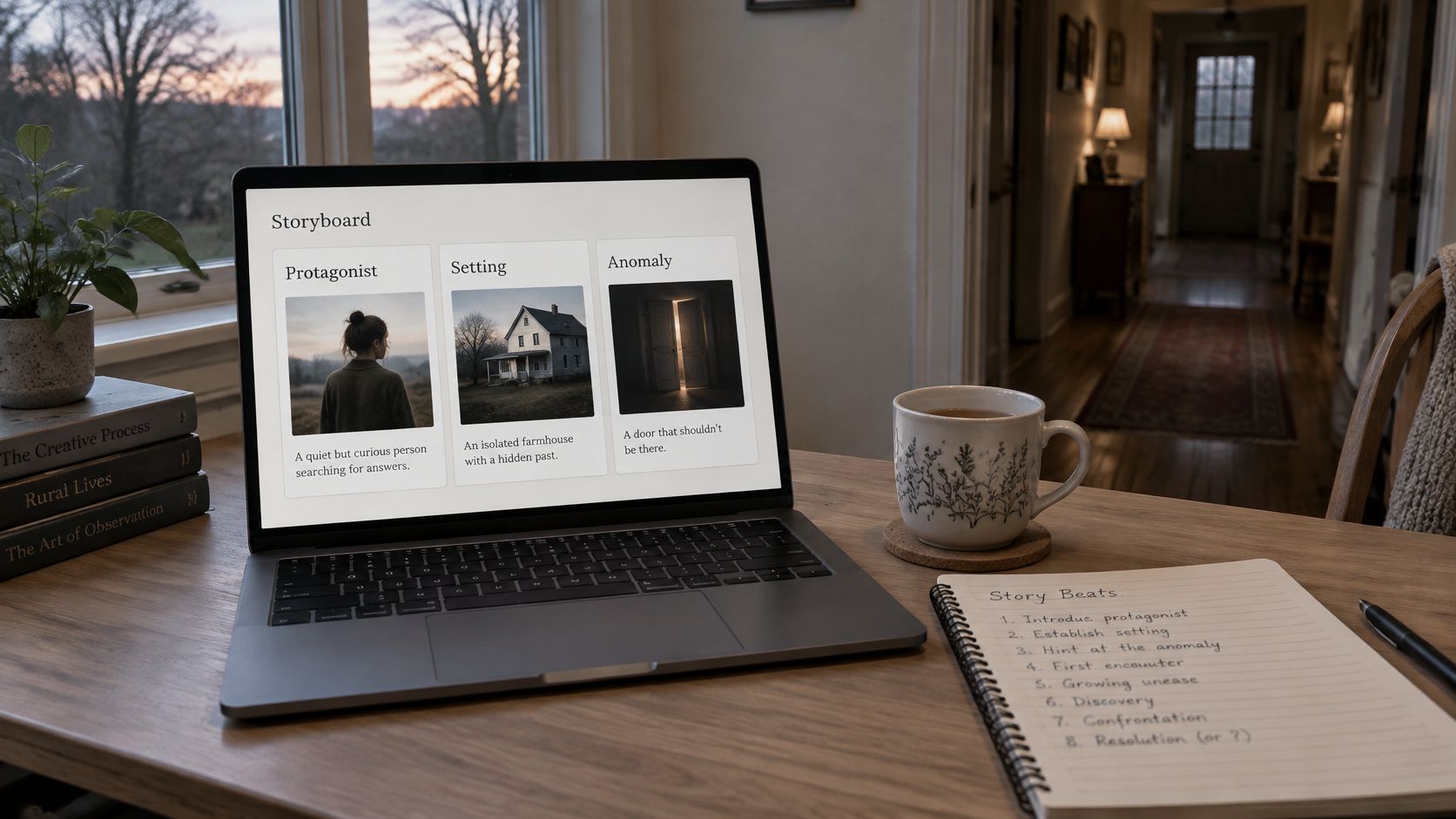
Copyable production prompts
Script prompt
Write a fictional first-person ghost story for the working timeline. The narrator is clearing her late father's rented flat after breaking a promise to visit. Establish the hallway lamp and closed bedroom. Introduce a changed detail in each beat. A note warns her not to open the bedroom when she hears his voice. She opens it seeking forgiveness. End by revealing evidence of her forgotten earlier visit. Mark the story as fiction and end on an image, without explaining the twist.
Change the protagonist's relationship, setting, and unresolved obligation together. Swapping daughter for caretaker without changing the motive gives you a cosmetic variation, not a new story.
For alternative premises, use the horror short-story prompts as starting material, then replace broad atmosphere with visible actions.
Image prompt
Same narrow rented-flat hallway throughout. Fixed view toward a closed bedroom door. Cream walls, worn wooden floor, framed family photograph. For this beat, show only the hallway lamp newly switched off. No apparition, no footprints, no additional changed objects. Restrained cool tones, readable shadows.
Keep a continuity description and alter only the beat-specific instruction. Don't request the lamp, footprints, moving frame, and ghost in the same image.
Voice-direction prompt
Use a restrained, lower-register delivery that sounds like someone recalling an uncomfortable memory. Keep ordinary details conversational. Pause before the final recognition, then finish plainly. Avoid growling, theatrical whispers, and a triumphant twist announcement.
Listen for intelligibility rather than pursuing the lowest possible pitch. A dark-sounding voice isn't useful if listeners miss the private nickname.
Review before accepting the render
The platform pairs scripts with automatically generated story-aligned images, voiceovers, and subtitles. That makes the prompt an important control, but it doesn't remove the need to inspect the result.
- Match each scene to its beat. Check that the intended change is visible.
- Reject premature evidence. Regenerate an image that exposes a later clue.
- Preserve continuity. Keep the door position, frame, clothing, and room layout consistent.
Use the walkthrough as a companion while checking the creation workflow.

Voiceover Pacing and Subtitle Timing
Set the delivery by reading the draft aloud, not by forcing it into a generic speaking-speed target. Suspense needs room for recognition: viewers must register the clue before the narrator reacts to it.
For this example, count the spoken words, record a natural read, and compare its duration with the edit. If it overruns, cut explanation before increasing playback speed.
Pacing and caption starting values
| Parameter | Starting value | Check |
|---|---|---|
| Narration speed | An unhurried, intelligible read | Slower than your standard explainer delivery |
| Pause before reveal word | Hold until the preceding clue registers | Keep the pause inside the reveal beat |
| Caption length | A short phrase broken at a natural boundary | Don't obscure the clue |
| Caption on-screen time | Long enough to read comfortably | Sync with the relevant sound or image |
| Reveal word | Isolated for its reveal beat | Remove competing text |
These are editorial starting points, not universal platform specifications. Use an audio-visual script template to align narration, image changes, sound cues, and captions before generating another version.
Make captions preserve the reveal
- Break by meaning. Keep a nickname or short action together rather than splitting it awkwardly.
- Avoid advance disclosure. Don't display the final caption before the voice reaches the recognition.
- Remove filler. Cut suddenly and unnecessary uses of then when the edit already communicates sequence.
- Check pronunciation. Listen to surnames, place names, and cultural terms. Adjust pronunciation or phrasing without erasing their meaning.
A caption should help viewers understand the moment they're watching, not announce the next one.
Finish with a silent playback to check whether captions carry the plot. Watch again with sound to catch premature text and awkward holds, then listen specifically for disagreements between narration and picture. Fix the cut where those disagree before adjusting music or effects.
Test One Variable Before You Scale
The scariest script isn't automatically the one worth repeating. A viewer might enjoy the shock without caring who experienced it, while a quieter ending might prompt a replay to inspect an earlier clue.
An analysis summarized by Clippie's guide to TikTok horror stories examined 19,382 TikTok videos and reported that horror videos generated 7.9% more likes and 13.5% more comments than platform averages. Those are engagement comparisons, not evidence that a particular script structure will work for your account.
Compare approaches to the same premise
Use the flat-clearing story as a controlled creative test.
- Shock-only. Emphasize disturbances and a threatening apparition. Keep the protagonist's background minimal.
- Character-led. Make the broken promise drive the investigation and the decision to open the bedroom.
- Documentary-folklore. Use genuinely sourced material, clearly labelled, with attribution built into the narration. If the premise is invented, don't manufacture a local tradition to fit this variant.
These cards can help you separate the approaches while planning.
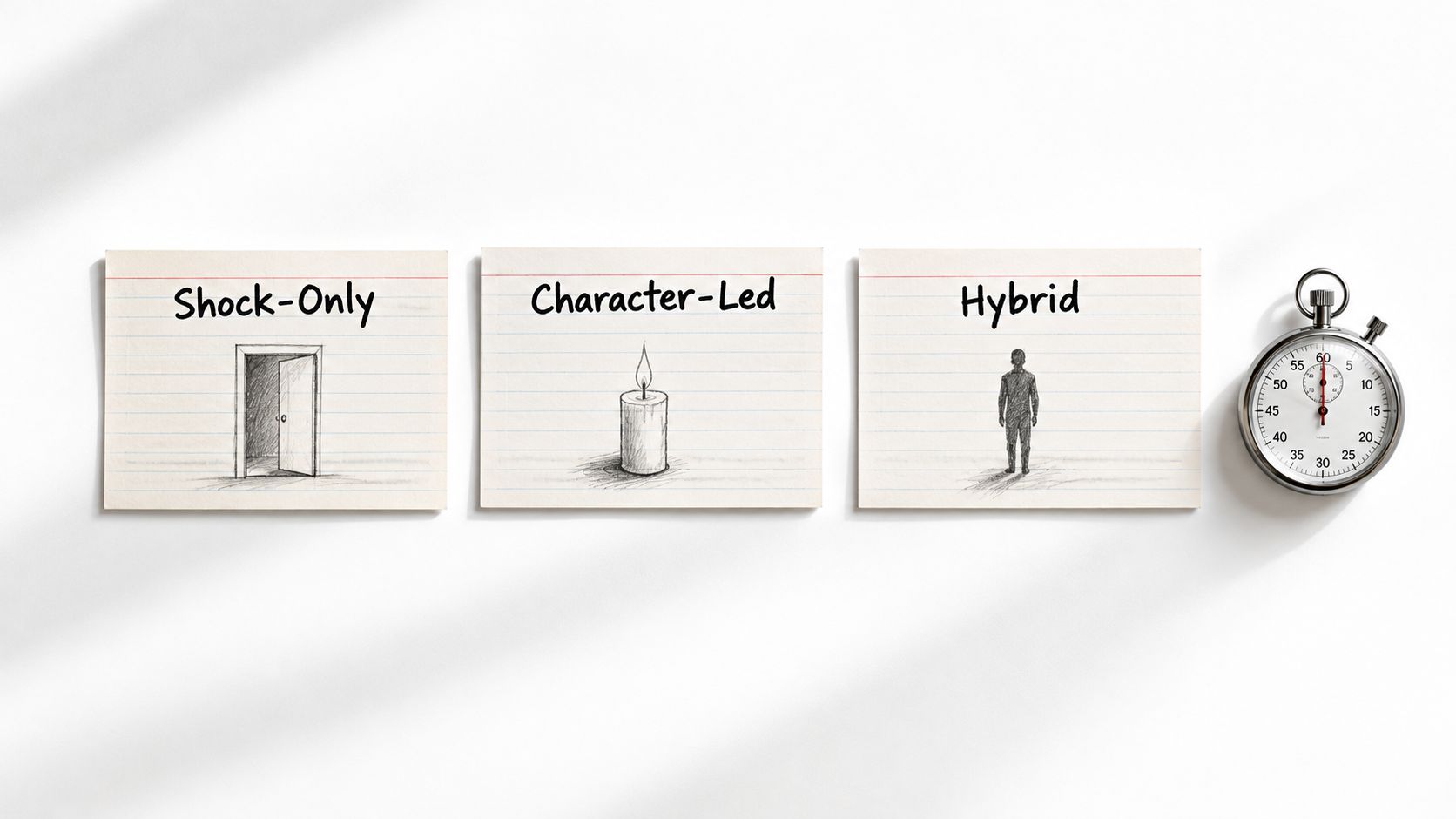
Keep the voice, caption styling, music treatment, and reusable visuals consistent. Where the script demands different images, acknowledge that you're comparing narrative packages rather than isolating script alone.
Use a video hook generator to draft alternative openings, but don't change the opening, narrator, visual style, and posting pattern simultaneously. You won't know which change mattered.
Read the signals separately
Completion rate helps you assess whether viewers reach the payoff. Rewatches can indicate interest in an earlier clue, but can also mean the ending was confusing. Read the comments before deciding which interpretation fits.
Comments that predict the next event suggest viewers are following the causal chain. Comments asking who the protagonist is suggest a clarity problem. Follows answer a different question: whether viewers want another story from the account.
Decision rule: Prefer a version that improves completion and rewatches without producing persistent plot confusion. Don't choose on raw views alone.
Choose a fixed posting batch and review date before starting, and compare results under reasonably similar publishing conditions. Treat an isolated spike as a reason to test again, not permission to duplicate the format indefinitely.
This week, choose a premise you can finish, build the script and matching assets, and publish on a fixed schedule. Record the outcome and the next change you'll test before producing another batch.
ClipCreator.ai turns custom story prompts into faceless videos with generated visuals, voiceovers, and subtitles, with scheduling available for publication. Visit ClipCreator.ai to build your labelled ghost-story draft, inspect each beat, and prepare a controlled test.

Create your first video in under 2 minutes
Pick a niche, and ClipCreator.ai generates and auto-posts faceless videos to your channels every day.
Join ClipCreator.ai