Yes, AI can write stories, and the ones it produces are coherent, readable and recognisable as narrative. It just isn't close to strong human writing on the measures that matter most. In a comparative study of GPT-generated fiction, GPT-3 scored 8.7 out of 100 for overall storytelling, GPT-4 scored 27.9, and selected human-written pieces from The New Yorker scored 84.7.
That spread raises a question most coverage skips. Commentators argue about whether a machine can write a story as though the answer were a single yes or no, when the practical answer splits in two. AI is already good at the parts of storytelling you can specify, and weak at the parts you can't. Fluency, structure, pace and a usable first draft arrive in seconds. Originality, three-dimensional characters and the ending that lands in a reader's chest do not.
The split reaches past craft. The same tools raise ownership questions, invite a sameness that shows up across an entire channel, and produce text that audiences rate differently once they learn where it came from. Each of those has a workable answer, and none of them is "let the model handle it".
Yes, AI Can Write Stories, but Quality Depends on the Task
Ask the question in the abstract and you get an argument. Ask it about one job, a 60-second narration, a three-act script, a villain's monologue, and the answer becomes measurable. Current models produce coherent, recognisable prose on demand, and they do it fast. What they don't do reliably is invent something a reader hasn't met before.
| Task | Verdict | Why it matters |
|---|---|---|
| Short premises and first drafts | Yes | Current models produce coherent, recognisable prose |
| Structured scripts with set format and length | Yes, with a detailed prompt | Structure and fluency are strong when format, tone and length are specified |
| Dialogue and attention-grabbing hooks | Partly | Fluent lines that are often generic |
| Original concepts and surprising twists | Weak | Creativity tests show AI well behind professional authors on originality |
| Three-dimensional characters and lasting emotion | Not reliably | Human evaluators describe AI characters as often unrelatable |
The pattern behind those verdicts holds across every study and every model generation. AI is strong where a rule can be written down and weak where taste has to make the call. Give a model a length, a genre, a cast of characters with motives and a required turn at the midpoint, and it fills the frame competently. Ask it to surprise you, and it reaches for the first twist that fits.
Rule of thumb: hand the model every part of the story you can specify, and keep for yourself the parts a viewer will remember a week later.
That's why the same tool can feel astonishing on Monday and hollow on Friday. The variable isn't the model, it's the brief. A high-volume premise or script generator is a solved job. A story that has to carry emotional weight still needs a person deciding what the ending means, and then cutting everything that doesn't earn it.
How AI Story Quality Compares With Human Writing
Start with the headline numbers. In a comparative study of GPT-generated fiction, GPT-3 received an overall storytelling score of 8.7 out of 100 and GPT-4 reached 27.9, while selected human-written pieces from The New Yorker scored 84.7. GPT-4 was roughly three times better than GPT-3 on that scale, a genuine generational jump, and it still sat at a third of the human benchmark.
Here's the visual version of the same comparison.
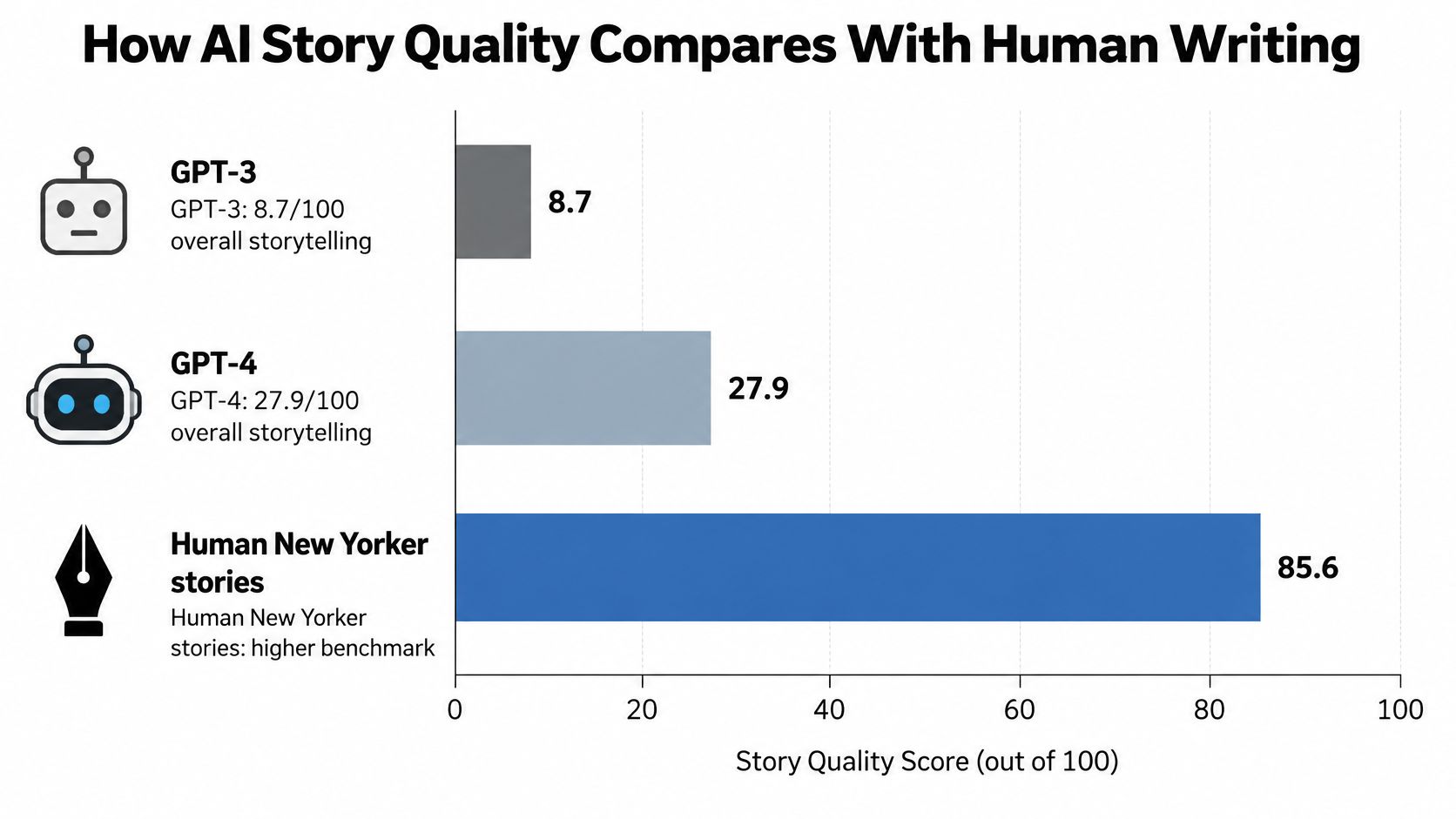
The same study's human evaluators described AI stories as often unrelatable, with characters lacking three-dimensionality and plots that lost force by the conclusion. That's the part a score can't show. Readers aren't scoring prose, they're deciding whether to care.
Absorption tells a gentler story than quality. A 2025 study published in Humanities and Social Sciences Communications measured narrative transportation at a mean of 4.90 for human-authored stories and 4.65 for AI-generated ones. Readers do get pulled into machine-written fiction. They just get pulled slightly less far.
Variety is where the gap widens. A 2024 University of California, Berkeley analysis compared 250 human-written responses with 80 AI-generated stories and found human narratives richer and more varied, while AI stories were more formulaic and repetitive. One good AI story often implies the next four.
| Measure | Study | Human result | AI result |
|---|---|---|---|
| Storytelling score (out of 100) | Comparative GPT fiction study | 84.7 (selected New Yorker pieces) | 8.7 (GPT-3); 27.9 (GPT-4) |
| Narrative transportation (mean score) | 2025 study in Humanities and Social Sciences Communications | 4.90 | 4.65 |
| Richness and variety of narratives | 2024 UC Berkeley analysis (250 human responses, 80 AI stories) | Richer and more varied | More formulaic and repetitive |
| Creativity tests passed | TTCW framework, 48 stories, 10 creative writers | Three to ten times more tests passed than machine stories | GPT-3.5 under 10%; GPT-4 and a second model about 30% |
Then there's the test designed to catch what readers miss. Using the TTCW creativity framework, 10 creative writers assessed 48 stories and found professional-authored ones passed three to ten times more creativity tests than machine-generated ones. GPT-3.5 passed under 10% of tests, while GPT-4 and another commercial model approached roughly 30%. Fluency was consistently the strongest dimension. Originality and creative flexibility were the weakest.
The same research found that automated language-model judges didn't positively correlate with expert human assessments. A model's opinion of a model's story is not an editorial review.
How to Prompt AI for a Story That Works
A vague prompt returns a vague story, and then people blame the tool. The fix is to treat the prompt as a production spec rather than a wish. Here is the workflow laid out end to end.
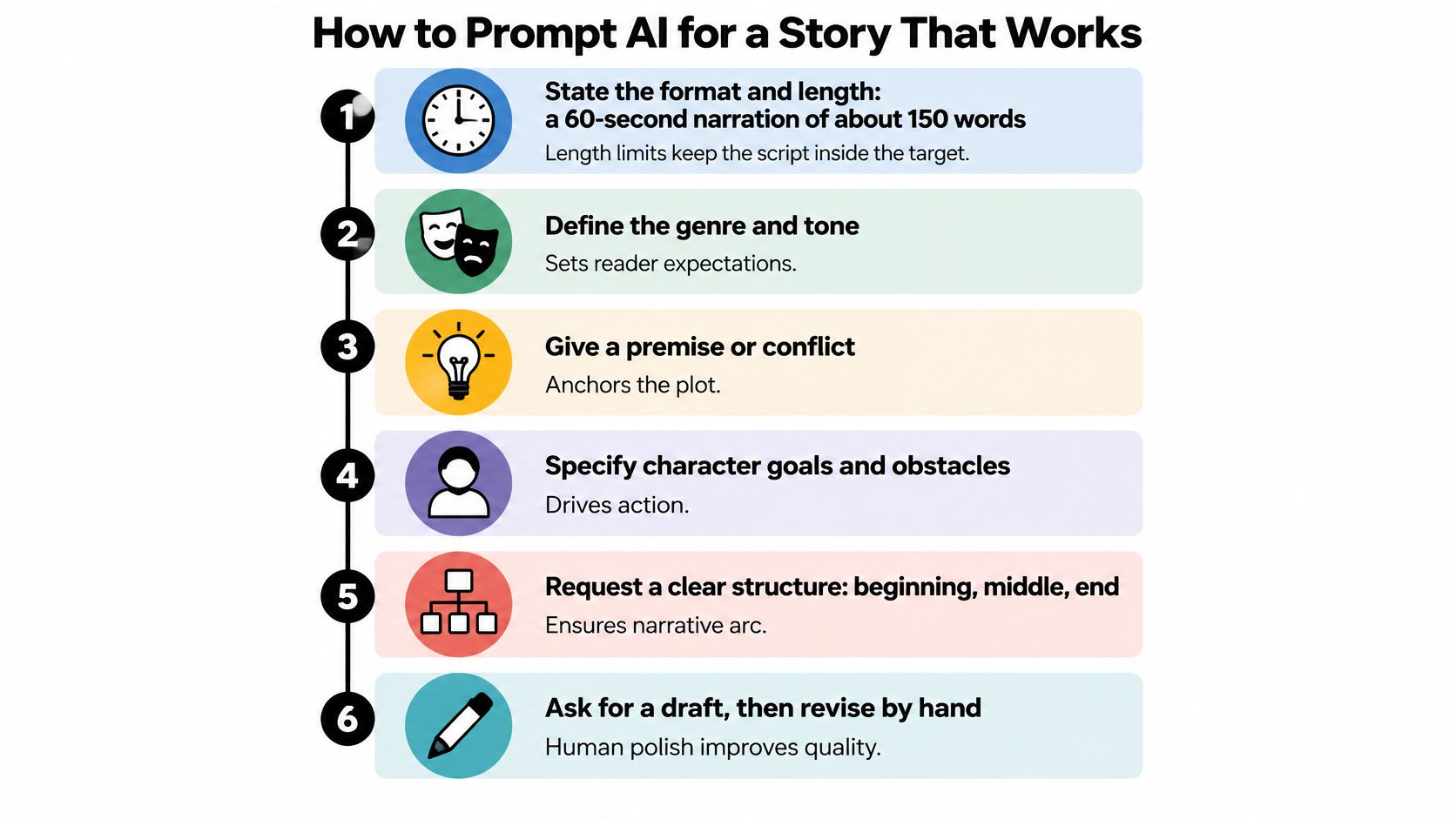
The eight parts of a working prompt
- State the format and length. A 60-second narration runs about 150 words. Length limits keep the script inside the platform's pacing and stop the model from writing a short film.
- Name the structure. Ask for a three-act arc with one turn at the midpoint. The model fills a skeleton far better than it invents one.
- Define each character by role and want. A named motive prevents the flat antagonist who exists only to be defeated.
- Set the conflict and the stakes in one sentence. Vague conflict produces vague plots, and vague plots produce endings nobody remembers.
- Specify the hook and the ending. Ask for a hook inside the opening sentence and a single final reveal, so the ending lands once and lands hard.
- Add tone and brand voice. Supply two approved sample lines and a list of banned words. Samples do more work than adjectives like "warm" or "witty".
- Ask for three candidates with different openings. The first draft is almost always the most predictable one, because the model defaults to the most common pattern. Comparing three openings forces variation into the output.
- Score the candidates against measurable criteria, then send the finalist to a human. Check for a novel premise, non-redundant imagery, causal plot progression, character-specific dialogue and a non-obvious ending. The ending test is the easiest one to run: if you can guess the reveal from the midpoint turn, the draft fails it.
That division of labour is supported by the evidence. In a controlled creative-writing study using the same zero-shot prompt and a human rubric, GPT-4-based ChatGPT outperformed the human group in most rubric categories, while humans scored best on originality. Fluency is a constraint you can prompt for. Novelty is a judgement you have to make.
If you want the format and length fields already structured for you, this AI story generator prompt guide walks through the same skeleton with worked examples.
A prompt template you can copy
Template: Write a [length] [format] for [audience] in a [genre] tone. Structure it in three acts with one turn at the midpoint. The protagonist is [name], who wants [goal] and is held back by [flaw]. The conflict is [one sentence] and the stakes are [what they lose]. Open with a hook inside the first sentence. End on a single reveal: [the reveal]. Match this voice: "[sample line 1]" and "[sample line 2]". Never use these words: [list]. Give me three versions with different opening lines.
Fill every bracket. The empty ones are where the generic output comes from.
Why AI Stories Sound Alike and How to Spot It
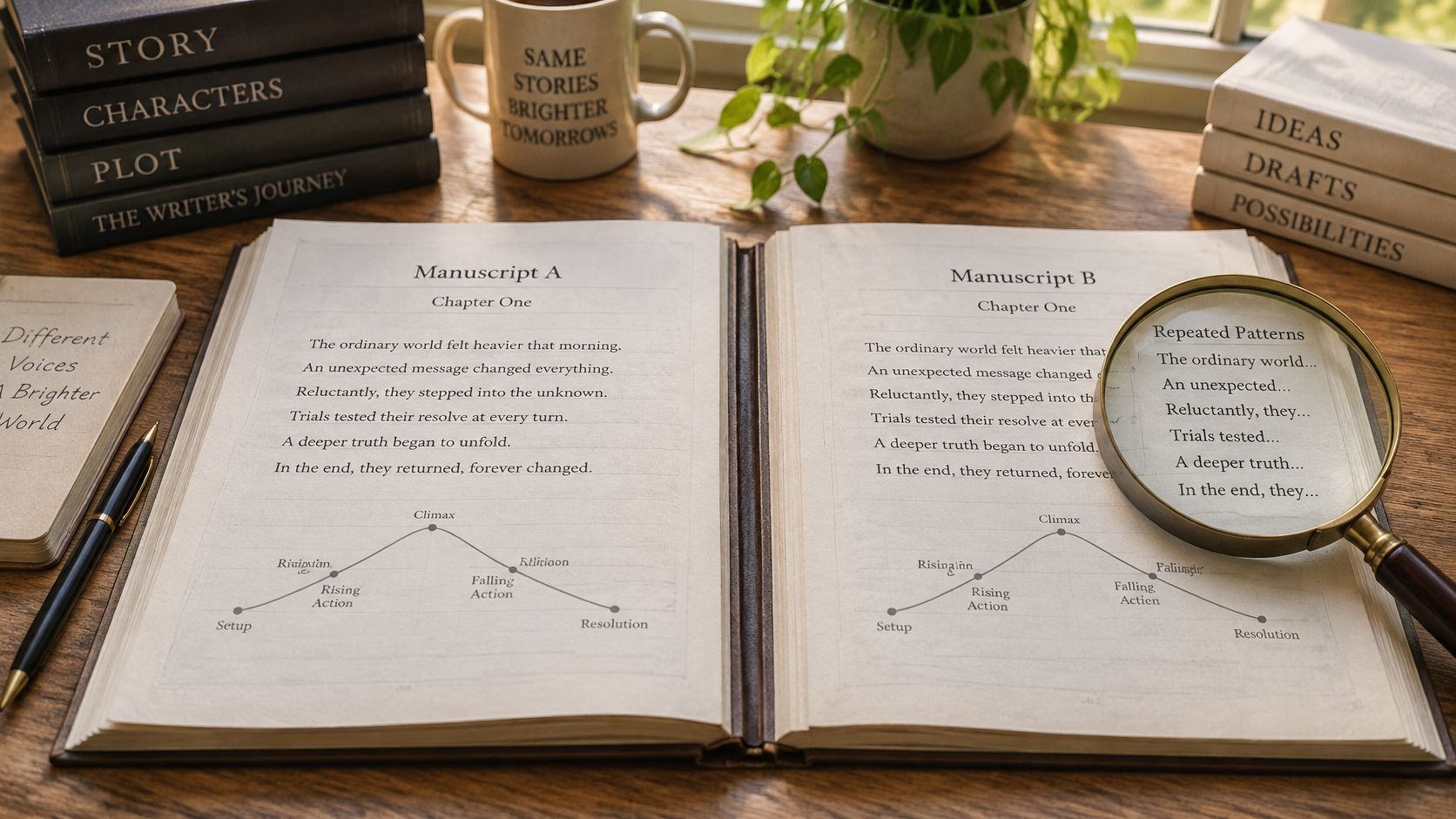
The sameness problem runs deeper than wording. AI fiction repeats its underlying narrative construction even when every sentence is different, so a single shape can travel through an entire channel. Change the fox to a rabbit and the story still opens with a sensory setup, turns at the same minute and closes by restating the lesson.
That matters commercially. When output scales, faceless channels and small businesses publish stories that look interchangeable to viewers and to platform algorithms, which weakens brand recognition and makes rights harder to defend.
Three checks to run on your next five episodes
- Compare the openings side by side. Put the first lines of five episodes in one document. If they share a structural habit, such as weather, a sound, then a character waking, the template is leaking through.
- List the twist types and stock phrases. Write down how each episode turns and which phrases repeat. Three episodes resolving through a hidden identity is a pattern, not a coincidence.
- Check that every character has a motive unique to that story. If the villain's reason for doing harm would work unchanged in another episode, the character is still a placeholder.
The fix is a proprietary base. Build a character bible and a set of world rules that every prompt references: names, histories, physical details, what magic or technology can and can't do, and how people in that world speak. Each new story then starts from a distinctive foundation instead of a blank page the model fills with its default shape.
Rights and disclosure sit on the same axis. A 2025 Cambridge survey of 332 novelists found that about 60% said their work had been used to train AI systems without permission or payment, so the material behind a brand voice arrives with an unresolved history. The label you choose changes how the same text is judged: a clear disclosure invites viewers to weigh the craft on its merits, while a channel caught hiding automation turns ordinary sameness into evidence of deception.
A model can flag repetition in a batch. Only a person can tell you the channel has started to sound like itself.
Turn an AI Draft Into a Story With Your Voice
Say a parenting brand needs a 60-second bedtime story about a fox who is afraid of the dark. The first AI draft opens with "Once upon a time, in a quiet forest", gives the fox no clear want, resolves the fear with a lesson stated outright, and uses a banned phrase twice. The prose is clean. Nothing in it belongs to the brand.
| Draft problem | Likely cause | Fix before publishing |
|---|---|---|
| Generic opening such as a stock setting | Prompt named only a genre | Rewrite the first line around one concrete detail |
| Flat antagonist or protagonist | No want or flaw given | Add a motive and one specific flaw |
| Predictable twist | Clue appears too late | Plant the clue in the first act |
| Stated moral at the end | Prompt asked for a lesson | Cut the moral and let the action carry it |
| Off-brand tone | No voice samples supplied | Replace lines with two approved brand samples |
| Repeated stock phrases across episodes | Model defaults | Keep a banned-phrase list and check each batch |
Work the list in order. Open on the concrete detail: a torch with a battery bar down to one red notch, which is a small, specific fear a child can see. Give the fox a want, to reach the stream before moonrise, and a flaw, pride that stops him asking for help. Plant the solution in the first act, so the fireflies he watches in scene two are the light he uses in scene five. Cut the closing line that explains the moral, because the fox crossing the dark with borrowed light says it better. Then replace the two banned phrases with lines lifted from the brand's approved samples, so the story sounds like the same person who wrote the product pages.
That division of labour is older than the current tools. In 2016, an AI-assisted novella titled The Day a Computer Writes a Novel passed the first screening round of Japan's Hoshi Shinichi Literary Award. It was one of 11 AI-authored submissions that year, human researchers chose the broad plot and materials, and the program generated portions of the prose. The judges weren't told which entries involved machines. Judge Satoshi Hase called it well structured but noted unresolved weaknesses in the character descriptions, and it didn't beat the human field.
The direction made that entry, not the generation. If you're coaching younger writers through that same discipline of cutting and reworking, these revision strategies for student writers map cleanly onto the pass-by-pass method above. The payoff is measurable in both directions: a 2024 University College London and University of Exeter experiment found AI-assisted participants' short stories scored 8.1% higher for novelty and 9% higher for usefulness than stories written without AI.
The stronger craft reference for the rewrite itself is narrative writing techniques, which covers the concrete-detail opening and the planted-clue structure the fox script needs. Ask one question before you publish: does this sound like the brand, or just like a story?
Who Owns AI Stories and When to Label Them
Ownership and disclosure are separate problems, and treating them as one produces bad decisions on both. Ownership is about what you can defend. Disclosure is about what your audience expects before the first line lands.
Writers are adopting the tools faster than the terms are settling. The Australian Society of Authors 2025 survey found that 21% of respondents used generative AI in their creative practice, up from 19% in early 2023. Permission to use generated output is not the same as legal title, though. It doesn't resolve training-data questions, similarity to existing work, or how much human authorship a registration needs.
Disclosure operates on perception, not fact. A 2026 Villanova study reported by the BBC, involving 1,682 participants, found readers generally could not reliably distinguish AI-generated short stories from human-written ones, with follow-up accuracy at approximately chance level. The label still moved the rating. AI-generated stories received stronger ratings when participants believed they were human-written, and a human label improved perceptions regardless of the story's true origin.
Precise labels beat vague ones. "AI-assisted, human-reviewed" tells a viewer something true. "Made with AI" tells them nothing and invites them to guess.
That means the category matters. AI-generated drafts, AI-assisted editing and fully automated publishing are three different claims, and audiences read them differently.
Three practices make the position defensible:
- Keep a record. Save prompts, drafts, human edits and source notes for each published story, so the human contribution is documented rather than asserted.
- Maintain a character bible. Recurring characters and world rules are the clearest evidence of a creative base that predates any single generation.
- State the level of AI involvement. One line in the caption or description, consistent across the channel, removes the ambiguity that invites scepticism.
If your team needs a documented internal policy for how these tools are used in production, MaxiJournal's 2026 AI governance guide covers the practical side of recording tools, review steps and accountability. Pair it with a plain read of fair use guidelines before you build a series around borrowed material. None of this is legal advice, and a lawyer is worth the hour if a series becomes a business.
Choose Your AI Story Workflow Before You Publish
One decision determines whether AI helps or homogenises your channel: which workflow you pick before the first episode goes out. Three cases cover most creators.
- You need a first draft. Use AI for premises, openings and a full draft, then rewrite by hand. Your time goes into the second pass, where the story gets its voice.
- You're producing scripts at volume. Batch the work. Generate in sets of five, score them against the originality criteria, and review the finalists together so patterns show up before your audience finds them.
- You need a consistent brand voice. Build the character bible and the voice samples first, before any generation. Every prompt then references the same base, and the output stops drifting.
Whichever path you take, confirm five things before publishing. The prompt specified format and length. At least three candidates were compared. A human reviewed the finalist for originality and emotional impact. Edits and sources are documented. The disclosure label matches the actual level of AI involvement.
For faceless short video on TikTok or YouTube, ClipCreator.ai handles the production side of that workflow. Story generation builds each narrative from a pre-made viral story type or from your own custom prompt, and custom stories let you direct the AI with your own topics and style so the output reflects your brand identity. Run the five-point checklist on the first batch regardless of which tool produces it.
ClipCreator.ai turns a script into a finished faceless video, generating the story, matching images, a lifelike voiceover and subtitles, then publishing to TikTok or YouTube on a schedule you set. You can start from a proven story type such as scary stories or bedtime tales, or bring your own prompt and direct the AI toward your brand's voice. Visit ClipCreator.ai to produce your first story video and test it against the checklist above.

Create your first video in under 2 minutes
Pick a niche, and ClipCreator.ai generates and auto-posts faceless videos to your channels every day.
Join ClipCreator.ai