For most creators, the strongest starting point is 21 to 34 seconds. But that answer is incomplete, because the right TikTok length depends less on a universal rule and more on what the video is trying to do.
A lot of TikTok advice still pushes the same lazy takeaway: keep it as short as possible. That's useful if you're posting trends, reaction clips, or punchline-first content. It's not useful if you're telling a story, teaching a process, or selling a product that needs context.
The better question isn't just how long should a TikTok video be. It's what length gives this specific idea the best chance to hold attention all the way through.
That's the lens that helps in practice. A trend clip and a mini tutorial shouldn't be cut to the same runtime. A faceless scary story and a product explainer shouldn't be edited by the same rules. The creators who get consistent results usually stop chasing one “ideal” number and start matching length to format, pacing, and payoff.
Why TikTok Video Length Is More Than Just a Number
The standard recommendation is still useful. Independent guidance has repeatedly pointed to 21 to 34 seconds as the highest-performing practical range for many creators because it fits TikTok's fast-scroll behavior while still leaving enough room for a complete idea, as noted in Loomly's breakdown of TikTok video length guidance.
That range works because it forces discipline. You usually have time for a hook, one core idea, and a clean payoff. No wandering intro. No unnecessary setup. No extra scene that slows the whole thing down.
Why the one-number answer fails
The problem starts when people treat 21 to 34 seconds like a law.
A trend participation video often wants less runway. A quick visual joke can land in a much shorter clip. On the other hand, a story video, a myth-busting explainer, or a product demo may need more breathing room to make sense. If you crush those formats down to fit a generic recommendation, you often hurt clarity, which then hurts retention.
Practical rule: A TikTok is too long when the next second adds no new value, and too short when the viewer leaves without the payoff.
That's why “shorter is better” is only half true. Shorter is better when the idea survives compression. When it doesn't, shorter just means rushed.
What actually works
When I review underperforming videos, the issue usually isn't the raw length. It's a mismatch between goal and runtime.
Common mismatches look like this:
- Trend content that drags: A simple reaction or trend clip gets padded with extra setup, which kills momentum.
- Tutorials that feel cramped: The creator rushes through steps so fast that the viewer can't follow.
- Stories with no shape: The video has enough time, but the edit doesn't build toward a payoff.
- Sales videos that arrive too late: The product value doesn't become clear until the viewer has already swiped.
The strongest approach is to pick the goal first, then choose the shortest length that still delivers the full experience. That's where TikTok length becomes strategy instead of guesswork.
How the TikTok Algorithm Judges Your Video Length
TikTok doesn't reward length by itself. It rewards attention. Length only matters because it changes how hard your video has to work to keep people watching.
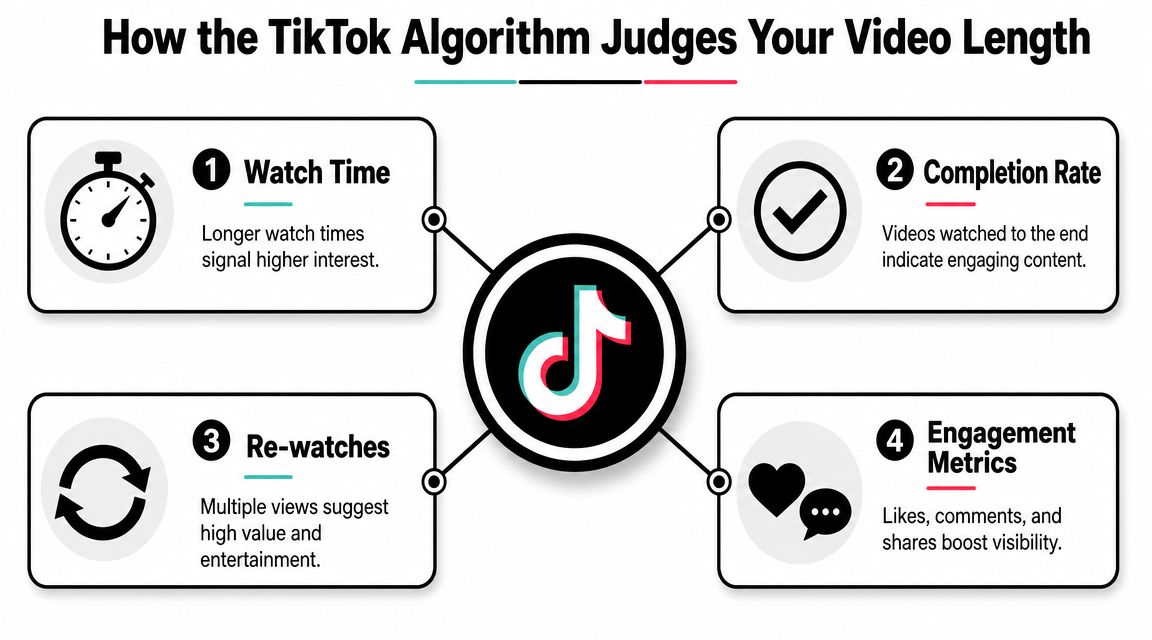
Completion rate and watch time aren't the same thing
A simple way to think about it is TV pacing. A short sitcom episode and a feature film ask for different kinds of commitment. If someone finishes a very short clip, that's a strong signal. If someone stays engaged through a much longer video, that can be just as meaningful, sometimes more so, because more total attention was earned.
That's why creators get confused when a very short video has a high completion rate but still doesn't scale the way they expected. Completion matters. Total watch time matters too. Rewatches, shares, comments, and saves also tell TikTok that the video gave people enough value to stop scrolling.
TikTok's platform limits have expanded over time. The app started with 15-second videos, then moved to 60 seconds, then 3 minutes, and now supports uploads up to 10 minutes in-app, according to Teleprompter's overview of TikTok video length changes. That shift shows TikTok has room for longer content, but it doesn't mean every idea should fill that room.
The algorithm is asking one basic question
The practical question behind every post is simple: did this video earn the next second of attention?
That's why packaging matters so much. The opening frame has to create curiosity. The middle has to keep delivering. The ending has to resolve the promise made at the start.
If you're also building paid content or shopping content, runtime decisions get even more constrained by format and placement. HiveHQ has a useful guide to TikTok Shop ad specs that helps clarify the production side when you need organic-style videos to also fit commerce use cases.
For organic content, this is the working model:
- Short videos win when the idea is instantly clear and easy to complete.
- Longer videos win when each segment creates enough curiosity to pull viewers forward.
- Dead space loses at every length.
That's also why “viral length” discussions can get messy. A video can be short and weak, or long and sticky. The more useful benchmark is whether the format matches the attention pattern. If you want a broader sense of what strong distribution looks like, this breakdown of what's considered viral on TikTok is worth reviewing alongside your own analytics.
A 7-second video with a full watch isn't automatically stronger than a 60-second video that keeps people locked in. The better signal is how much attention the edit actually earns.
A Goal-Based Framework for TikTok Video Length
The cleanest way to choose length is to stop asking for one perfect number and start with the content objective. Recent coverage has gotten more nuanced: viral content often clusters around 11 to 18 seconds, while storytelling and educational videos can work well at 21 to 34 seconds or up to 60 seconds, and one 1,449-video analysis found a viral-tier median length of 41 seconds, according to Trivision Studios' review of TikTok length patterns in 2026 coverage.
That lines up with what strong accounts do. Different formats need different amounts of space.
TikTok video length by content goal
| Video Goal | Ideal Length | Example Formats | Key Metric |
|---|---|---|---|
| Trend participation | 0 to 15 seconds | Trending sound, reaction, visual gag, meme format | Completion rate |
| Quick value | 15 to 30 seconds | One tip, one mistake, one surprising fact, product benefit | Rewatches |
| Storytelling | 21 to 34 seconds | Mini story, confession, before-after narrative, faceless story beat | Retention through payoff |
| Education | 30 to 60 seconds | Short tutorial, myth busting, process breakdown, explainer | Watch time |
| Deep explanation | 60 seconds and up | Niche tutorial, detailed product demo, layered story, commentary | Sustained watch time |
How to choose the right bracket
Use 0 to 15 seconds when the content is built around instant recognition. Trends, jokes, quick reactions, and loopable visual payoffs usually work best when the viewer understands the point almost immediately.
Use 15 to 30 seconds when you have one clear takeaway but need a little setup. This is a strong range for simple educational points, small product moments, and compact opinion clips.
Use 21 to 34 seconds when the video needs a beginning, middle, and end. Many creators should default to this length because it gives enough room for structure without encouraging rambling.
Use 30 to 60 seconds when the viewer needs context before the payoff lands. This range fits tutorials, comparisons, or “here's what nobody tells you” style videos.
Use 60 seconds and up only when the depth is the reason to watch. If the longer length doesn't increase interest, it's just friction.
A fast decision filter
Before scripting, ask these four questions:
- Is the payoff obvious right away? If yes, go shorter.
- Does the viewer need context to care? If yes, give it more room.
- Can one sentence explain the video's promise? If not, the concept may be overloaded.
- Would this work better as a series? If each part has its own hook and payoff, split it.
That's the framework I'd use before touching the timeline. It keeps the edit honest.
Scripting and Editing for Maximum Retention
The right length only helps if the script is built for that length. A weak 20-second video feels long. A sharp 60-second video can feel fast.
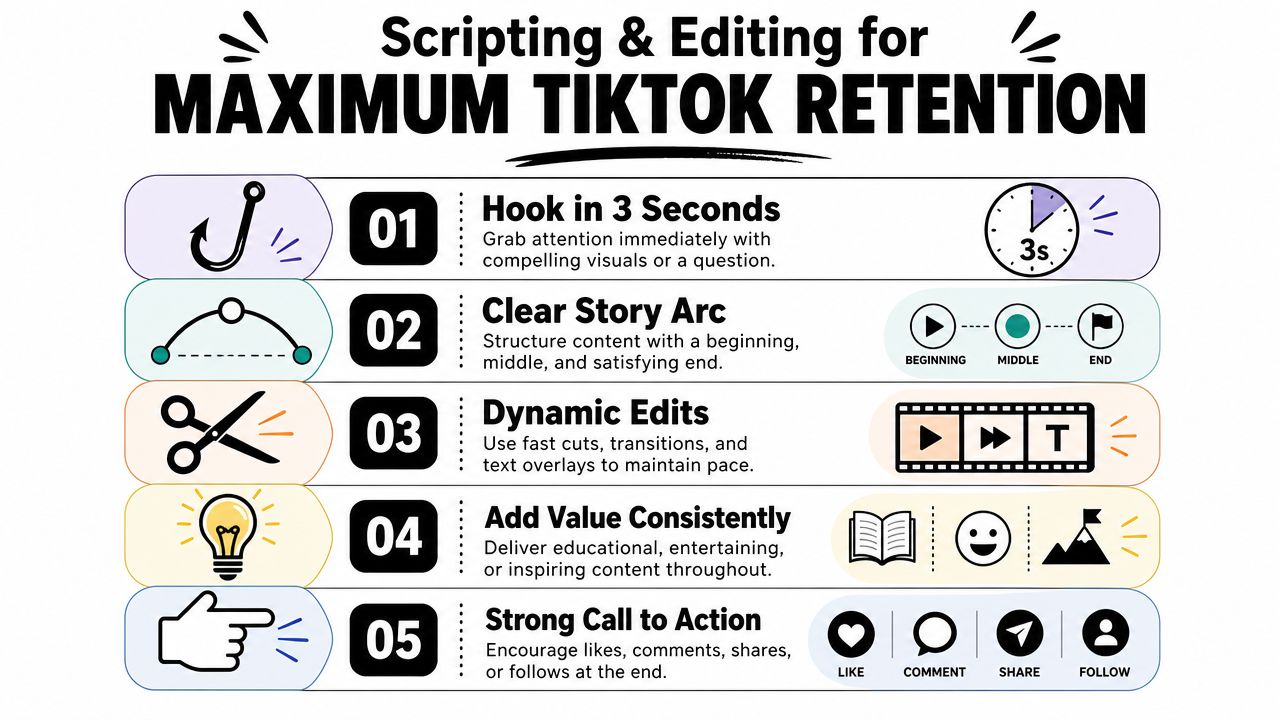
Under 15 seconds needs instant payoff
This bracket has no patience for scene setting. Open with the most interesting frame or line first.
A reliable formula is:
- Hook
- Payoff
- Loop or punchline
Example structure:
- “I tried the weirdest TikTok productivity trick.”
- Show the result immediately.
- End on a frame that naturally encourages a replay.
What doesn't work here is throat-clearing. If the first moments feel like setup, the clip is already in trouble.
The 21 to 34 second range needs shape
A classic narrative arc works well. Not a movie plot. Just enough structure that the viewer feels pulled forward.
A simple formula:
- Hook
- Build
- Climax or reveal
For faceless content, that often means pairing on-screen text with escalating visuals. Each beat should answer one question while raising the next. That keeps attention moving.
Keep every scene on trial. If removing it makes the video stronger, cut it.
The mechanics matter too:
- Front-load curiosity: Open with the strongest tension point.
- Change visuals often: Switch framing, text treatment, or motion before the video feels static.
- Write for captions: Silent viewers need to understand the plot instantly.
- Cut overlap: Most creators repeat points without realizing it.
If your footage looks soft or compressed after exporting, clean visuals help retention more than people admit. This guide on how to sharpen a video professionally is useful when you want text, product details, or image-based storytelling to stay crisp on mobile.
A good editing demo helps more than generic advice. This one breaks down pacing and structure clearly:

Longer videos need chaptering
Past the shorter ranges, viewers need more guidance. They don't want to wonder where the video is going.
Use these techniques:
- On-screen chapter labels: “Part 1,” “What went wrong,” “The fix,” “Final result.”
- Pattern interrupts: Change angle, add B-roll, insert text, switch pace.
- Open loops: Raise a question, then resolve it after the next beat.
- Micro-payoffs: Don't save all value for the end. Give the viewer reasons to stay.
For educational or faceless formats, one of the most effective script shapes is Hook, Problem, Solution, CTA. It works because each section has a job. If you need a starting point, this library of video script templates is a practical reference for building repeatable formats without making every post sound identical.
What usually hurts retention
Three editing mistakes show up constantly:
- Slow openings: The viewer doesn't know why to care yet.
- One-speed pacing: Every clip is the same length and energy level.
- Late payoff: The reveal comes after attention is already gone.
Fix those first. Most TikTok length problems are really pacing problems.
The Case for Longer TikTok Videos
Longer TikTok videos aren't automatically worse. They're just less forgiving.

Buffer's analysis found that about 86% of TikTok videos were under 60 seconds, yet videos longer than a minute received 43.2% more reach than 30 to 60 second videos and 63.8% more watch time than that same group. Compared with 10 to 30 second clips, the longer-than-a-minute group had 70.3% more reach and 175.6% more watch time. The same dataset found that only 12% of videos were between 1 and 10 minutes, but those longer videos had the highest median reach at 432.5 and median watch time of 11.3 seconds, as reported in Buffer's review of longer TikToks and performance.
Why longer videos can work
This is the part most shallow advice misses. If a creator can hold attention, a longer video gives TikTok more watch time to measure and more opportunities for meaningful engagement.
Longer videos tend to make sense when the format itself creates momentum:
- Niche tutorials: The audience wants steps, not just highlights.
- Story-led content: Suspense and progression reward a longer runtime.
- Detailed product explainers: Context improves trust and understanding.
- Educational breakdowns: The value is in the sequence, not one isolated line.
That doesn't mean creators should suddenly default to one-minute-plus videos. It means longer TikToks are a strategic option when the content earns it.
Platform limit and performance limit aren't the same
TikTok lets creators publish much longer content than it used to. But technical capacity isn't creative permission.
A platform limit tells you what can be uploaded. A performance limit tells you how much your audience will tolerate before retention falls apart. Those are different things.
Longer TikTok videos work when the subject creates enough tension, novelty, or usefulness to justify staying. Without that, length becomes a tax on the viewer.
That distinction matters most for brands. A founder story, customer pain-point breakdown, or product comparison may deserve more time. A basic announcement rarely does. The longer the runtime, the stricter the editing has to become.
How to Test and Scale Your Video Strategy
No article can tell you the exact perfect runtime for your account. The only dependable way to find that is controlled testing.
Recent coverage also notes that videos longer than 60 seconds are underrepresented in viral samples, and one analysis advises that past 75 seconds creators should consider splitting content into a series, according to Sociality's article on TikTok video length strategy. That's a practical testing rule. Once a script pushes beyond that point, you should ask whether it's one strong video or several cleaner ones.
A simple testing system
Keep the topic constant and vary only one thing at a time.
Test like this:
- Same concept, different lengths: Post one version tighter and one version more developed.
- Same length, different hooks: Find out whether the opening or the runtime is the primary issue.
- Same script, different edits: Sometimes the script is fine and the pacing is the problem.
- Track by format, not just averages: Story videos and tutorials shouldn't be judged in the same bucket.
Your own dashboard matters more than generic advice. If you need a clearer process, this guide on how to see TikTok analytics is the right starting point for reviewing retention patterns and comparing formats.
The scaling problem most creators hit
Testing sounds easy until you try to produce enough videos consistently. Writing scripts, recording voiceovers, sourcing visuals, adding captions, trimming pacing, and scheduling posts becomes the bottleneck.
That's where automation can help, especially for faceless formats. ClipCreator.ai generates short-form videos for TikTok, YouTube, and Instagram with script generation, visuals, voiceover, subtitles, and scheduled publishing, and its workflow is built around faceless videos up to 90 seconds. That makes it relevant for the ranges that usually matter most in TikTok testing, especially story videos, educational clips, and branded explainers.
What to scale and what to stop
Once you've tested enough volume, patterns become obvious.
Scale the formats that show:
- Strong hooks: Viewers understand the promise immediately.
- Clean retention shape: Fewer dead zones in the middle.
- Repeatable production: You can make more without quality dropping.
Stop forcing formats that only work when heavily over-edited or unusually lucky. Sustainable TikTok strategy comes from repeatable wins, not isolated spikes.
TikTok Video Length FAQs
Should you split a long TikTok into a series
If each segment can carry its own hook and payoff, yes. A series usually works better than stuffing too many beats into one video. If the second half only exists because the first half was too crowded, split it.
If the full emotional or educational payoff depends on uninterrupted flow, keep it as one post. But be honest. Most creators overestimate how much setup viewers will tolerate.
Does deleting and reposting at a different length help
Sometimes the shorter or tighter version performs better, but the gain usually comes from the improved edit, not from the act of reposting itself. If you repost, change the structure meaningfully. Cut dead space, rewrite the hook, and tighten the reveal.
Deleting and re-uploading the same weak pacing rarely fixes anything.
Do Stitch and Duet change the ideal length
Yes, often toward shorter. Stitch and Duet formats inherit context from the original clip, so you usually don't need as much setup. The strongest versions get to your reaction, argument, or addition quickly.
That said, if you're adding real analysis, you may need more time. The same rule applies: keep only the seconds that create value.
Is it better to aim for the maximum allowed length
Usually no. The platform may allow much longer uploads, but most creators shouldn't treat that as a target. Runtime should be earned by the idea. If the concept gets stronger when compressed, compress it.
The most useful default remains simple: start short, expand only when clarity or payoff improves.
If you want to apply this without scripting and editing every faceless video manually, ClipCreator.ai gives you a practical way to do it. You can generate short-form story, educational, and explainer videos with scripts, visuals, voiceover, subtitles, and scheduling built in, which makes it easier to test different TikTok lengths consistently instead of guessing.

Create your first video in under 2 minutes
Pick a niche, and ClipCreator.ai generates and auto-posts faceless videos to your channels every day.
Join ClipCreator.ai