You post on schedule. The edits are tighter. Thumbnails look better than last month. Then you open YouTube Studio and something is wrong.
Your latest Short isn’t getting pushed. Real-time views look dead. Subscriber views still trickle in, but new viewers are gone. No strike. No warning. No obvious violation. Just silence.
That’s the moment most creators start searching for youtube shadow banning.
I’ve seen this pattern across small channels, established Shorts accounts, and automated publishing setups. The panic is understandable because the symptoms feel personal. You didn’t just get fewer views. You lost distribution without explanation.
In practice, that usually means one of three things. YouTube reduced recommendations. Your video failed an early performance test. Or your upload pattern triggered systems built to catch spam and misleading content. Those are different problems, and they need different fixes.
The good news is that this is usually diagnosable. The bad news is that guessing makes it worse. Randomly uploading more, swapping titles every hour, or cloning a format across multiple channels can push a shaky channel deeper into suppression.
That Sinking Feeling When Your Views Vanish Overnight
A creator uploads three Shorts in a week. The first two do fine. The third one flatlines.
Nothing else changed on the surface. Same niche. Same length. Same publishing time. But browse and Shorts feed exposure disappear, and almost all remaining views come from existing subscribers. For the creator, it feels like a hidden penalty.
That feeling matters because it points to a real platform behavior, even if the label is messy. YouTube rarely tells creators, “We are reducing your distribution now.” Instead, reach just collapses.
Why this hits so hard
Short-form creators depend on discovery. A normal dip is frustrating but manageable. A sudden disappearance from recommendation surfaces feels different because it cuts off the audience you need to grow.
The emotional pattern is almost always the same:
- Confusion first: You check for a strike and find nothing.
- Self-doubt next: You wonder if the content suddenly got worse.
- Bad decisions after that: You upload more, change too much at once, or duplicate what worked on another account.
Most channels don’t need panic. They need a clean diagnosis.
The trap is treating every view drop like a conspiracy or every slump like normal variance. Neither is useful. Some channels really are getting demoted. Others are just failing early audience tests. Those can look identical from a distance.
What creators usually miss
The first instinct is to stare at view count. That’s not enough.
The better question is: where did the views stop coming from? If non-subscriber distribution vanishes while your content remains public, you’re looking at a recommendation problem, not a publishing problem.
That distinction changes everything. It tells you whether to audit policy and spam signals, or whether to rebuild the opening hook and audience fit of the content itself.
What Is YouTube Shadow Banning Really
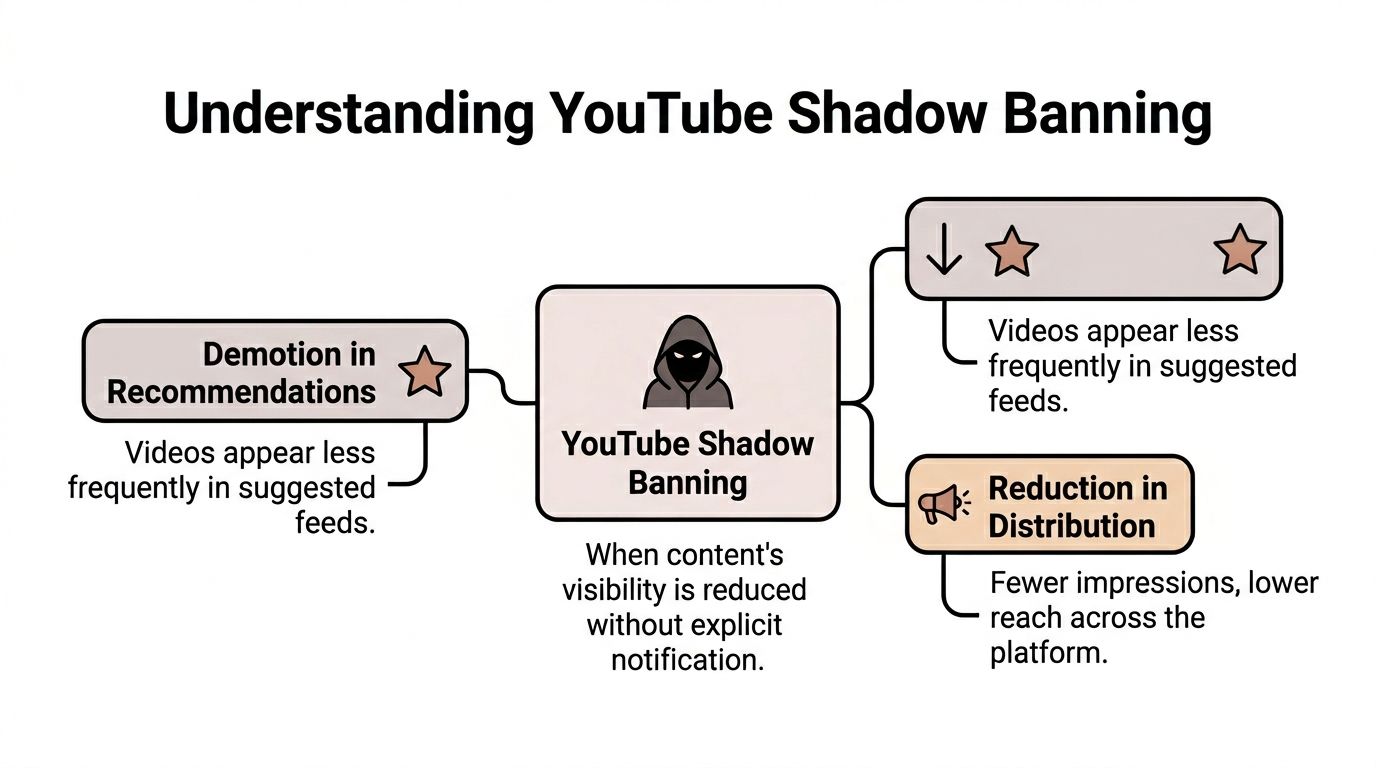
YouTube doesn’t officially frame this as “shadow banning.” The platform language is closer to demotion in recommendations or reduction in distribution. Creators use the shadow ban label because the experience feels the same. Content stays public, but YouTube stops showing it to enough new people to matter.
That difference matters. It’s not usually a secret blacklist in the dramatic sense. It’s a trust and performance system deciding your video, or sometimes your channel pattern, shouldn’t get broad distribution right now.
The penalty box
A practical way to think about youtube shadow banning is a penalty box, one that lacks overt notification.
Your videos are still live. Subscribers may still see them. Direct links still work. But recommendation surfaces stop carrying the load. For Shorts creators, that’s brutal because discovery is the whole engine.
A documented case described a 70% drop in views from non-regular viewers after anti-spam systems detected suspicious patterns such as a rapid surge in videos across channels, according to creator-tools.com’s write-up on YouTube demotion in recommendations. The content wasn’t removed. It was pushed less.
The same source notes that for YouTube Shorts in 2026, shadowban indicators include a 70-90% drop in impressions without a quality or schedule change, and suppressions can last 2-4 weeks if the creator removes likely triggers and posts stronger follow-up content.
Why YouTube does this
YouTube’s incentives are simple. It wants viewers to keep watching and to trust what appears in the feed.
That means the platform reacts badly to patterns that look like:
- Spam behavior: bulk uploads, duplicate assets, sudden publishing surges
- Misleading packaging: clickbait titles or thumbnails that promise something the video doesn’t deliver
- Borderline trust signals: content that creates quick clicks followed by fast abandonment
If the packaging drives curiosity but the video disappoints, YouTube reads that as a poor viewer experience. The platform then protects itself by reducing distribution.
What this is not
It’s not always punishment for breaking a rule. Often it’s automated risk control.
That’s why creators get stuck. They keep asking, “What rule did I violate?” when the system is really reacting to a bundle of signals:
| Signal type | What YouTube likely reads | What the creator experiences |
|---|---|
| Distribution signal | Low trust or low confidence in broader recommendation | New viewers disappear |
| Metadata signal | Packaging looks misleading or over-optimized | Clicks happen, then reach shrinks |
| Upload pattern signal | Activity resembles spam or feed-cluttering | Multiple videos stall at once |
| Behavioral signal | Viewers abandon early or respond poorly | Promotion stops |
Practical rule: If your videos are public but discovery traffic disappears, treat it as a distribution problem first, not a content-deletion problem.
Why the term still matters
Even if YouTube prefers softer language, creators need a term for what they’re seeing. “Shadow ban” survives because it describes the lived experience of unexplained invisibility.
The useful mindset is this: stop arguing over the label and diagnose the mechanism. Once you know whether your problem is trust, performance, or spam detection, recovery gets much more straightforward.
Shadow Ban vs Channel Strike vs Algorithm Change
A lot of creators misdiagnose a recommendation demotion because all traffic drops feel the same from the dashboard level. They aren’t the same.
A Community Guidelines strike is explicit. YouTube tells you about it. A broad algorithm change affects many channels at once and usually changes what formats or behaviors perform well. A shadow-ban-like demotion is narrower. Your content remains available, but distribution narrows hard.
Identifying Your Channel's Issue
| Indicator | Shadow Ban (Demotion) | Community Guideline Strike | Algorithmic Throttling |
|---|---|---|---|
| Notification from YouTube | Usually no direct notice | Yes, typically explicit in Studio or email | No direct notice |
| Video availability | Usually still public | May be removed or restricted | Still public |
| Where views come from | Often mostly subscribers | Depends on the restriction | Mixed, but weaker than usual |
| New audience discovery | Falls sharply | Can be limited by enforcement action | May slow during testing |
| Channel features | Usually unchanged | Can be limited depending on strike status | Unchanged |
| Main cause | Recommendation demotion, spam signals, low trust | Policy violation | Normal testing, audience mismatch, format shift |
| Recovery path | Remove triggers, improve signals, wait for re-evaluation | Appeal if appropriate, comply with policy | Adjust content strategy and audience fit |
The clearest symptom of demotion
One of the strongest signs of a shadow-ban-style issue is views coming almost entirely from subscribers. That’s a major break from how Shorts usually grow.
Miraflow’s analysis notes exactly that pattern and describes YouTube suppression as a performance gate rather than a classic ban. It also cites broader 2025 social platform data where 8.1% of Facebook users and 3.8% of Instagram users believed they had experienced shadow banning, while on YouTube the practical version often looks like promotion stopping after initial audience tests, without explicit notification. See Miraflow’s breakdown of YouTube Shorts shadowban signals.
When it’s probably not a shadow ban
Sometimes a channel is just getting normal algorithmic resistance.
That happens when YouTube tests a video with a small audience and does not like the response. The video isn’t demoted for trust reasons. It does not earn a wider push.
Signs you may be dealing with regular throttling instead:
- Some non-subscriber traffic still exists: It’s weak, not absent.
- Only one format drops: The whole channel isn’t affected.
- Recent niche drift: You changed topic, pacing, or audience promise.
- Everyone in your niche is reporting turbulence: That often points to a platform-wide adjustment.
When it’s definitely something else
If YouTube restricts features, removes a video, flags content directly, or sends policy notices, stop calling it shadow banning. You have an enforcement issue.
That matters because the wrong fix wastes time. If your channel has a strike, tweaking thumbnails won’t solve it. If your videos fail audience tests, taking a long upload pause may not help much either.
The fastest recovery starts with naming the correct failure mode.
For most creators, the useful split is simple. Silent loss of discovery suggests demotion. Explicit account action suggests policy enforcement. Uneven performance without obvious suppression patterns usually suggests ordinary recommendation testing.
How to Diagnose a Shadow Ban on Your Channel
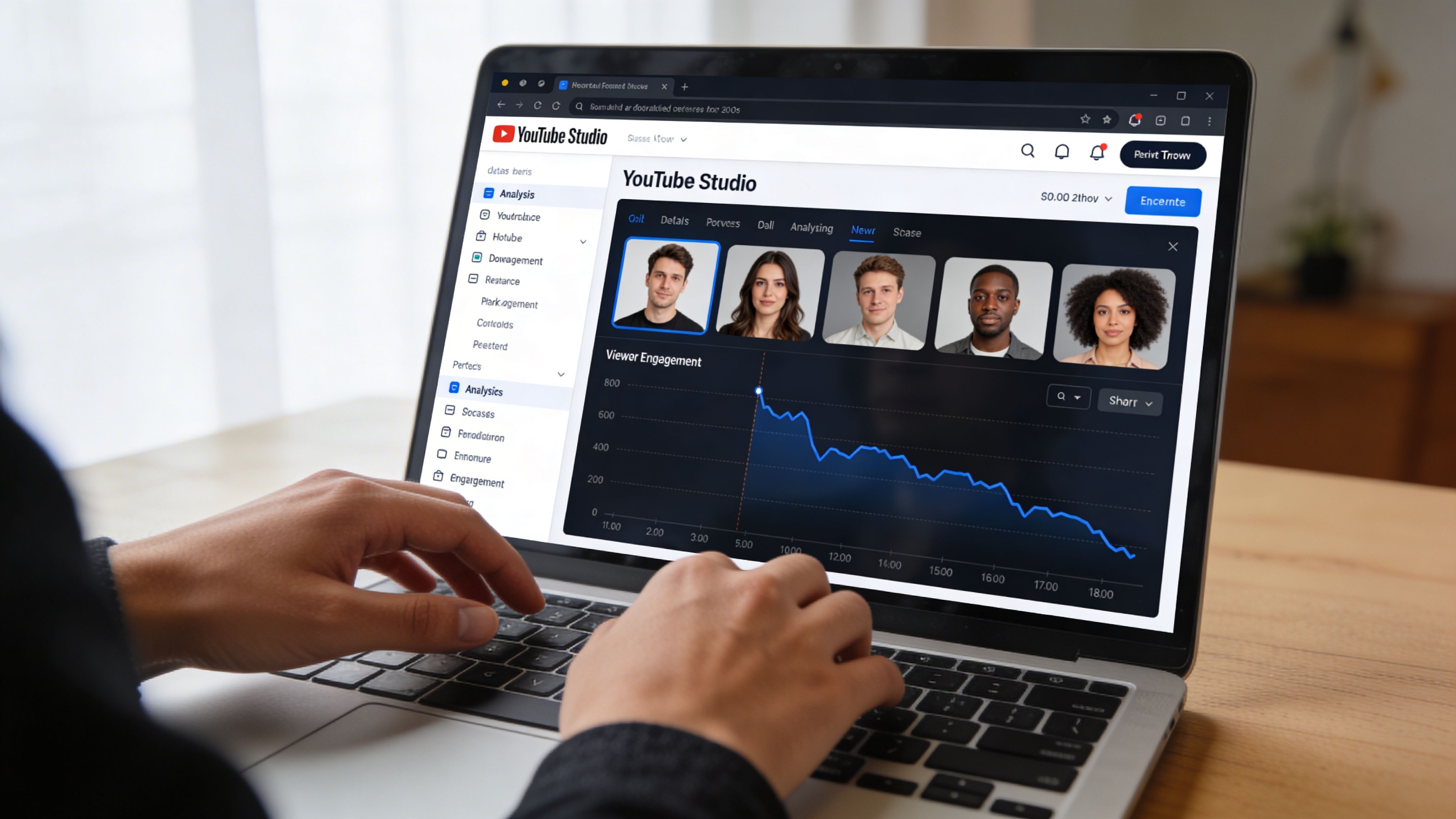
Diagnosis starts in YouTube Studio, not in creator forums.
You’re looking for evidence that distribution shrank in a specific way. The goal isn’t to prove a theory. The goal is to isolate whether YouTube reduced recommendation exposure, whether your video failed early testing, or whether a hidden restriction is undercutting reach.
Start with traffic source shape
Don’t begin with total views. Begin with how viewers find your videos.
If browse features, suggested video traffic, or Shorts feed exposure collapse while your video remains public, that’s a serious clue. If the remaining audience is mostly subscribers or direct traffic, distribution has likely narrowed.
Check several recent uploads, not just one. A single weak upload can be normal. A repeating pattern across multiple videos usually isn’t.
Look for a testing failure pattern
Recent creator case studies point to new-channel and AI-heavy biases that can mimic shadow bans. Those include “invisible age restrictions”, thumbnails with AI-generated faces, and early testing phases where low initial CTR causes impressions to get cut, with creators reporting 80-90% view drops without strikes. That pattern is discussed in this creator analysis of hidden YouTube suppression signals.
What you’ll often see is this sequence:
- A video gets a small initial push.
- CTR or early viewer response underwhelm.
- Impressions stop.
- The video never gets a second wave.
That’s not the same as a manual penalty, but the effect on growth is almost identical.
Use a practical channel audit
Run a clean audit across your last batch of uploads.
- Check consistency: Did traffic collapse after a thumbnail style change, topic shift, or upload surge?
- Review audience source mix: Are non-subscriber views suddenly missing?
- Watch real-time behavior: Did views die after a brief burst?
- Inspect comments and visibility: Open an incognito window, search your video when logged out, and see whether the content and discussion appear normally.
One practical incognito test often used by operators dealing with spam suspicion is to search while logged out, sort by newest when relevant, and verify whether the video and comments are visible to a neutral viewer. It won’t prove everything, but it helps spot obvious indexing and visibility anomalies.
Check for hidden restrictions
Not every reach collapse comes from low performance.
Sometimes the issue is a hidden limiter attached to the content itself. Story channels, faceless narration, and edgy educational formats can run into age-related or suitability flags that never look dramatic from the front end but still cut recommendation potential.
Watch for these clues:
- A topic that suddenly underperforms despite stable execution
- A thumbnail style that correlates with drops
- A channel history issue, where older content may still influence how the system classifies your newer uploads
Don’t audit in your head
Use a repeatable spreadsheet or dashboard. Track title, thumbnail type, hook style, topic, publish time, first-hour response, and traffic source mix. If you don’t have a system, this guide on how to track content performance gives a practical structure for reviewing Shorts and spotting pattern changes early.
If you can’t point to the moment impressions stopped and where the remaining views came from, you’re still guessing.
What usually confirms it
A likely shadow-ban-style demotion usually leaves a cluster of signs rather than one smoking gun:
| Diagnostic clue | What it suggests |
|---|---|
| Discovery traffic disappears but video stays public | Recommendation demotion |
| Most views come from subscribers | Distribution narrowed |
| New subscriber growth stalls despite uploads | YouTube isn’t finding new viewers for you |
| Real-time views stop after an initial burst | Early testing failed or impressions were cut |
| Incognito visibility looks inconsistent | Search or distribution issue worth deeper review |
Use the bundle, not a single metric. Creators get into trouble when they call every weak upload a shadow ban. The stronger diagnosis is pattern-based and boring. That’s usually what makes it right.
The Hidden Hurdles for Automated and Faceless Channels
Automated and faceless channels don’t just face the usual recommendation volatility. They run into two extra filters at the same time.
First, they have to pass an early performance gate. Second, they have to avoid looking like spam.
That combination is why youtube shadow banning gets discussed so much in AI Shorts circles. A channel can be fully compliant with policy and still get buried because the content feels templated, the upload pattern looks synthetic, or the assets overlap too heavily across accounts.

The performance gate problem
For faceless Shorts, the opening moments do more than attract interest. They decide whether the video gets to leave the testing lane.
Research aimed at automated channels points to a critical threshold in the first part of the video. If initial audience retention in the first segment is poor, promotion stops. This is especially rough on templated narratives like scary stories, trivia, and bedtime-style formats when the hook doesn’t match the audience promise.
A lot of faceless content fails here for a simple reason. The script was optimized for topic popularity, not for signal coherence. The thumbnail promises one thing, the opening line signals another, and the pacing lags before the payoff.
Why scale triggers spam systems
The second problem is operational.
Bulk uploading and duplicate deployment across channels can trigger spam detection. That includes AI-generated shorts repurposed into multiple languages or lightly rewritten versions of the same idea. One experiment described 100+ AI Shorts uploaded rapidly that stalled at under 100 views per video, with the pattern attributed to spam detection and duplicate-content recognition. Practical mitigations in the same analysis included limiting early posting velocity to 3-5 videos per week per channel and maintaining more than 70% script divergence between assets. That comes from Fliki’s breakdown of YouTube shadowban triggers for AI content.
What the system notices
YouTube doesn’t need your videos to be identical to classify them as low-trust. It can react to patterns.
Common risk patterns include:
- Burst publishing: too many uploads too quickly on a new or weak-trust channel
- Cross-channel duplication: similar scripts, visuals, or voice patterns deployed repeatedly
- Shared operational footprints: multiple channels behaving like one network
- Metadata sameness: titles, thumbnails, and descriptions that follow a repeated template too closely
What works for faceless operators
The channels that survive automation don’t usually do it by posting harder. They do it by posting cleaner.
A better operating model looks like this:
| Bad habit | Better move |
|---|---|
| Uploading in large batches right away | Start slower and let the channel build normal history |
| Reusing the same script with cosmetic edits | Rewrite the narrative angle and opening completely |
| Using one thumbnail system for every topic | Build topic-specific packaging |
| Syncing identical assets across platforms | Adapt each asset to the platform and audience |
| Treating every low-view Short as random | Audit hook, retention, and source mix after each post |
Faceless channels can scale. They just can’t scale carelessly.
If you’re building one of these channels, it helps to study channel architecture before you automate publishing. This guide on how to make a faceless YouTube channel is useful because it focuses on structure and positioning, not just content generation.
The biggest mistake I see
Creators assume automation causes suppression. It doesn’t.
Predictable, low-trust automation causes suppression. There’s a difference.
If your visuals feel generic, your voiceover style never changes, your scripts recycle the same dramatic cadence, and your post schedule looks machine-perfect across multiple accounts, you’re handing YouTube a pattern it can classify. The platform doesn’t need to know your intent. It only needs enough signals to reduce confidence.
A Step-by-Step Recovery and Prevention Plan
Recovery works best when you stop trying to “beat the algorithm” and start repairing the signals that damaged trust or failed testing.
For automated and faceless channels, one overlooked issue is the early performance gate. If the video underperforms in the opening phase, YouTube can stop promoting it. Guidance aimed at these channels suggests that escaping that gate depends on a CTR above 5-10% and retention above 50% in the initial phase of testing, as discussed in this breakdown of performance gates for faceless channels.
First do less
The worst move after suspected suppression is flooding the channel.
Instead:
- Pause uploads briefly. If your recent pattern looks spammy or unstable, give the system a chance to reset around cleaner inputs.
- Audit your recent videos. Focus on titles, thumbnails, hooks, duplicated formats, and any metadata that overpromised.
- Remove obvious triggers. If a thumbnail implies something the video never delivers, fix it or replace the asset.
- Stop cross-post cloning. Don’t ship the exact same package everywhere and expect YouTube to treat it as fresh.
A short content detox often works better than frantic activity because it removes fresh negative signals while you clean the backlog.
Rebuild the first seconds
For Shorts, the opening is where suppression often starts.
Use a stricter hook checklist:
- Match promise to payoff: If the thumbnail suggests a reveal, the first line must move straight toward that reveal.
- Cut setup language: Don’t spend the opening explaining what the video is about.
- Use visual change early: A static first beat hurts faceless videos fast.
- Align voice, text, and image: Mixed signals create weak retention even when each asset looks fine alone.
Your thumbnail gets the audition. Your first seconds decide whether YouTube books the role.
Fix packaging before you post more
A lot of channels focus on script quality and ignore packaging quality. That’s backwards. YouTube often decides whether to keep testing a video based on how the package and the opening perform together.
Disciplined search and discovery fundamentals are helpful here. If you need a practical refresher, Whisper AI’s guide to YouTube SEO best practices is useful because it keeps the focus on titles, intent alignment, and metadata choices that support trust instead of gaming clicks.
Build a prevention system
Recovery is good. Prevention is cheaper.
Use these operating rules going forward:
- Vary your publishing rhythm: Avoid patterns that look aggressively automated.
- Separate channel identities: Don’t let multiple channels feel like copies of one machine.
- Test packaging families: Compare hook styles and thumbnail directions instead of assuming one template fits all.
- Track first-phase metrics: Watch early impressions, CTR, retention, and source mix before scaling a format.
- Earn history carefully: A stable pattern of clear audience fit beats volume.
If you want a tactical playbook for discovery on Shorts after cleanup, this guide on how to get views on YouTube Shorts is a solid complement to the recovery work above.
What doesn’t work
Creators waste weeks on the same bad fixes:
- Uploading more to force a breakout
- Changing titles repeatedly on weak videos
- Copying a viral competitor too closely
- Running identical story formats across multiple channels
- Assuming quality alone overrides spam signals
Quality matters. So does operational discipline. You need both.
Frequently Asked Questions About Shadow Banning
Can a YouTube shadow ban be permanent
Sometimes the damage lasts a long time, especially when creators keep feeding the same negative signals into the system. But many channels recover once they stop the behaviors that triggered demotion and start publishing cleaner, better-matched content. Permanent usually isn’t the right frame. Persistent is.
Does shadow banning affect monetization
It can, indirectly. If YouTube reduces distribution, views and subscriber growth slow down. That makes monetization harder because the channel struggles to generate the watch activity and audience momentum needed to support revenue. The platform may not remove monetization features, but suppressed reach still hits earnings.
Is this more common on Shorts than long-form
It’s more visible on Shorts because Shorts depend so heavily on recommendation distribution. When that disappears, the drop feels instant. Long-form videos can still pull from search, library traffic, and older evergreen behavior. Shorts channels often don’t have that cushion.
Can linked accounts on other platforms get affected
There’s no reliable public evidence that a YouTube suppression event directly carries over into TikTok or other platforms. What does happen is operational spillover. If you post the same low-trust assets everywhere, each platform may independently react poorly.
What if a harmful or false video about me is part of the problem
That’s a separate issue from recommendation demotion, but it matters for brand safety. If you’re dealing with damaging content, this guide on how to remove a negative video from YouTube is a useful resource for understanding your options.
Should I delete low-performing videos
Not automatically. Delete or rework videos when they clearly carry misleading packaging, duplicate too much of other assets, or create channel-level trust problems. Don’t purge your library just because a few uploads underperformed.
If you run a faceless or automated Shorts workflow, ClipCreator.ai can help you produce and schedule original short-form videos without the usual manual bottlenecks. It’s built for creators, educators, brands, and agencies that need consistent output while keeping tighter control over scripts, visuals, voiceovers, and publishing. See how it works at ClipCreator.ai.

Create your first video in under 2 minutes
Pick a niche, and ClipCreator.ai generates and auto-posts faceless videos to your channels every day.
Join ClipCreator.ai