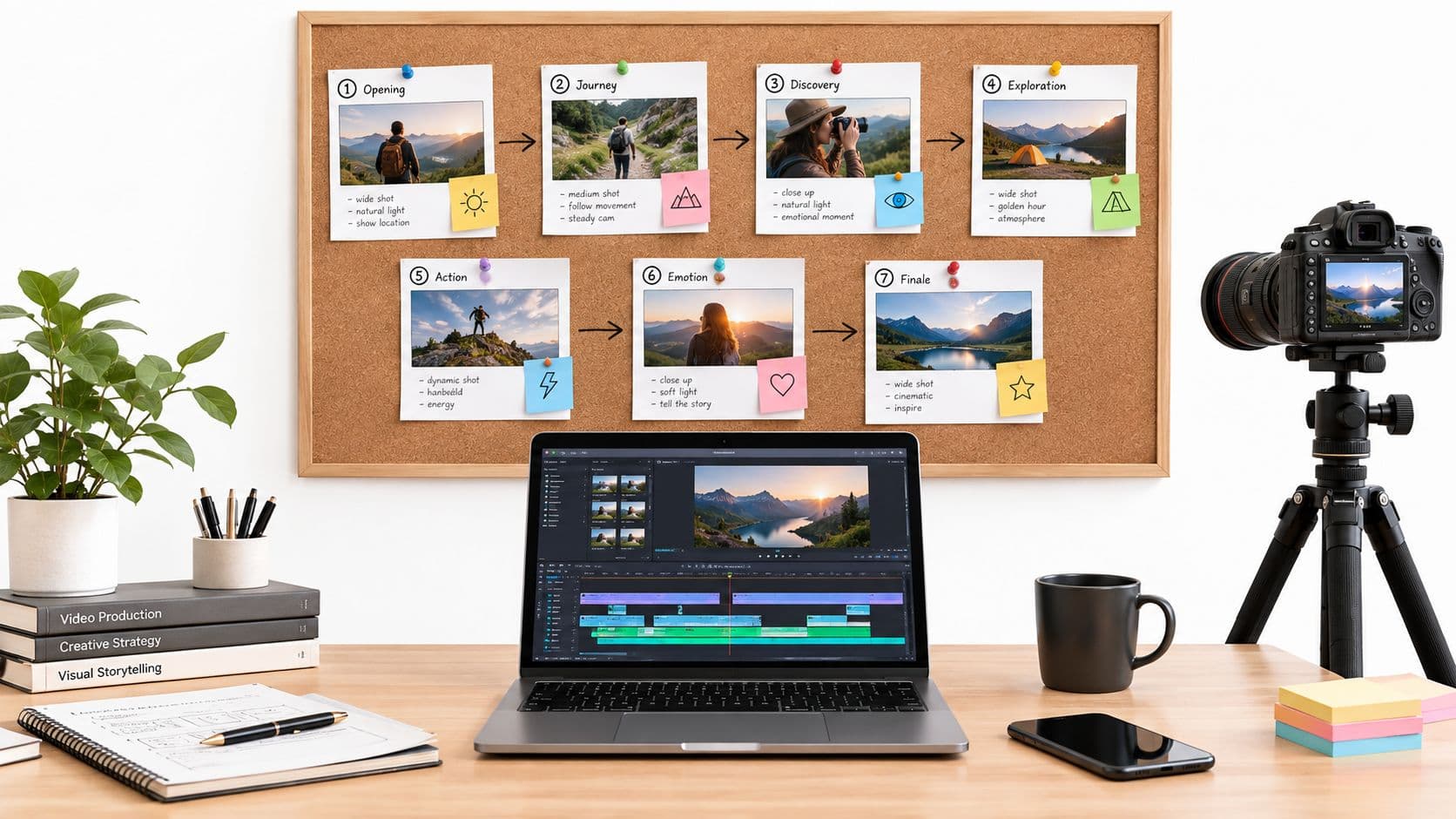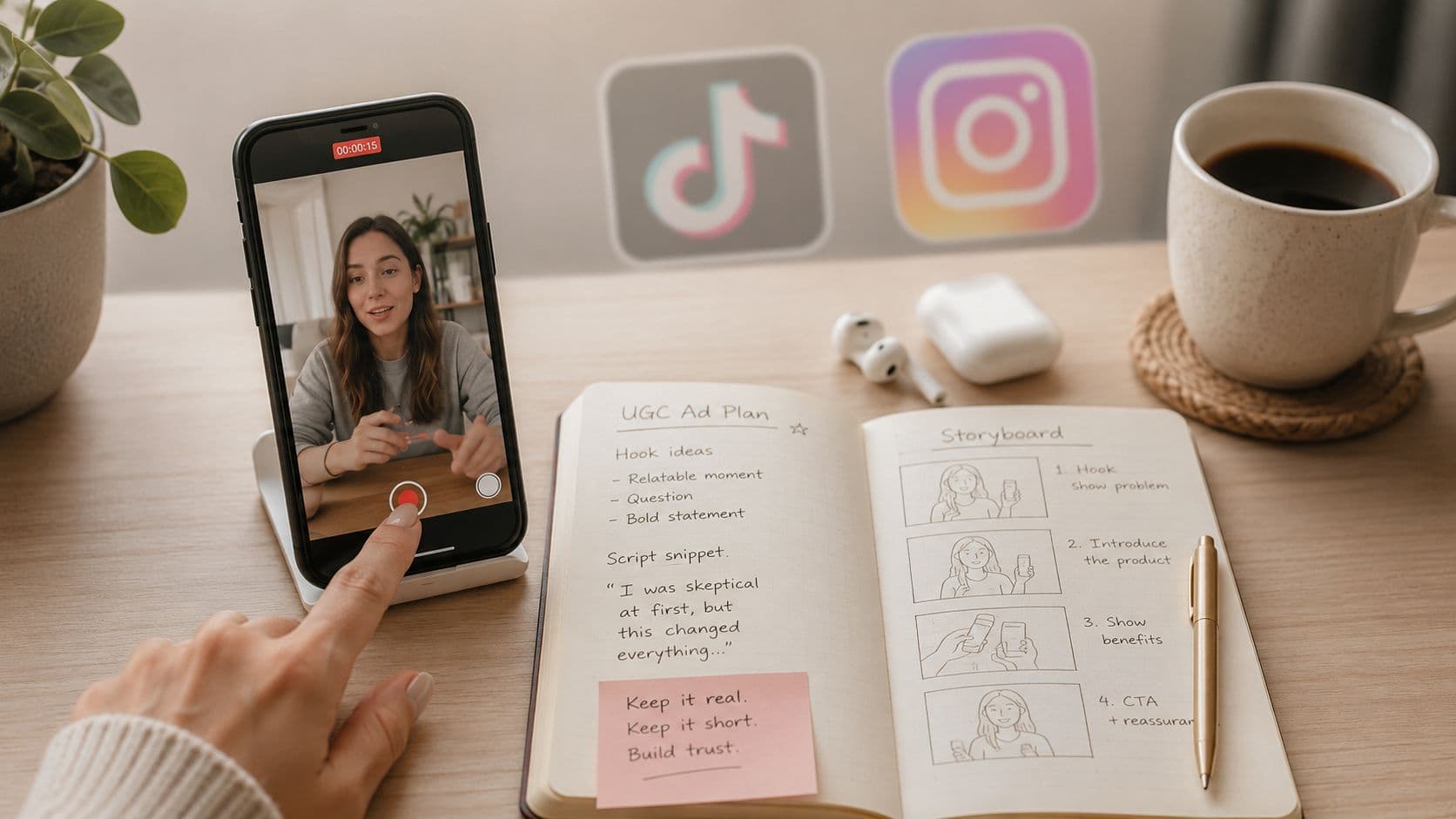
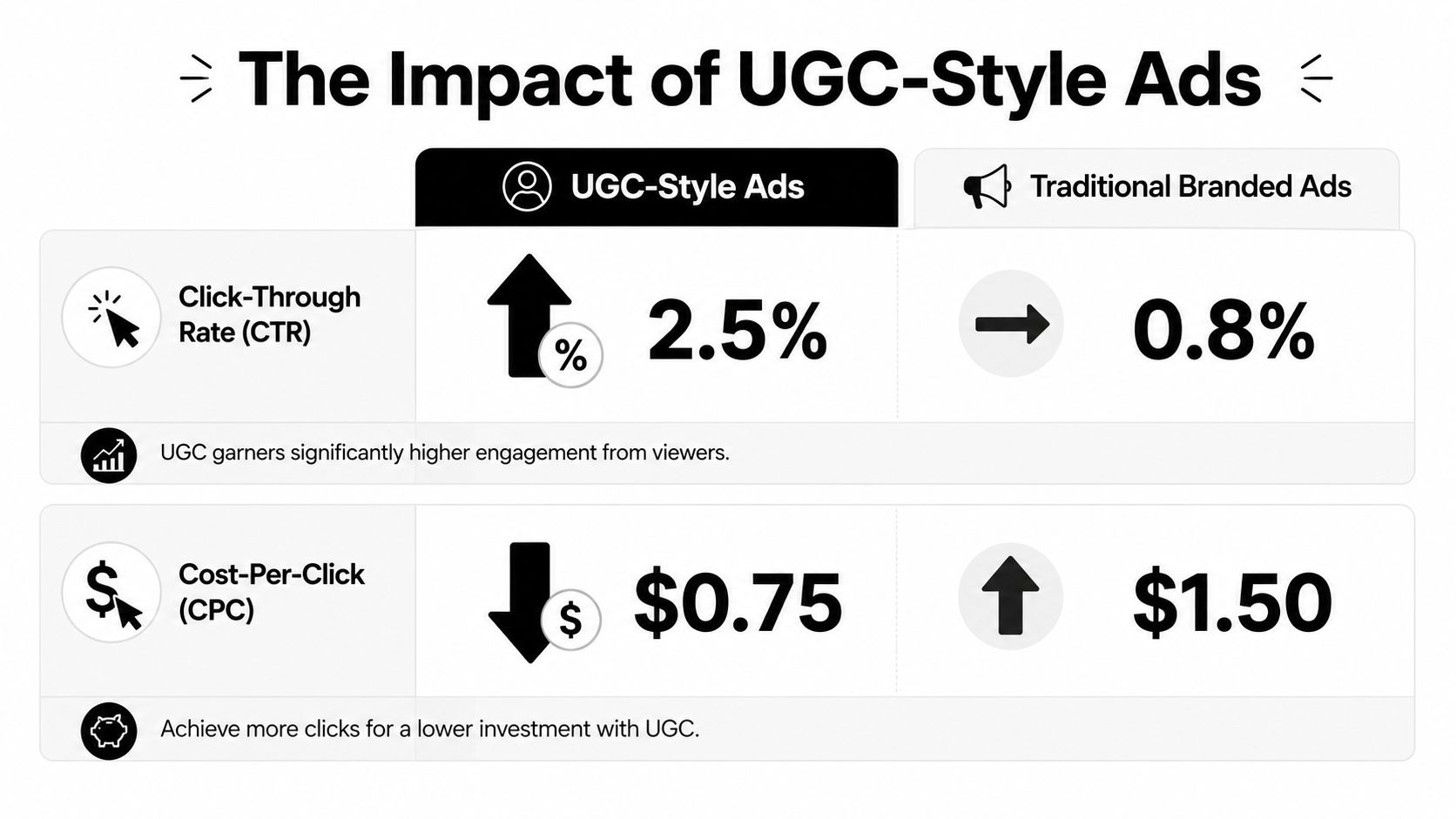
UGC style ads stopped being a creative trend once they became a media buying advantage. Performance data cited by Kapwing's 2026 UGC statistics roundup shows UGC-style ads generate 4x higher click-through rates and reduce cost-per-click by 50% versus traditional studio-produced brand ads. That changes how you plan campaigns, not just how you edit videos.
A persistent error in strategy is treating UGC as a single format. They write a problem hook, hand it to a creator, launch it, then wonder why it works for cold traffic but stalls with warmer audiences. The fix is usually not “better content” in the abstract. It's better creative sequencing. Cold audiences need recognition. Warm audiences need proof. Skeptical buyers need conviction without feeling pushed.
That's where strong UGC systems separate from random creative testing. The work starts before filming, gets sharper in the brief, and keeps evolving after launch. If you want ugc style ads to scale, you need a repeatable way to move from rough authenticity to structured persuasion.
Why UGC Style Ads Dominate Social Feeds
UGC-style creative has become one of the clearest performance advantages in paid social. As noted earlier, Meta benchmark data cited by Kapwing found materially higher click-through rates and lower CPCs for UGC ads than traditional branded creative. That gap explains why many growth teams now treat creator-style ads as a primary buying asset, not a nice-to-have variation.
The reason is simple. UGC matches how people already consume short-form content.
A polished brand ad often signals itself in the first second. Clean product shot. Branded intro. Broad promise. Viewers on TikTok, Reels, and Shorts have seen that pattern thousands of times, so they decide fast whether to keep watching. UGC-style ads interrupt that filtering process because they look and sound closer to content people would watch by choice.
What makes an ad feel UGC style
The strongest UGC ads share a few traits, even when the production quality is high:
- Direct address: A person speaks to the viewer in a natural cadence instead of reciting approved brand copy.
- Native pacing: The edit moves at feed speed, with quick cuts, on-screen captions, and early visual payoff.
- Familiar production cues: Phone-shot footage, casual framing, home or office settings, screen recordings, and hands-on product use make the ad feel socially native.
- Personal framing: The message comes through as lived experience, specific observation, or a recommendation grounded in use.
Those cues matter, but they are only the wrapper. Performance comes from message-to-audience fit.
Cold traffic often responds to recognition. Warm traffic usually needs evidence. Retargeting audiences that already know the category but doubt the claim tend to convert on proof, comparison, and objection handling. That is the part many UGC guides skip. They teach problem-solution hooks for awareness, then leave brands stuck once frequency climbs and the audience gets more skeptical.
Why audiences respond
UGC works because it reduces resistance at the moment of impression. The viewer sees a person using, reacting to, comparing, or explaining a product before the brand asks for belief.
That sequence matters.
In accounts I have scaled, top-of-funnel UGC usually wins on relatability and pace. Mid-funnel and bottom-funnel UGC win for a different reason. They can carry proof without looking like a hard sell. A creator showing texture, setup, wear test, before-and-after results, or a side-by-side comparison often does more than a polished value proposition card because it answers the next question a skeptical buyer already has.
That also creates a clear path for faceless creative. You do not need an on-camera personality to get the UGC effect. Screen recordings, product-only demos, POV hands, text-message style narration, customer review overlays, AI voiceover, and AI avatars can all work if the ad still feels specific, feed-native, and evidence-led. The format is flexible. The persuasion mechanics are not.
Practical rule: If the first seconds feel over-produced or over-explained, the ad is asking for attention before it has earned it.
What usually fails
Weak UGC ads copy the surface style and miss the selling structure. The footage looks casual, but the persuasion feels artificial.
These versions usually lose:
| Weak approach | Why it breaks |
|---|---|
| Fake casual language | Viewers hear the brand script underneath the “authentic” phrasing |
| Generic pain-point hooks | They blend into every other ad in the category and rarely hold attention past the opener |
| Over-scripted testimonials | They remove the small imperfections that make a recommendation believable |
| No proof moment | The ad asks for trust before showing why the claim should be believed |
The best UGC creatives are not raw for the sake of being raw. They are specific, believable, and structured for the audience's stage of awareness. That is why they keep winning in crowded feeds, and why the strongest programs evolve creative from problem-sold hooks into proof-sold ads as prospects get closer to purchase.
The Pre-Production Blueprint for Winning Ads
The easiest way to waste UGC is to start with execution instead of strategy. Teams chase creators, write a loose brief, then try to fix weak positioning in the edit. Most of the time, the actual failure happened before the first line was written.
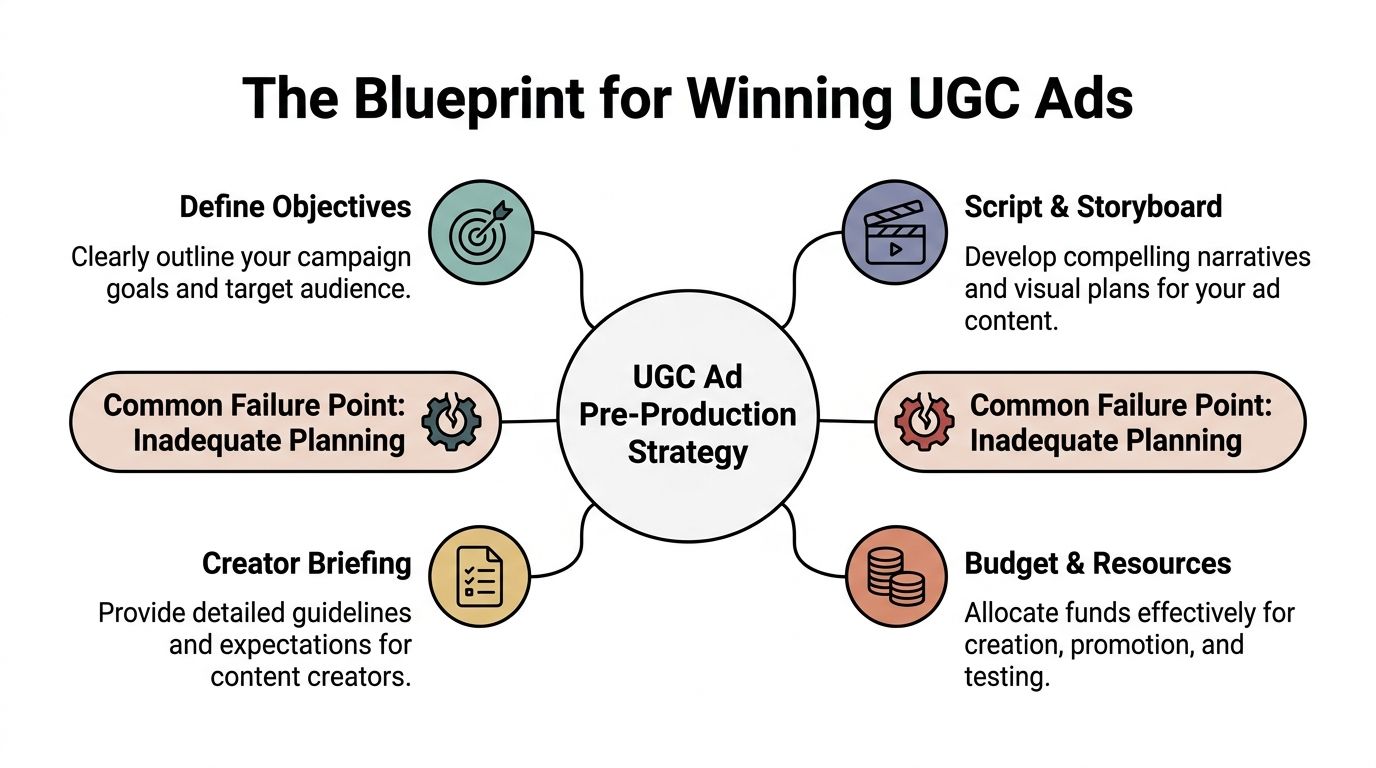
A trust-first planning phase matters because consumers use UGC as purchase validation, not just entertainment. According to Billo's UGC statistics roundup, 85% of consumers rely on seeing UGC videos before trusting a product enough to purchase, and integrating UGC on product pages can increase conversions by 74%. If trust is the job, your brief has to define what kind of trust the ad needs to build.
Start with one job per ad
A winning UGC ad usually does one thing well. It doesn't educate, qualify, close, and retarget all at once.
Before scripting, lock these three decisions:
- The conversion goalAre you trying to earn the click, the lead, the add-to-cart, or the purchase?
- The audience temperatureIs this cold traffic, returning site visitors, cart abandoners, or product-aware prospects?
- The friction pointDo they need problem awareness, mechanism clarity, comparison proof, or reassurance?
When teams skip this, they write catch-all ads. Catch-all ads usually feel busy and expensive.
Here's a useful training aid for briefs and creator direction:

Match the message to funnel depth
The biggest shift most brands need is moving from problem-sold creative to proof-sold creative.
A problem-sold ad says: “You have this issue, and here's a better option.”
A proof-sold ad says: “You already know the category. Here's why this one is worth believing.”
That distinction changes the entire brief.
| Funnel stage | What the viewer needs | Best UGC angle |
|---|---|---|
| Top of funnel | Recognition | Problem, frustration, failed workaround |
| Mid funnel | Clarification | Demo, mechanism, use case, comparison |
| Bottom funnel | Conviction | Results, side-by-side proof, objection handling |
The ad brief should answer one question before anyone films: “What doubt are we removing?”
Build the brief before the script
A usable brief doesn't need to be long. It needs to be hard to misread.
Include:
- Audience snapshot: Who this ad is for, in plain language
- Awareness level: Cold, warm, or solution-aware
- Core promise: The single outcome or advantage to emphasize
- Mandatory proof cue: Demo, testimonial structure, comparison, screen capture, before and after framing
- Disallowed moves: Claims that sound too broad, too polished, or too aggressive
This process helps many teams save money. A clear brief produces tighter first drafts, cleaner creator output, and fewer revision loops. A vague brief creates “content” instead of ads.
Scripting UGC Ads That Actually Convert
Scripts fail when they read like copywriting and not speech. The viewer should feel like they've interrupted someone mid-thought, not stepped into a commercial.
The most reliable frameworks for UGC still come from direct response. Stackmatix's guide to TikTok UGC ad performance points to frameworks like PAS and Before/After as core parts of a repeatable testing and scaling cycle. That's not because formulas are magical. It's because they force clarity.
Write the hook like it carries the ad
Most performance is decided before the body has a chance to work. If the opening line is vague, the rest of the script doesn't matter.
Good hooks usually do one of four things:
- Name a familiar frustration
- Introduce a sharp opinion
- Signal comparison
- Promise a specific reveal
Weak hooks usually sound like this: “Hey guys, I wanted to talk about…” or “I've been using this product and…”
Those lines waste the highest-attention moment in the ad.
Don't write the first line to introduce the product. Write it to earn the next line.
Use frameworks as scaffolding, not final copy
Here are practical starting points you can hand to a creator or adapt for faceless production.
| Framework | Hook (0-3s) | Body (4-15s) | CTA (15-20s) |
|---|---|---|---|
| PAS | “If you're tired of dealing with [problem], this is the first thing I'd try.” | Agitate the old method or pain point. Introduce the product as the simpler fix. Show the use moment. | “If that's your issue too, it's worth trying.” |
| Before and After | “My old setup was a mess, this is what I changed.” | Show the “before,” then the new workflow, routine, or result with the product in context. | “See if it fits how you work.” |
| Contrarian | “I thought this product category was overhyped until I tested this one.” | Explain the skepticism first. Then describe the feature, behavior, or result that changed your mind. | “If you've been skeptical too, start here.” |
| Proof sold comparison | “I tried a few options. This is the one I kept.” | Briefly compare alternatives, then explain the deciding factor. Show proof, not praise. | “Check the details and compare it for yourself.” |
The body needs movement
The middle of the script should do at least one visual job. It can't just continue the claim.
For physical products, that usually means:
- product in hand
- setup or unboxing
- side-by-side use
- before and after context
For software or SaaS, it often means:
- screen recording
- dashboard walkthrough
- one specific task completed
- result framed through workflow relief
If your script is still abstract by second five, rewrite it.
Sound like a person, not a campaign
Three edits improve most UGC scripts immediately:
- Cut adjectives. “Amazing,” “incredible,” and “game-changing” usually weaken credibility.
- Replace brand language with spoken language. Nobody says “pioneering solution” on camera unless they're reading.
- Shorten every sentence. Spoken rhythm wins.
For teams building scripts at volume, a dedicated UGC script writing workflow helps standardize hooks and variations without turning every ad into the same template.
Write differently for proof-sold ads
Most guides fall short by concluding prematurely. Problem-solution scripts are fine for cold traffic, but warmer audiences often need a different voice.
A proof-sold script often starts with skepticism, not pain:
- “I didn't think this would be better than the others.”
- “I ignored this for a while because it looked like the same thing.”
- “This only made sense once I used it like this.”
That tone works because it mirrors the buyer's internal dialogue. It doesn't assume belief. It answers doubt.
Producing Your Ad From Creators to Faceless AI
There are two practical ways to produce ugc style ads at scale. You can work with human creators, or you can build faceless assets using scripts, B-roll, voiceover, captions, product footage, and screen recordings. Both paths can work. The better option depends on speed, control, brand risk, and how much variation you need.
Working with creators
Human creators still have one major advantage. They can make a script feel lived in. A small pause, a skeptical expression, an unscripted reaction, or a believable product-use moment can give the ad a layer of trust that polished in-house content often misses.
The workflow is straightforward:
- Source for fit, not follower count: Look for on-camera clarity, natural speech, and category alignment.
- Brief tightly: Give one angle, one audience, one friction point.
- Ask for options: Different hooks, different openings, or multiple CTAs.
- Review for believability: The delivery should sound familiar, not performed.
DM outreach can work well for recruiting creators, especially if you already know the style you want. The usual failure point is over-briefing. Once the script starts sounding like legal copy with personality pasted on top, the creator's value drops.
Building faceless UGC-style ads
Faceless production works best when you need consistency, speed, or high creative volume. It's also useful for brands that don't have a founder on camera and don't want to manage constant creator logistics.
The building blocks are simple:
| Asset type | Best use |
|---|---|
| B-roll | Lifestyle framing, product context, motion between claims |
| Screen recordings | SaaS demos, app walkthroughs, proof of function |
| Product close-ups | Texture, packaging, setup, feature emphasis |
| Captions | Reinforce hooks and keep silent viewers engaged |
| Voiceover | Carries the testimonial or narrative structure |
The challenge with AI-assisted production isn't just realism. It's trust. Motion's guide to effective UGC ads highlights a growing issue here: 68% of consumers distrust content they suspect is AI-faked, and platform compliance around AI labeling is becoming more important. That means faceless AI ads should aim for clarity and usefulness, not deception.
If the production method becomes the story, the ad loses focus. The product should still be the most interesting thing on screen.
Keeping AI content credible
A few rules matter:
- Label synthetic elements when required: Don't gamble with platform policy.
- Use grounded scripts: Narrow observations sound more credible than giant claims.
- Show real interface or product footage: Authentic visuals anchor synthetic narration.
- Avoid fake testimonial energy: Calm conviction usually beats exaggerated enthusiasm.
Teams figuring out where AI fits into creative operations may find Busylike on AI for creative teams useful because it frames AI as a production system choice, not just a content shortcut.
For faceless narration, the voice matters more than many teams expect. A flat, over-pronounced voice can kill an otherwise solid concept. Choosing a more natural AI text-to-speech voice for ad narration usually improves watchability more than adding another transition or effect.
Technical details that usually matter
Short-form platforms reward content that fits the feed, not content that forces adaptation.
Keep these standards in mind:
- Vertical framing: Prioritize 9:16 for TikTok and Reels
- Readable captions: Large enough to scan on a phone screen
- Front-loaded pacing: Strong visual or verbal movement immediately
- Clean audio: Viewers forgive casual visuals faster than muddy sound
The ad doesn't need cinematic production. It needs clear communication delivered in a native format.
Launching and Optimizing for Performance
Analysts at AdLibrary found that 73% of top-performing UGC ads used problem-solution hooks early, while the 29% that lasted past 30 days more often shifted into proof-based storytelling. That pattern matches what happens in live accounts. Problem-sold creative earns the first click. Proof-sold creative earns the sale once the audience already knows the category and starts asking harder questions.
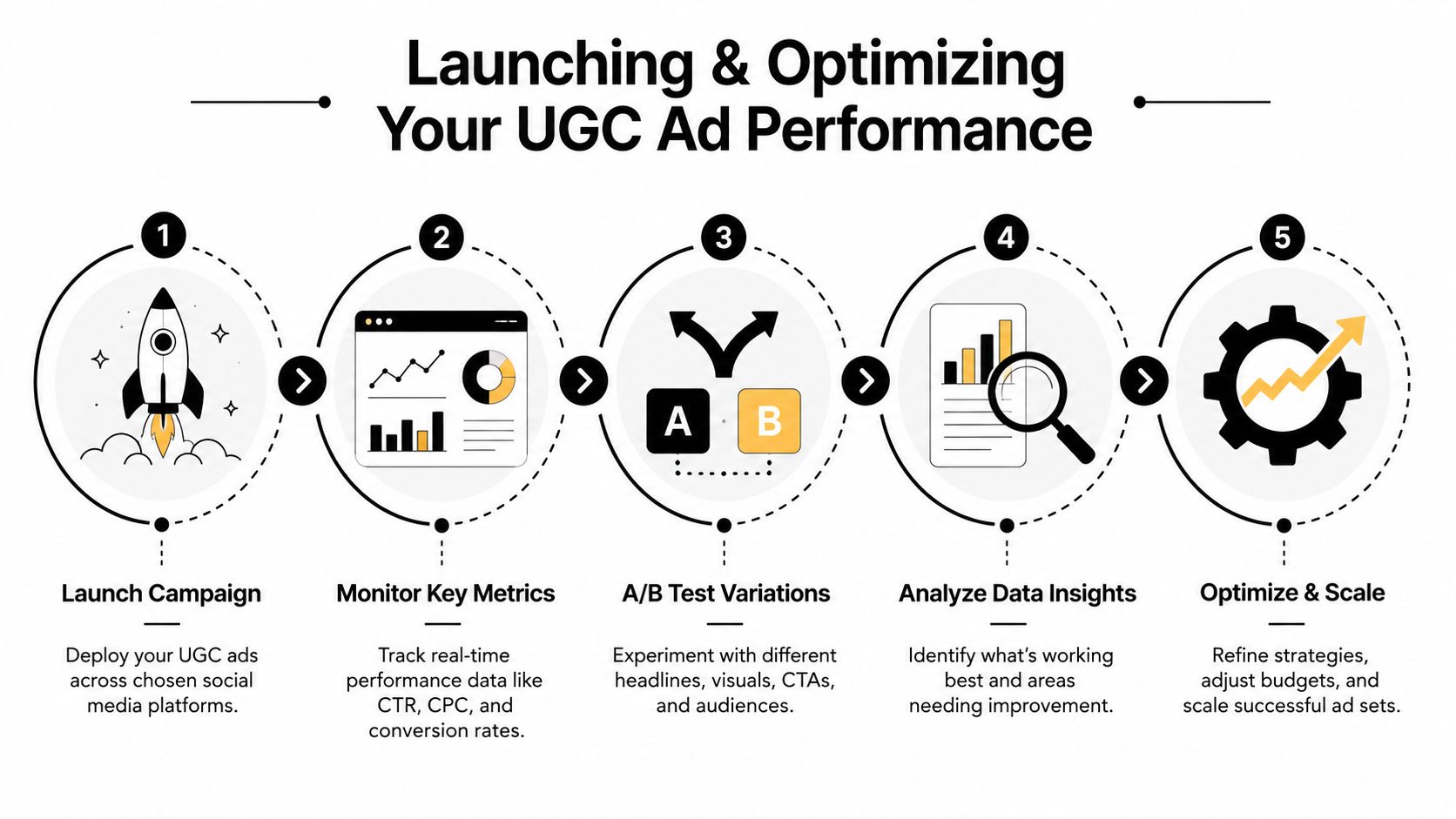
Launches work best when each variable has a job. If the goal is to learn which angle deserves budget, keep the product, offer, and core body copy stable. Change one major variable at a time so the result is readable.
A clean first batch usually includes:
- Hook test: Same ad body, different first 3 seconds
- Proof test: Same promise, different evidence type such as demo, comparison, or result framing
- Delivery test: Same script, different creator, voice, or faceless presentation style
- CTA test: Same concept, different close based on intent level
That setup matters even more if you produce ads at volume with an AI content creation workflow for social media. Speed is useful only if the testing structure stays disciplined.
Use spend thresholds before opinions
Creative review gets messy once teams fall in love with a script. Performance rules fix that.
Stackmatix's TikTok UGC performance methodology lays out practical thresholds: launch 3 to 5 creatives with 50 to 200 test budgets, scale winners by 2 to 3x, pause ads that fail to generate a purchase after $150 in spend, and treat a CTR below 1% in the first 24 hours as an early warning sign. Their analysis also notes that once 7-day frequency passes 2.5, CPAs often climb 12% to 18% in the following week if the creative is not refreshed.
I use those numbers as guardrails, not law. Price point, sales cycle, and account maturity change the pace of learning. A 25 impulse product can be judged faster than a 120 product with heavier consideration. The point is to decide in advance what success and failure look like.
Match optimization to funnel stage
A common mistake is trying to fix every weak ad with a stronger hook. That helps at the top of funnel. It does less for warm audiences who already understand the problem and are now questioning if your product is effective.
Use the right edit for the right failure:
| What you see | What it usually means | Better next move |
|---|---|---|
| Low thumbstop rate or weak CTR | The angle is not earning attention | Rewrite the first line or opening visual |
| Strong CTR, weak CVR | The promise got interest but not belief | Add proof, demonstration, or objection handling |
| Good view rate, skeptical comments | The audience is solution-aware but unconvinced | Shift to comparison, process transparency, or specific evidence |
| Rising frequency, falling efficiency | The audience has seen the pattern too often | Rotate creator, footage, claim framing, or ad structure |
This is the point where UGC strategy gets more mature. Early winners are often problem-sold. Durable winners become proof-sold. Instead of saying the problem louder, show why this product works better, faster, or more credibly than the alternatives people are already considering.
Proof usually outperforms persuasion for warm traffic
For retargeting and broader warm pools, I look for proof assets in this order:
- Visible product use
- Before-and-after context with realistic framing
- Comparison against the old method
- Specific objection handling
- Outcome recap with a clear CTA
Faceless AI ads can work well here because they are easier to refresh quickly. The catch is that proof has to carry the ad. Synthetic narration cannot rescue vague claims, weak footage, or a script that sounds like a testimonial parody.
For teams treating paid social as a revenue system instead of a content treadmill, this perspective on operational marketing for revenue growth is useful because it connects creative testing to account-level decision making.
Refresh parts before the whole ad breaks
Fatigue usually shows up in pieces first. The hook gets stale. The creator becomes familiar. The claim starts attracting doubt. Rebuilding the entire ad every time is expensive and unnecessary.
Replace the weakest component first:
- Falling CTR, change the opening line and first scene
- Stable CTR but weaker conversion, add proof and cut generic benefit language
- Higher frequency, rotate creator face, VO, or visual pattern
- More skeptical comments, answer the objection inside the ad instead of in the caption
The accounts that scale UGC consistently do not wait for a hero ad to collapse. They keep a steady replacement cycle running and push each concept from attention-led to proof-led as the audience gets warmer.
Building a Scalable UGC Ad System
The shift that matters most is mental. Stop thinking in terms of “making ads.” Start thinking in terms of building a creative operating system.
That system has a rhythm. One part identifies the audience and the friction. One part turns that into scripts. One part produces variants. One part tests and promotes the winners. Then the cycle repeats with better information than the last round.
What a stable system includes
A scalable UGC workflow usually needs these parts working together:
- A briefing layer: Clear audience, funnel stage, and proof requirement
- A scripting layer: Hooks and bodies built for testing, not perfection
- A production layer: Creator-sourced or faceless assets that can be turned around quickly
- A feedback layer: Performance review tied to creative decisions
- An operations layer: Asset naming, approvals, handoffs, and scheduling
Teams often don't fail because they lack ideas. They fail because production and optimization get trapped in one person's head.
Build for repeatability, not novelty
The strongest UGC systems reuse what works without repeating it mechanically. That means keeping the structure while refreshing the expression.
A practical checklist looks like this:
- Map each ad to one funnel stage
- Choose whether the angle is problem-sold or proof-sold
- Write multiple hooks before producing anything
- Capture or generate enough visual assets to support variation
- Track outcomes at the creative level
- Refresh the weakest component first
If you need support capacity around research, outreach, versioning, or repetitive production admin, using LatAm VAs can make the system easier to maintain without forcing senior marketers to handle every task manually.
A consistent publishing engine also matters. Teams producing recurring short-form assets often benefit from a documented AI content creation workflow for social media because consistency usually beats sporadic bursts of creative effort.
The brands that keep winning with ugc style ads don't rely on one creator, one script, or one lucky hook. They build a process that keeps learning. That's what turns social creative from a bottleneck into an advantage.
If you want a faster way to produce and publish faceless short-form videos for TikTok, YouTube, and Instagram, ClipCreator.ai helps turn prompts into scripted, voiced, captioned videos built for consistent output. It's a practical option for marketers, agencies, and creators who want more testing volume without a slower production workflow.

Create your first video in under 2 minutes
Pick a niche, and ClipCreator.ai generates and auto-posts faceless videos to your channels every day.
Join ClipCreator.ai