Ever tried to pin down exactly how many views is viral? It’s a bit like trying to grab a cloud—the answer shifts and changes depending on where you're standing. There's no single magic number that unlocks viral status. It’s all about context: the platform, your audience size, and, most importantly, how fast those views start rolling in.
True virality isn't a number; it's a phenomenon. It’s about explosive growth that completely shatters your normal performance benchmarks.
What Does It Really Mean to Go Viral Today

Let's clear up the biggest misconception right away: "viral" isn't a prize you get for hitting a specific view count. It's a moving target, and what feels like a massive victory for one creator might just be a regular Tuesday for another.
Think about it. If you're just starting out with 100 followers and your video suddenly skyrockets to 100,000 views, that's a viral home run. Your content has clearly broken containment and found a massive new audience.
But for a huge brand with 10 million followers, getting 100,000 views is a drop in the bucket. They'd probably need to hit 10 million views or more to feel that same explosive impact relative to their size.
A Snapshot of Viral View Benchmarks
To give you a clearer picture, here's a quick look at what "going viral" might look like for creators at different stages. Remember, these are just ballpark figures—true virality is more about the rate of growth than the final number.
| Creator Size (Followers) | Potential Viral View Count (Low End) | Potential Viral View Count (High End) |
|---|---|---|
| 1,000 - 10,000 | 100,000 | 250,000+ |
| 10,000 - 100,000 | 250,000 | 1,000,000+ |
| 100,000 - 1,000,000 | 1,000,000 | 5,000,000+ |
| 1,000,000+ | 5,000,000 | 10,000,000+ |
This table helps illustrate how virality is entirely relative. The key takeaway is that you're aiming for a view count that is many, many times larger than your follower count.
Speed and Spread: The True Measures of Virality
The real engine behind any viral hit isn't just the final view count; it's the speed and the spread. We're talking about view velocity—how quickly your content catches fire. A video that gets a million views over the course of a year isn't viral. A video that gets a million views in 48 hours? That’s the stuff of legends.
This rapid acceleration is a massive signal to the platform's algorithm. It screams, "Hey, people are loving this and sharing it right now!" This creates a powerful feedback loop. People share it, the algorithm sees the velocity, and it pushes your video out to an even wider audience, fueling the fire. This is precisely what makes a video go viral.
Virality happens when your content travels far beyond your own network. It's not about reaching your followers; it's about your followers' followers—and theirs—sharing your content organically.
In the age of short-form video, the definition of success has also evolved. Raw views are still important, but deep engagement and watch time are the metrics that truly matter. In fact, an incredible 30% of short-form videos achieve average watch rates over 81%. This shows that modern virality is measured not just by how many people see your content, but by how deeply they connect with it.
Looking Beyond Views to the Metrics That Matter
It's easy to get fixated on a big view count, but that number is really just a symptom of virality, not the cause. The truth is, social media algorithms care less about the final tally and far more about how your video got there. They’re constantly scanning for specific signals that scream, "This content is high-quality and people need to see it!"
To create a viral hit, you need to understand these underlying metrics. Think of it less like chasing a magic number and more like learning the secret language the algorithm speaks.
The Power of View Velocity
One of the most potent signals is view velocity. This isn't about how many views you get, but how fast you get them. A video that explodes to 100,000 views in the first 24 hours sends a much more powerful message than one that slowly trickles to the same number over a month.
Imagine a snowball rolling downhill. A slow, gentle slope will eventually make a big snowball. But a steep, fast drop creates an avalanche. View velocity is that avalanche—that rapid, explosive growth is exactly what algorithms are designed to spot and amplify. This initial burst of momentum is often what separates a decent video from a true viral phenomenon.
Key Takeaway: High view velocity tells the algorithm your content is hitting a nerve right now. It's a real-time signal that you've tapped into the cultural zeitgeist, which practically forces the platform to show it to more people.
Shares: The Ultimate Endorsement
If velocity is the spark, shares are the gasoline. A high share-to-view ratio might just be the most powerful vote of confidence your content can get. When someone hits that share button, they're essentially co-signing your video and vouching for it with their own reputation.
This single action tells the algorithm several crucial things:
- High Value: The content is so good, it’s worth passing along to friends.
- Audience Expansion: It's actively introducing new people to your content and the platform.
- Deep Connection: It triggered a strong emotional response—laughter, shock, or a sense of "this is so me"—that compelled them to act.
A video with 500,000 views and 50,000 shares is infinitely more valuable to the algorithm than a video with a million views and just a couple hundred shares. If you want to really get into the weeds on this, our guide on how to measure social media engagement breaks it all down.
Watch Time and Completion Rate
Finally, let's talk about holding attention. Watch time and completion rate are the metrics that show whether your content is actually compelling or just clickbait. If people are bouncing after the first three seconds, it's a huge red flag to the algorithm that your hook fell flat.
On the flip side, a high completion rate—where a huge chunk of your audience watches all the way to the end—is a massive green light. It proves your content is satisfying and entertaining, encouraging the platform to serve it to more people who will likely do the same. This metric is a pure reflection of your ability to tell a great story.
Cracking the Code: What “Viral” Really Means on Each Platform
Going viral isn't a one-size-fits-all deal. Every platform has its own algorithm, its own audience, and its own secret sauce for what makes a video truly take off. If you want your content to explode, you have to understand the unique rules of the game for each one.
What gets a million views on TikTok might barely make a ripple on YouTube. A successful Instagram Reel pulls different levers than a YouTube Short. Forget a single strategy; you need a specific game plan for every platform you're on.
TikTok: The Realm of Speed and Stickiness
On TikTok, the algorithm is all about speed. It decides a video's fate within the first few hours, and the "For You" page is the ultimate gatekeeper. A video that smashes through 1 million views in just three days is a solid contender for viral status.
The two metrics that matter most are early watch time and completion rate. If you can hook someone in the first three seconds and keep them glued to the screen until the very end, TikTok's algorithm sees that as a massive win. It’ll start pushing your video out to more and more people, creating a snowball effect that can turn a modest hit into a viral sensation overnight.
YouTube: The Two-Sided Coin of Shorts and Long-Form
YouTube is a different beast entirely because it plays two different games. For your classic long-form videos, hitting 5 million views within a week is a huge signal that you've got a viral hit on your hands. Here, things like click-through rate (CTR) from search and suggested videos are king.
But YouTube Shorts are a whole other story. They play by rules much closer to TikTok's, where the benchmark for virality is lower—often around 1-2 million views. The algorithm here is looking for quick engagement and high session watch time. It’s not just about getting people to watch your Short, but about keeping them swiping to watch more Shorts right after.
Instagram Reels: Powered by Shares, Saves, and Sounds
Instagram Reels are all about community and interaction. While getting 1 million views is a great benchmark, the algorithm cares just as much—if not more—about shares and saves. A Reel with 500,000 views but over 50,000 shares is arguably more "viral" in the algorithm's eyes than one with twice the views but hardly any engagement.
Another massive lever here is trending audio. The algorithm actively boosts Reels that use popular sounds, giving your content an immediate shot of visibility. Figuring out how to find trending topics and sounds is a non-negotiable skill if you want to win on Reels.
This diagram really nails down the core signals that drive virality across the board.
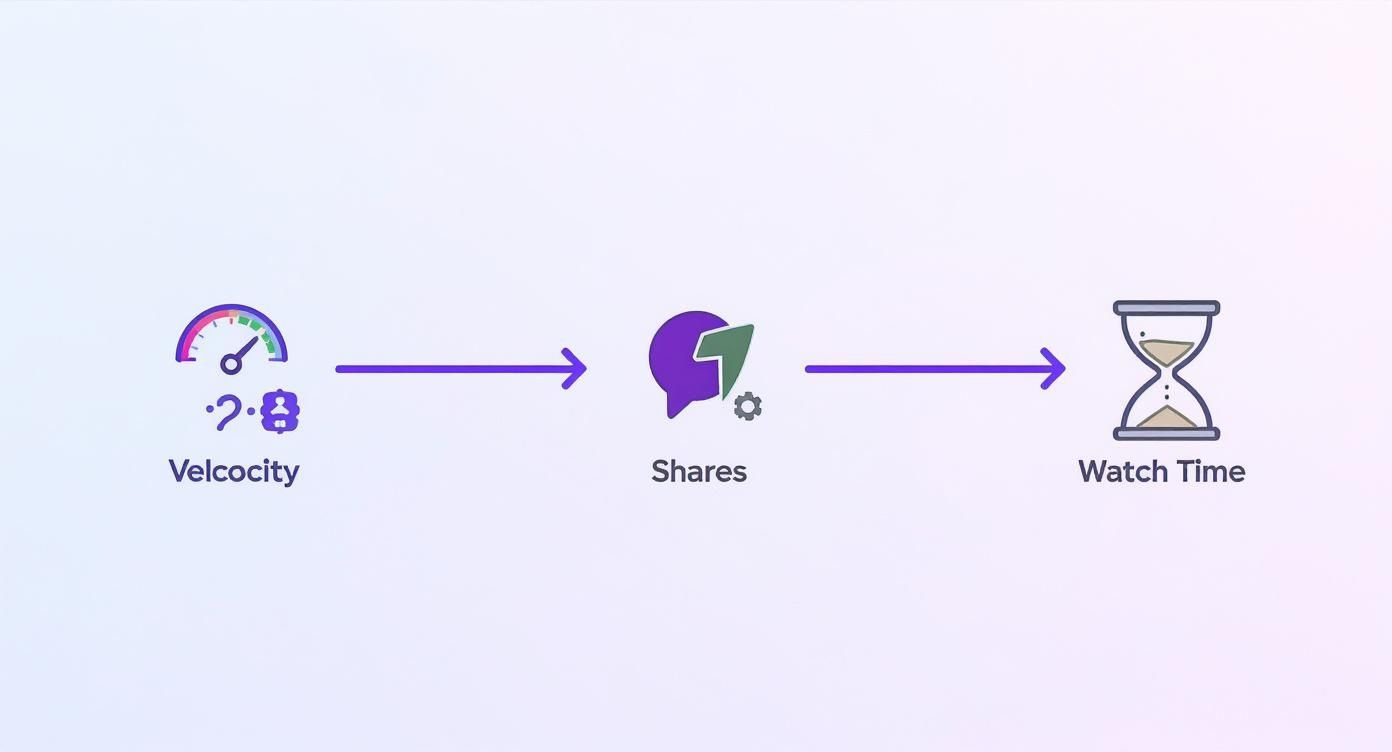
As you can see, it all starts with velocity. Quick views lead to shares, which drives up watch time, creating a powerful loop that tells the algorithm, "Hey, people love this!"
Platform Virality Signals Compared Side by Side
To make it even clearer, let's break down the key differences in what each platform looks for when deciding if your content is worthy of going viral.
| Metric | TikTok | YouTube Shorts | Instagram Reels |
|---|---|---|---|
| Typical Viral Views | 1M+ views in 3 days | 1-2M+ views | 1M+ views |
| Primary Signal | Watch Time & Completion Rate | Session Watch Time & Swipe Rate | Shares & Saves |
| Key Velocity Factor | First 1-3 hours | Audience Retention | Community Engagement |
| Content Hook | Immediate attention-grabber | Quick, valuable loop | Relatability & Trending Audio |
Ultimately, what this table shows is that while the exact numbers and metrics change, the underlying principle is the same. Each platform is hunting for content that grabs attention, holds it, and makes people want to share it.
The Big Picture: The specific view count is just one piece of the puzzle. True virality is a blend of speed, watch time, and shareability. Master that combo, and you've got the keys to the kingdom.
The good news? The opportunity has never been bigger. By 2025, it’s predicted that video will make up around 82% of all internet traffic. That's a mind-boggling amount of attention up for grabs, meaning even the most niche content can find a massive audience if it plays by the right rules.
Deconstructing Real-World Viral Success Stories

Theories and metrics are one thing, but the best way to really get a feel for how many views is viral is to see it in the wild. When you pull back the curtain on videos that genuinely captured the internet's attention, you start to see the patterns.
So, let's break down three totally different viral hits: a scrappy comedy sketch, a deep-dive explainer video, and a jaw-dropping travel Reel. We're going to look past the final view count and pinpoint the smart moves that fueled their explosive growth.
TikTok Case Study: The Low-Budget Comedy Sketch
Picture this: a 15-second video, filmed in a kitchen, no fancy gear. The creator uses TikTok’s stitch feature to silently react to a completely absurd "life hack" video. That’s it. The punchline lands in seconds.
So, why did it blow up?
- Relatability: The creator’s look of pure disbelief was exactly what thousands of viewers were thinking. That shared “are you kidding me?” moment creates an instant bond.
- Platform Features: Using the stitch feature was the secret sauce. It gave viewers immediate context and let the video ride the coattails of an already-trending clip—a huge signal to the algorithm.
- Shareability: The joke was simple and universal. It was the perfect video to fire off to a friend with a quick "lol, this is you" message.
This little video is proof that you don't need a Hollywood budget. Virality is often just a perfectly timed, relatable idea that uses the platform's own tools to its advantage.
YouTube Case Study: The Insightful Explainer Video
Now let's shift to a 10-minute YouTube video breaking down a complex scientific idea with simple analogies and clean animations. The title is straight to the point, and the thumbnail makes you curious without feeling like cheap clickbait.
This video didn't chase a trend; it focused on delivering real value. Its path to virality was a slower burn, but it steadily racked up millions of views over weeks, not hours.
Why It Succeeded: This video absolutely nailed audience retention. By making a tough subject easy and engaging, it kept people glued to their screens. That high watch time told YouTube's algorithm, "Hey, people love this," prompting it to push the video out to more and more viewers.
This shows that on YouTube, true expertise and quality can be a powerful engine for virality. It's about satisfying curiosity so completely that the algorithm can't ignore it.
Instagram Case Study: The Breathtaking Travel Reel
Our last stop is a 30-second Instagram Reel. It kicks off with a stunning, fast-cut shot of a mountain peak at sunrise, perfectly synced to a trending song. The caption is short and sweet, asking a simple question: "Would you hike here?"
The visuals were a total scroll-stopper. But the real genius was in how it sparked engagement.
What sent this one into the stratosphere?
- Emotional Trigger: The Reel tapped right into that universal feeling of wanderlust. It made people feel something—a desire to escape and explore.
- Strategic Audio: Using a trending sound was a savvy move. It gave the Reel an immediate algorithmic boost, putting it in front of way more eyeballs.
- High Engagement: That simple question in the caption opened the floodgates for comments. Meanwhile, the stunning scenery drove a massive number of shares and saves as people bookmarked it for their "dream vacation" list.
This Reel proves how a powerful emotional hook, combined with smart tactics like trending audio, can create a viral masterpiece. For more concrete illustrations, you can also check out these examples of great press releases that went viral to see how these principles apply in other contexts.
Your Action Plan for Increasing Viral Potential

Knowing what "viral" means is one thing. Actually making it happen is a whole different ball game. Think of this section as your practical playbook, filled with strategies that give your content the best possible shot at catching algorithmic fire.
Going viral isn't just a lottery ticket. It’s about making smart, repeatable choices that appeal to both real people and the platform's code. By sticking to a few core principles, you can stop hoping for a hit and start engineering one.
Craft an Irresistible Hook
You have about three seconds—if you're lucky—to stop someone's thumb from scrolling past your video. The opening, your hook, is the single most important element for getting people to stick around. If you don't immediately spark curiosity, deliver a punchline, or show something visually shocking, they're gone.
Forget slow intros and branded logos. Start your video right at the climax. Ask a bold question, flash a surprising result on screen, or state a controversial opinion that makes people stop and think. A great hook is the non-negotiable entry fee for going viral.
The first-hour engagement determines 80% of your content’s viral potential. A killer hook gets those crucial early viewers to watch longer and engage faster, which is exactly the signal the algorithm is looking for.
At the end of the day, any serious attempt at virality comes down to understanding how to make viral content that hits people on an emotional level. It all starts with the hook.
Structure Your Story and Use Trending Audio
Even a 15-second clip needs a story. A simple narrative—a beginning (your hook), a middle (the build-up), and an end (the payoff)—is what keeps viewers glued to the screen. This structure builds suspense and delivers a satisfying punchline, which is critical for maximizing your watch time.
And don't forget the cheat code: trending audio. Platforms like TikTok and Instagram literally push content that uses popular sounds into more feeds. The key is to avoid just copying the trend. The real magic happens when you adapt a popular sound to your own niche in a clever or unexpected way.
Your AI-Powered Secret Weapon
Coming up with enough content to test different hooks, storylines, and audio trends is exhausting. This is where AI tools can give you a serious edge. A platform like ClipCreator.ai, for example, can automate the entire creation process for high-quality, short faceless videos.
This lets you ramp up your production without burning out or letting quality slide. With AI doing the heavy lifting on video creation, you can:
- Test more ideas, faster: Throw dozens of hooks and concepts at the wall to see what sticks with your audience.
- Stay consistent: Keep a steady flow of content going to stay relevant with the algorithm and top-of-mind with your followers.
- Focus on what matters: Free up your time to analyze performance and plan your next big hit instead of getting lost in the weeds of editing.
When you automate the production part, you get to focus all your energy on the creative strategy—the part that actually makes a video go viral.
Common Questions About Going Viral Answered
Even with all the metrics and benchmarks laid out, the idea of "going viral" can still feel a bit mysterious. It’s a topic surrounded by myths and half-truths, so it's natural to have a few lingering questions. Let's tackle some of the most common ones I hear from creators to give you the clarity you need.
Think of this as clearing the fog, so you can stop guessing and start building a smart, practical growth strategy.
Can a Video Go Viral Weeks After Posting?
You bet. It happens more often than you'd think, and it's what we call a "sleeper viral." While most hits explode within the first 48 hours, the algorithms are always watching. They can absolutely resurrect an older video if it suddenly starts picking up new steam.
So, what causes this? Sometimes, a new trend or a piece of breaking news makes your old video super relevant again. Other times, a huge account might stumble upon your video and share it, giving it a massive second wind.
This is why creating evergreen content—videos that stay relevant long after you post them—is such a smart play. It's like planting seeds. You just never know which one will suddenly sprout weeks, or even months, later.
How Does Follower Count Affect What Is Considered Viral?
Follower count is all about context. It’s the measuring stick that tells you if a certain view count is a huge win or just business as usual. For a creator with 1,000 followers, hitting 100,000 views is an absolute game-changer. That’s an audience 100 times bigger than their follower base.
But for a major celebrity with 10 million followers, those same 100,000 views would be a flop. Virality is always relative to your starting point.
Instead of obsessing over a magic number, focus on your view-to-follower ratio. A ratio that climbs past 10:1 is a solid sign your content has broken free from your existing audience and is reaching new people.
Should I Aim for High Views or High Engagement?
This is one of the most important questions, and the answer isn't what you might expect: always, always aim for high engagement first. Engagement is the engine that drives views, not the other way around.
Think about it: a video with a million views but next to no comments, shares, or saves is like a massive, empty concert hall. It might look impressive on the surface, but the algorithm sees it as unsatisfying content and will stop showing it to people.
A video with fewer views but thousands of genuine comments and shares sends a much stronger signal. All that interaction tells the platform, "Hey, people love this!" That’s what gets you pushed to a wider audience, which is how you get those viral view counts in the first place. Start a conversation, and the views will come.
How Can AI Tools Help My Videos Go Viral?
Think of AI tools as your secret weapon. They can dramatically speed up your workflow and give you a huge strategic advantage, especially when it comes to volume and testing.
For example, tools like ClipCreator.ai let you produce a ton of polished, faceless videos in a fraction of the time. This means you can test more hooks, more ideas, and more formats to figure out what your audience—and the algorithm—truly wants. You're basically getting more at-bats, which naturally increases your odds of hitting a home run.
By taking the grunt work of production off your plate, these tools free you up to focus on the creative strategy and storytelling. And that’s the human touch that really makes a video connect and take off.
Ready to boost your chances of going viral without burning out on editing? ClipCreator.ai automates the creation of slick, short-form faceless videos, letting you focus on the big picture. Start creating your next hit video today!

Create your first video in under 2 minutes
Pick a niche, and ClipCreator.ai generates and auto-posts faceless videos to your channels every day.
Join ClipCreator.ai