You post a TikTok. It gets a small burst of views, then stalls.
That moment confuses almost every new creator. You start asking the wrong questions. Was the topic bad? Did TikTok shadowban it? Do you need more followers before anything can take off?
Usually, the better question is simpler. What is considered a viral video on TikTok for your account, not for a celebrity account?
A lot of advice online skips that distinction. It jumps straight to million-view examples, which makes new creators think anything below that is failure. It is not. On TikTok, virality is partly absolute and partly relative. A mega-creator and a brand-new faceless account do not need the same number of views for a post to count as a breakout.
TikTok is less like a follower-based broadcast system and more like a rolling taste test. The platform keeps sampling videos with new viewers. When enough people watch, rewatch, share, save, and finish the clip, TikTok keeps expanding distribution. If those signals weaken, the push slows down.
That means virality is not pure luck. It is a performance outcome.
If you want a quick companion read focused specifically on view thresholds, this breakdown on how many views count as viral on TikTok is useful. The bigger picture, though, is understanding why one video with modest-looking views can still be a huge win, while another with a bigger raw number can be average for a larger account.
The Meaning of Going Viral on TikTok
Most creators first define viral by a number. One million views is the popular shorthand. That number matters, but it is incomplete.
At the top end of the platform, viral clearly means massive reach. Some of the biggest TikToks have reached extreme view counts. As of January 2025, Zach King’s “Magic Ride” had passed 2.3 billion views, and James Charles’ Christmas video had reached 1.7 billion views, according to Statista’s list of the most-watched TikTok videos.
Those examples show what blockbuster virality looks like. They do not give a useful benchmark to someone with a small account posting tutorials, stories, or niche commentary.
Viral is a breakout from your baseline
For a new creator, a viral post often means a video that dramatically outperforms your normal range.
If your recent videos usually stop at a few hundred views, then a post that suddenly reaches tens of thousands has entered viral territory for your account. It has broken out of your baseline and reached strangers well beyond your existing audience.
That is why asking “what is considered a viral video on tiktok” needs two answers:
- Absolute virality: huge public reach, often the kind of video people across TikTok recognize
- Relative virality: a strong breakout compared with your own usual performance
Both matter. But if you are new, relative virality is the one that helps you make better decisions.
Virality is distribution plus response
TikTok does not reward a video because it exists. It rewards a video because viewers send strong signals that they found it worth watching.
Think of the platform as testing your post in rounds. First, it shows your video to a small audience. If those people respond well, TikTok expands the test. Then it expands again. A “viral” video is one that keeps passing those rounds.
Key takeaway: A viral TikTok is not just a video with big views. It is a video that keeps earning wider distribution because viewers keep responding well to it.
Why this matters for new creators
This definition changes how you judge your own posts.
Instead of chasing celebrity numbers, ask:
- Did this video beat my usual performance by a wide margin?
- Did people stay through the ending?
- Did strangers, not just followers, engage with it?
- Did it keep gaining views after the first push?
If the answer is yes, you are much closer to virality than you think.
Decoding the Signals TikToks Algorithm Values Most
TikTok’s algorithm makes more sense when you stop treating it like a mystery box.
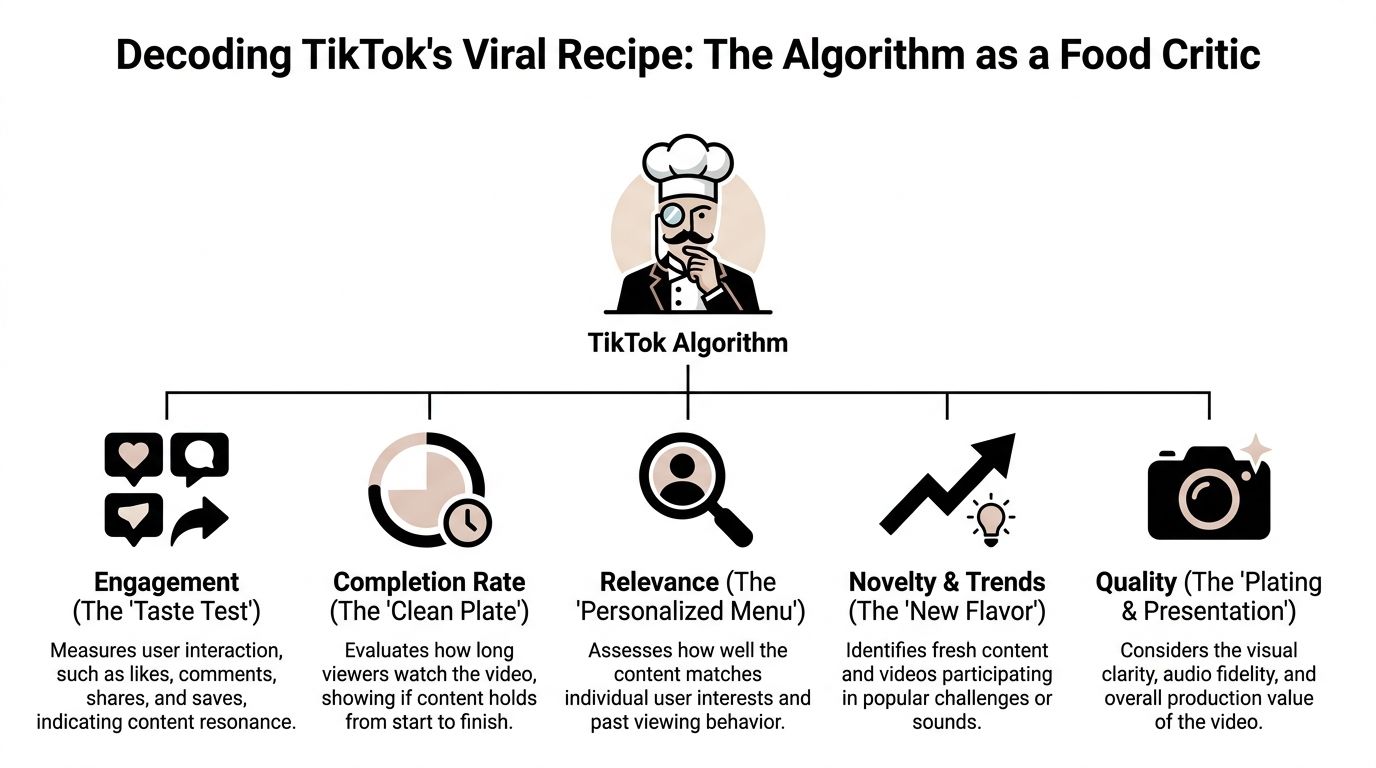
A better analogy is a food critic testing dishes before putting one on the front page of a restaurant guide. Your video is the dish. TikTok gives it to a small sample audience first. If people like it enough, the critic recommends it to more people.
The first audience is the taste test
TikTok reportedly starts by testing videos with a small batch of viewers. A video can move from that early testing stage to much broader For You Page distribution when it combines strong engagement with high completion. Graphed notes that TikTok treats 80 to 90%+ video completion rates plus rewatches, shares, and saves as strong viral signals, while videos below 70% completion tend to get deprioritized. The same analysis describes initial testing with roughly 100 to 500 users before wider expansion. You can review those benchmarks in Graphed’s explanation of how to analyze why a TikTok video went viral.
This is why a post can look dead at first, then suddenly climb. It passed a test round.
The cleanest signal is completion rate
If someone watches your full video, TikTok gets a strong message. The content matched the viewer’s interest well enough to hold attention all the way through.
That is why completion rate sits near the top of the hierarchy.
A like is easy. A full watch is expensive. It costs time. TikTok values that signal because time is harder to fake than a quick tap.
Rewatches tell TikTok your video has pull
Rewatching is even stronger in some cases. It suggests one of three things:
- the ending paid off and the viewer wanted to catch details
- the pacing was fast enough that the viewer watched again
- the content had a loop-like quality
Faceless story videos often do well here because viewers replay them to pick up clues, confirm a detail, or hear a line again.
Shares and saves beat passive approval
A share means someone wants another person to see the video. A save means someone wants to come back later. Both are stronger than a casual like because they signal utility or emotional impact.
In plain terms, likes say “I noticed this.” Shares and saves say “This mattered.”
Practical rule: If a video gets likes but weak watch time, it often stalls. If it gets strong completion, rewatches, shares, or saves, TikTok has a reason to keep testing it.
The first seconds do heavy lifting
The opening frames decide whether your video gets a chance to prove itself.
A weak start hurts completion before the main idea even begins. A strong start creates curiosity, tension, surprise, or immediate clarity. For many creators, this is the biggest fix available.
Useful hooks often do one of these:
- Start mid-action: Show the interesting part before the explanation
- Create a gap: Promise an answer, reveal, mistake, or twist
- Make the payoff obvious: Tell viewers why staying matters
- Use on-screen text early: Help sound-off viewers follow immediately
If you want to see how your own videos perform at this level, use TikTok’s analytics rather than guessing. This guide on how to see TikTok analytics is a good place to start.
A simple hierarchy to remember
Here is the order I suggest new creators use when evaluating a post:
- Completion rate
Did people finish it? - Rewatch behavior
Did some viewers run it again? - Shares and saves
Did people think it was worth passing along or storing? - Comments
Did it spark a response, question, or debate? - Likes
Helpful, but less predictive on their own
When you understand that hierarchy, TikTok becomes less random. Not easy, but less mysterious.
What Does a Viral Video Look Like for You
Many creators get misled at this point.
They compare their account to a household-name creator and conclude they are failing. But relative virality matters more than raw numbers when you are small.
Klap’s analysis highlights that account size changes the benchmark. For creators with under 1,000 followers, 100,000 views can count as viral if that result is 10x above normal performance. For mega-influencers with 10M+ followers, the comparable impact may require 5M+ views. The same source also notes that strong early engagement can boost reach for low-follower accounts by up to 300% when a video matches niche interests. That account-size nuance is explained in Klap’s article on what is considered viral on TikTok.
The same view count means different things
A video with 80,000 views can be a career moment for one creator and an average post for another.
That is why the better benchmark is not “Did I hit one million?” It is “Did I massively outperform my norm?”
Here is a practical way to think about it.
| Follower Count | Strong Performance (Good) | Viral Threshold (Excellent) |
|---|---|---|
| Under 1,000 | Meaningfully above your usual range | Around 100,000 views if it is roughly 10x your baseline |
| 1,000 to 10,000 | Strong breakout beyond recent average | A post that clearly escapes your normal ceiling |
| 10,000 to 100,000 | Large jump over standard performance | A breakout that reaches well beyond your usual audience |
| 10M+ | High views alone may be normal | Around 5M+ views for similar relative impact |
The table gets less precise in the middle on purpose. We do not have verified numeric thresholds for every tier, so the right move is to stay qualitative rather than invent benchmarks.
A better benchmark for small creators
If you are new, use three questions:
- Did this post exceed my normal performance by a wide margin?
- Did it bring in viewers who do not follow me?
- Did it keep gaining traction after the first day?
If yes, that is a viral result for your size.
This mindset matters for faceless creators in particular. Story clips, educational explainers, and niche commentary accounts often look “small” by celebrity standards even when they are winning exactly the right audience.
Why this helps emotionally and strategically
Creators who use relative benchmarks improve faster because they can see momentum earlier.
Instead of dismissing a breakout as “not really viral,” they study it. They examine the hook, the pacing, the structure, the topic, and the format. That turns one strong post into a repeatable content pattern.
Helpful lens: Judge success in layers. First by your baseline, then by your niche, then by platform-wide standards.
That order keeps your expectations realistic and your analysis useful.
Analyzing Real Examples of Viral TikToks
The easiest way to understand virality is to dissect what viewers probably experienced.
Not just “this got a lot of views,” but why the format fit TikTok so well.
Zach King and the instant visual payoff
Zach King’s “Magic Ride” reached 2.3 billion views as of January 2025, making it the most-watched TikTok video in the Statista ranking already mentioned earlier.
What makes that style so effective?
First, the premise is visual and immediate. A viewer does not need context, backstory, or audio explanation. The clip delivers curiosity in the first moment. Something impossible seems to be happening, so the brain stays to resolve the gap.
Second, the format invites replay. Visual illusion videos often make people watch twice just to understand the trick. That replay behavior is exactly the kind of signal that can keep a post expanding.
Third, the payoff is fast. There is very little wasted setup. On TikTok, that matters.
James Charles and event-based attention
James Charles’ Christmas video reached 1.7 billion views in the same Statista list.
This type of video works differently from a visual illusion. It benefits from recognizability, timing, and broad seasonal relevance. Holiday content gives viewers a familiar frame right away. They know the emotional territory before the clip fully begins.
For creators, the lesson is not “be famous.” It is this: shared cultural context lowers friction.
If viewers instantly understand the setting or occasion, you spend less time explaining and more time delivering.
The faceless story format and why it scales
Faceless videos rarely show up in top-viewed all-time rankings because celebrity and entertainment clips dominate those lists. But as a format, faceless storytelling lines up extremely well with the signals TikTok values.
A strong faceless story usually includes:
- a sharp opening line that creates a question
- visual movement, even if simple
- subtitles that keep viewers oriented
- a structured payoff or twist at the end
This is why scary stories, quick history facts, mystery clips, and “you won’t believe what happened” narratives can outperform personality-led content in some niches. The viewer is not watching for the person. The viewer is watching to finish the story.
A repeatable analysis framework
When you study any TikTok that feels viral, ask these questions:
What happened in the opening moment
Did the video begin with motion, tension, surprise, or a strong promise?
If the first second felt slow, it probably was not the hook that drove the post.
Why would someone stay to the end
Was there a reveal? A transformation? A punchline? A twist?
Good viral videos usually make the ending feel necessary.
Why would someone rewatch or share it
Visual tricks, dense information, emotional resonance, and surprising endings all create replay or share behavior.
That is the practical lens. Not “Was it cool?” but “What viewer action did this clip naturally invite?”
Use this habit: Save strong posts in your niche and write one sentence under each: “People kept watching because...” That sentence teaches you more than copying the video ever will.
Practical Strategies to Boost Your Viral Potential
You cannot force virality. You can, however, build videos that give TikTok stronger reasons to keep distributing them.

Build the hook before you build the rest
Most creators script the middle and improvise the beginning. That is backwards.
Write your opening first. If it does not create instant interest, the rest of the video never gets tested properly.
Try openings that do one of these:
- Lead with the result: “This tiny mistake ruined the whole video”
- Open a loop: “I thought this was fake until I tried it”
- State the surprise: “Nobody expects the ending to happen as fast”
- Drop the viewer into the moment: Start at the turning point, not the intro
Use trends as a vehicle, not a crutch
Trend participation works best when you add a distinct angle.
Rise at Seven notes that videos can enter a viral trajectory when they combine trending audio or effects with an original twist, and that using a top trending sound can increase initial exposure by 15 to 30x. The same analysis ties viral momentum to 10x baseline engagement velocity, with shares or comments jumping 500 to 1000% above normal within a day. Their breakdown of how the TikTok algorithm works and how to go viral is useful here.
The key phrase is original twist.
A trend gives you a familiar container. Your job is to make the content inside it specific to your niche, brand, or story angle.
Tighten the video like an editor, not a creator
Creators often leave in setup because they remember recording it. Viewers do not care.
Before posting, cut anything that does not create one of these outcomes:
- curiosity
- clarity
- momentum
- payoff
If a line explains what the next line already shows, remove it.
Be deliberate with hashtags and captions
TikTok uses captions, hashtags, and audio to understand where your video belongs. That means your metadata should help categorize the post clearly.
A practical approach is to combine niche tags with selective broader trend tags rather than stuffing everything into one caption. If you want a clearer framework for keeping that balanced, Mastering the TikTok Hashtags Limit gives a useful breakdown of how to think about hashtag volume without turning captions into clutter.
For actual hashtag formatting ideas, this list of copy and paste TikTok hashtags can help as a starting point. Just keep them relevant to the video.
Use a pre-post checklist
This is the simplest habit that improves content quality over time.
- Hook check: Does the first moment create a reason to stay?
- Pacing check: Can any second be cut without hurting the message?
- Caption check: Does the text help TikTok classify the topic?
- Share check: Would someone send this to a friend?
- Save check: Is there information or entertainment worth revisiting?
Short rule: Before posting, ask “what action is this video designed to trigger?” If the answer is vague, the content usually feels vague too.
For creators making faceless content at scale, tools that automate scripting, voiceover, visuals, subtitles, and scheduling can help keep this checklist consistent. One example is ClipCreator.ai, which is built for short faceless videos and scheduled posting across short-form platforms.
Going Viral Without Showing Your Face
A lot of new creators assume face-to-camera content has a built-in advantage. Sometimes it does. But faceless content has its own strengths, especially on TikTok.
The biggest one is focus. When viewers are not watching your expression, outfit, or background, they pay more attention to the story, claim, question, or reveal.
That can lead to stronger retention.
Why faceless formats fit the platform
Browseract’s roundup notes several patterns tied to viral performance. Under-7-second TikToks go viral 18% more often, gaming content has reached 200 billion views, BookTok has reached 150 billion views, and collaborative content sees 31% more engagement. Those examples appear in Browseract’s 2025 collection of TikTok video statistics.
For faceless creators, the useful part is not just the niche totals. It is the broader lesson that niche short-form formats can scale hard when they match viewer intent.
A viewer on BookTok wants recommendations, reactions, summaries, and emotional hooks around books. A viewer on gaming TikTok wants clips, takes, reveals, and moments. Your face is optional if the format satisfies the interest.
Faceless storytelling often improves completion
A well-structured faceless video can move like a mini-movie.
You can script every beat. You can put subtitles exactly where attention needs support. You can pair voiceover with images and cut dead time more aggressively than many talking-head clips.
That makes faceless content especially good for:
- horror or mystery stories
- history snippets
- unusual facts
- tutorials with screen or product visuals
- list-based educational content
This example shows the style in action:

The tradeoff is consistency
Faceless videos work well when creators treat them like a system.
You need repeatable topics, recurring structures, clean editing, readable subtitles, and a posting rhythm that gives the algorithm more chances to test your work. That is where many creators stall. Not because the format is weak, but because production friction slows them down.
Best use case: If you enjoy research, writing, curation, or narration more than being on camera, faceless content is not a compromise. It is a format with real algorithmic advantages.
Your Path to Consistent TikTok Growth
A viral video is not a magic number. It is a video that outperforms your normal reach because viewers give TikTok strong reasons to keep distributing it.
For a celebrity, that may mean millions. For a new creator, it may mean a breakout that crushes your baseline. Both are real.
The more useful goal is not one lucky spike. It is building a repeatable system. Strong hooks. Better completion. Clear niche signals. Posts worth sharing and saving. That is how creators grow without guessing.
If you want to turn that system into a consistent publishing workflow, ClipCreator.ai helps you create and schedule short faceless videos with AI-written scripts, voiceovers, visuals, subtitles, and auto-posting. It is a practical option for creators, educators, and brands that want to test more ideas without spending all week editing.

Create your first video in under 2 minutes
Pick a niche, and ClipCreator.ai generates and auto-posts faceless videos to your channels every day.
Join ClipCreator.ai