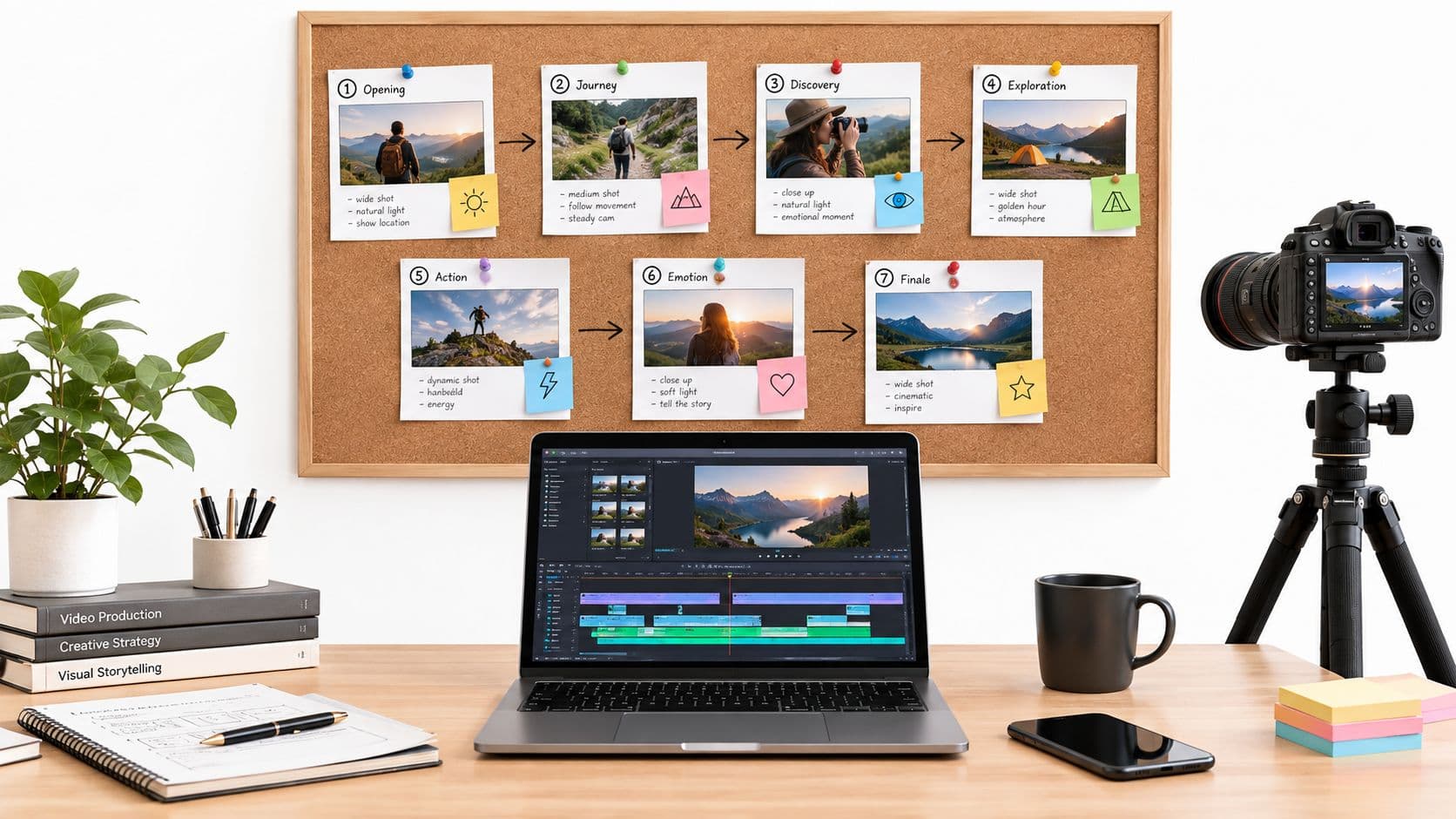
Let's be honest, "scriptwriting" can sound a little intimidating, right? It brings to mind Hollywood screenplays and complex formatting rules. But for short-form video, it's something entirely different—and way more accessible.
Think of a script not as a rigid document, but as your strategic blueprint. It’s the simple plan that turns a random idea floating in your head into a focused, compelling video that both people and platform algorithms will actually pay attention to.
Why Scripting Is Your Secret Weapon for Going Viral
In the fast-paced world of short-form video, winging it rarely works. A script is what gives your content a backbone, ensuring it doesn't just ramble on. It’s the difference between a video that people scroll past and one they watch all the way through.
Platforms like TikTok, YouTube Shorts, and Instagram Reels are fundamentally storytelling machines. Their algorithms are literally built to find and push content that keeps eyeballs on the screen. A solid script is your most reliable tool for achieving that, making sure your video has a killer hook, a valuable middle, and a strong finish. You don't need to be a professional screenwriter; you just need a framework.
The Unstoppable Demand for Good Stories
We're living through an explosion of digital content. The move away from traditional TV to streaming services has created a massive, hungry audience for new stories—and not just on Netflix. This is happening on our phones every single day.
The global market for screen and script writing software is expected to hit USD 237.49 million by 2031. That’s a huge number, driven almost entirely by this boom in digital video. With streaming now making up over 38% of all TV viewership, the need for well-structured narratives has never been greater. For creators just starting out, this is fantastic news. It means there are more tools, templates, and resources available than ever before.
A script isn't just about what you're going to say. It's about mapping out the viewer's journey. You're guiding their attention and emotions from the first frame to the last, and that level of control is what separates a one-hit wonder from a creator with a consistently growing audience.
Turning Your Ideas Into High-Performing Videos
The best part? You don't have to do it all by hand anymore. Technology has made scripting incredibly straightforward, letting you focus on the creative part—the idea itself.
Modern tools can handle the heavy lifting. For instance, a platform like ClipCreator.ai can take a simple idea or prompt and instantly generate a complete script that's ready to go. This kind of workflow is a game-changer, especially for creating faceless videos quickly and at scale. When you learn how to write a script for YouTube video that captivates and converts, you're not just making videos; you're building a system for viral growth.
Mastering the 60-Second Story Arc
Believe it or not, the same storytelling principles that fuel Hollywood blockbusters are the secret sauce behind most viral short-form videos. That classic three-act structure just gets a serious speed boost. For a 60-second video, it collapses into a tight, punchy arc: the Hook, the Middle, and the Payoff.
This isn't a new concept, just a faster one. Script writing has always been about grabbing and holding attention, whether for a two-hour film or a 15-second clip.
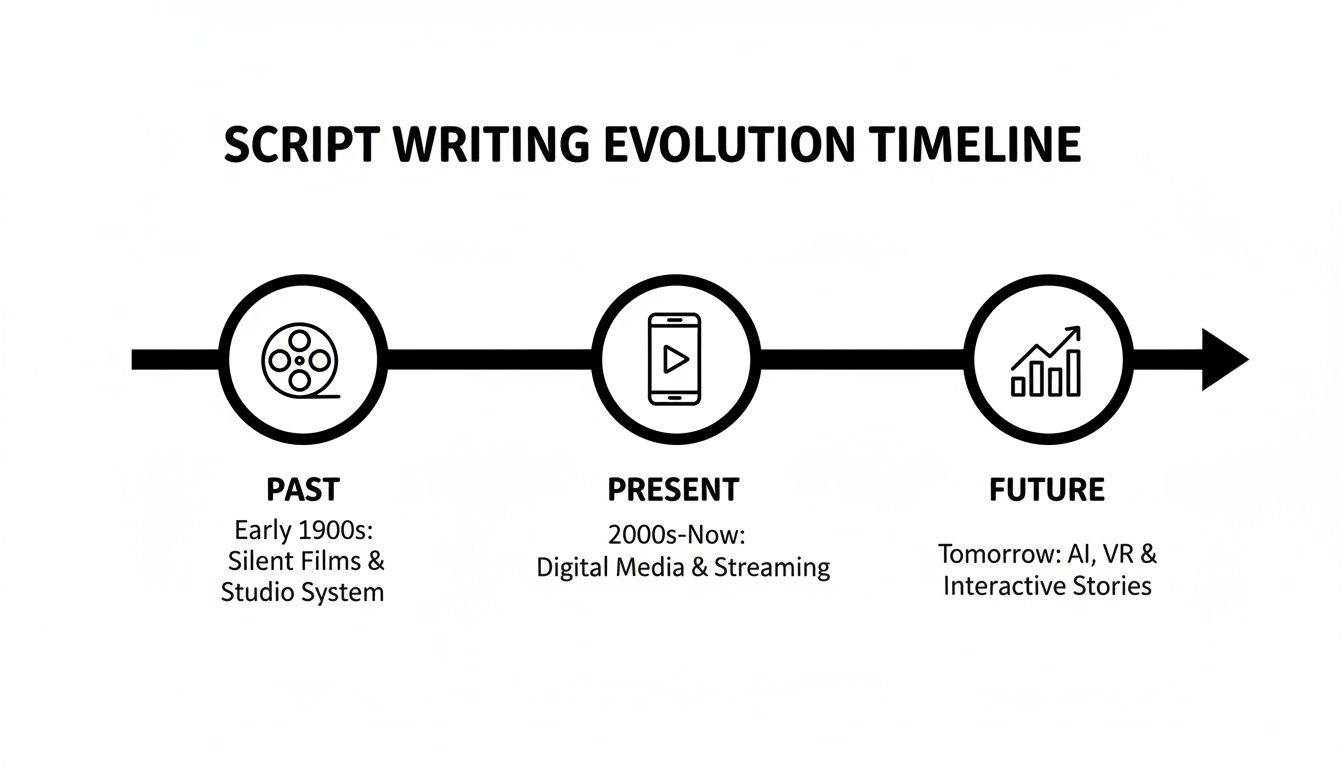
The takeaway here is simple: while the platforms and tools have changed dramatically, the core need for a killer story structure hasn't. It's just compressed.
Nail the First 3 Seconds with a Powerful Hook
You have literally no time to waste. The first one or two lines of your script—the initial 3 seconds—have one job: stop the scroll. This is your Hook, and it must be sharp, intriguing, and impossible to ignore.
A great hook doesn't ease the viewer in; it yanks them in by creating an immediate question or an emotional spark. Think of it as the video's headline, making a promise the viewer has to see fulfilled.
- Provocative Question: "What if you’ve been cleaning your coffee maker wrong this whole time?"
- Bold Claim: "This is the one history fact they never taught you in school."
- Intriguing Statement: "I found a secret message in an old thrift store painting."
The goal is instant curiosity. Once you've got them, you can lead them into the story.
Deliver Value in the Middle
Okay, you’ve hooked them. Now, the Middle of your script (roughly seconds 4 to 55) is where you make good on your promise. This is the meat of your video, but every single second has to count. Each sentence needs to build on the last, adding information, building tension, or demonstrating value.
If you're telling a spooky story, this is where you layer in the unsettling details. For a micro-lesson, it's where you walk through the solution to the problem you teased in the hook. Pacing is everything. Keep your sentences short and your ideas moving. If a line doesn’t push the story toward its conclusion, cut it.
Your script's middle section should feel like a satisfying journey, not a detour. Every word must earn its place by moving the story forward and keeping the viewer engaged until the very end.
Create a Memorable Payoff
The final 5 seconds are reserved for the Payoff. This is your grand finale—the punchline, the plot twist, the “wow” moment. A strong payoff is what makes a video stick in someone's mind and gets them to hit that share button. It gives them a sense of satisfaction and makes them feel their time was well spent.
A weak ending can completely kill an otherwise brilliant video. Your payoff must directly answer the question or resolve the tension you created in the hook. If your hook was about a cleaning hack, the payoff is the sparkling clean result. If you started a mystery, this is the shocking reveal.
To help you get the rhythm right, here’s a quick timing breakdown for a standard 60-second video.
Timing Your 60-Second Script
| Script Section | Time Allotment | Objective & Example Prompt |
|---|---|---|
| The Hook | 0–3 seconds | Grab attention. Start with a bold claim: "You're using your air fryer all wrong." |
| The Middle | 4–55 seconds | Deliver value. Explain the common mistake and demonstrate the correct, game-changing technique. |
| The Payoff | 56–60 seconds | Provide closure. Show the perfectly cooked result and give a quick call-to-action: "Try this and tell me what you think!" |
This simple framework is your foundation. For more inspiration on how to structure these critical moments, I highly recommend checking out these excellent script outline examples that show how popular formats are built.
By truly understanding the timing and purpose of the Hook, Middle, and Payoff, you can turn basic ideas into compelling stories that don't just get watched—they get remembered.
How to Find Your Voice and Tone
A great script isn't just about the words on the page; it's about the personality behind them. Think of your voice as who you are—your core identity as a creator. Your tone, on the other hand, is the specific mood you create for each video. Getting these two right is the secret to connecting with people and building a brand they remember.
Your voice should be the constant, the thing that feels familiar to your audience every time they watch. Your tone, however, needs to be flexible. You wouldn't tell a scary story with the same energetic tone you'd use for a tutorial on a new productivity hack, right? But both should still sound like they’re coming from you. This consistency is what builds trust and turns casual viewers into a real community.
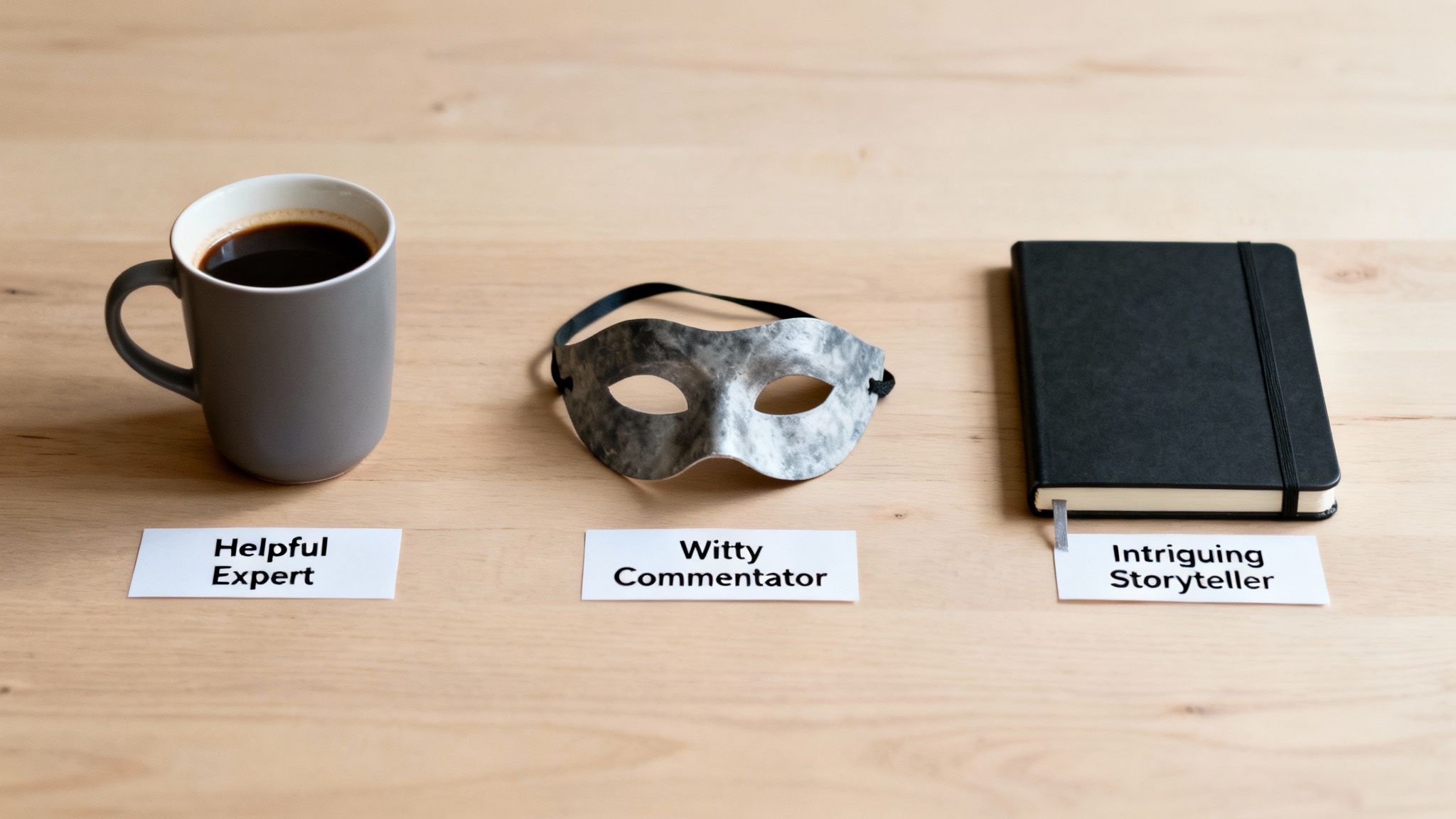
Figuring this out is a huge step in script writing for beginners. It's what makes your stories land the way you intend them to.
Pick Your Persona
Before you even think about writing, ask yourself: what kind of creator am I? Defining a persona gives you a compass for your content, guiding everything from your word choice to your delivery. When your audience knows what to expect, they'll keep coming back.
Here are a few common personas you can run with:
- The Helpful Expert: You’re the authority, the person with the answers. Your voice is clear and confident but still approachable. You exist to solve problems and deliver real value.
- The Witty Commentator: You’re the one with the clever, sarcastic takes on trends, pop culture, or just the weirdness of daily life. Your voice is sharp, funny, and always relatable.
- The Intriguing Storyteller: You're a master of narrative. Whether it's a chilling mystery or a heartfelt personal journey, your voice is captivating, using suspense and emotion to pull viewers in.
Choosing a persona isn't about putting yourself in a box. It’s about creating a strong foundation. You can always evolve, but starting with a clear identity makes your content feel intentional and authentic.
Think of your persona as a filter for your ideas. Always ask, "How would The Helpful Expert break this down?" or "What's the angle The Witty Commentator would take on this?" This simple check keeps everything you create perfectly on-brand.
Create a "Word Bank" for Your Tone
With your voice established, you can start playing with tone. A dead-simple trick I’ve used for years is to build a "word bank" for the different moods I want to convey. It's basically a cheat sheet of words and phrases that immediately trigger a specific feeling.
For a suspenseful tone, your word bank might look like this:
- "...but what they found next was chilling."
- Words: eerie, unsettling, phantom, lurking, strange.
- Phrases that build mystery: "At first, everything seemed normal."
On the flip side, an inspirational tone would need a totally different vocabulary:
- "What if you could finally..."
- Words: empower, achieve, breakthrough, limitless, potential.
- Phrases that motivate: "The first step is always the hardest, but you've got this."
This little hack makes script writing so much less intimidating. Instead of facing a blank page, you’ve got a palette of words ready to go. You can even plug these word banks into a tool like ClipCreator.ai to generate script ideas that already have your desired tone baked in, saving you a ton of time while keeping your content consistent.
Proven Script Templates for Viral Videos
One of the smartest things you can do when you're just starting out is to lean on formulas that are already working. Why stare at a blinking cursor when you can use a structure that audiences already love? Think of these templates less as rigid rules and more as reliable starting points. They help you nail the pacing and hit the right emotional notes that get people to watch, engage, and share.
You don't have to reinvent the wheel. Seriously. Once you get the hang of these, you’ll start seeing these patterns everywhere in the videos that go viral on your own feed.
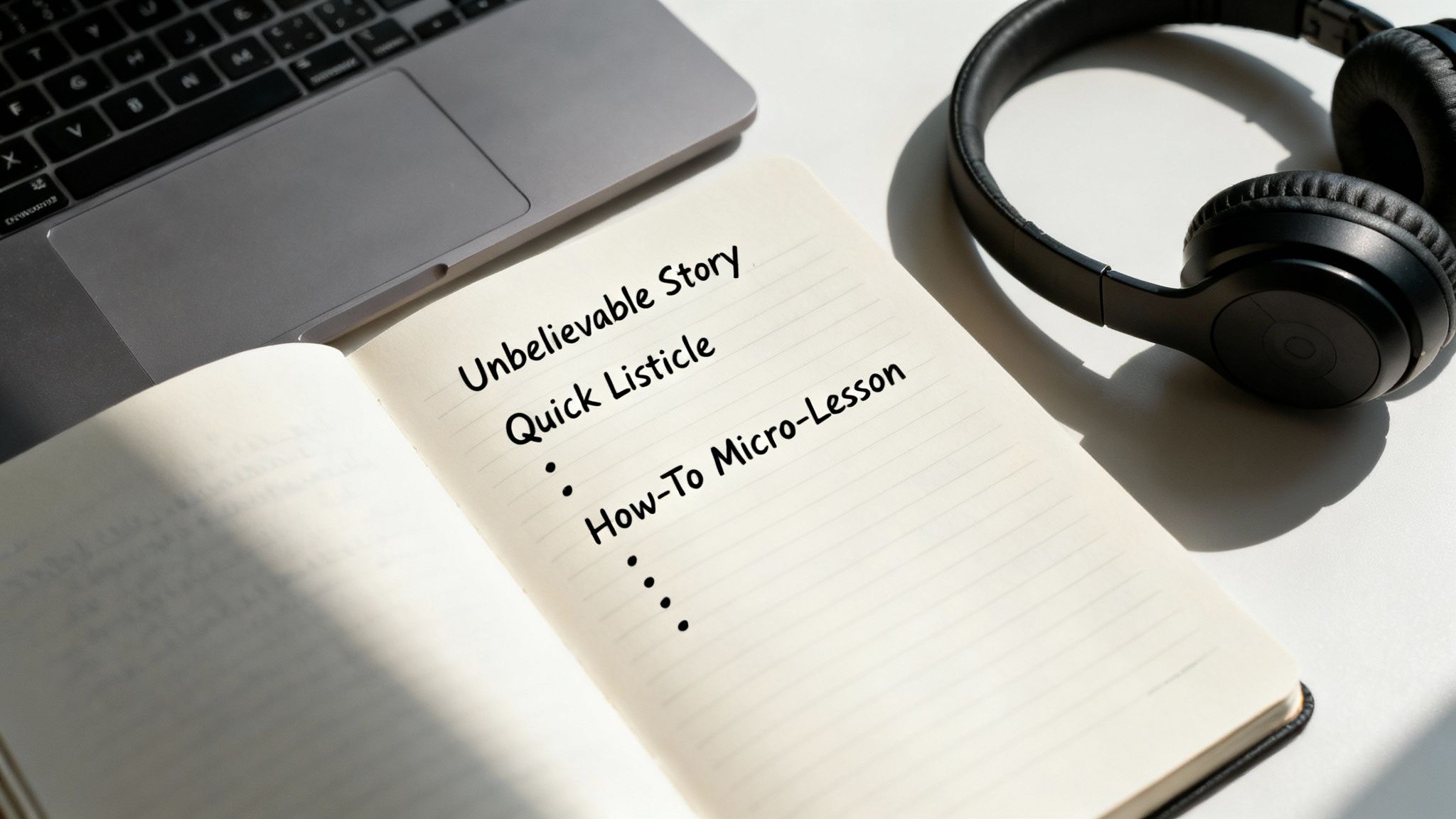
Let's break down three of the most powerful script templates you can grab and use right now.
The Unbelievable Story Template
This one is all about building suspense and delivering a knockout punchline or reveal. It's a fantastic fit for mind-blowing historical facts, true crime stories, or even a personal anecdote that sounds too crazy to be real. The entire goal is to methodically build tension and then give the audience that satisfying "aha!" moment.
- Hook (0–5s): Open with a bold, unbelievable claim. Something like, "You won't believe the real reason this famous painting is so terrifying."
- Buildup (6–40s): This is where you layer the mystery. Slowly drip-feed details about the setting, the people involved, and the strange things that started happening. Keep your sentences short and punchy to build a feeling of urgency.
- Reveal (41–55s): Hit them with the twist. This is the big moment where you unveil the shocking truth and everything suddenly makes sense.
- Payoff (56–60s): End with a final thought that makes them stick around in the comments. "Now you'll never look at it the same way again."
The Quick Listicle Template
People love listicles. They're predictable in the best way possible—they promise quick, digestible nuggets of information in a clean, easy-to-follow package. For this format, speed and value are everything. You need a powerful hook and a rapid-fire delivery that leaves zero room for fluff.
The whole game here is to make a clear, numbered promise and then deliver on it. Fast.
- Hook (0–3s): State what the list is and how many points you'll cover. "Here are three psychological tricks that actually work."
- Point 1 (4–15s): Jump straight into the first item. Explain what it is and its benefit, then move on.
- Point 2 (16–30s): Keep the energy up and transition smoothly to the next point. No time to waste!
- Point 3 & CTA (31–45s): Deliver your last point and immediately follow it with a call-to-action. "Which one will you try first? Let me know below."
The magic of the listicle is its predictability. Viewers know exactly what they're getting, which makes them more likely to stick around to see all the points. Keep it punchy and deliver on your promise.
The How-To Micro-Lesson Template
This template instantly positions you as a helpful expert. The structure is dead simple: identify a common problem, present a clear solution, and then show off the amazing result. It’s all about being genuinely useful and giving your audience something they can immediately put into practice.
- Problem (0–5s): Kick things off with a relatable frustration. "Tired of your houseplants always dying? You're probably making this one mistake."
- Solution (6–50s): This is the core of the video. Walk the viewer through your fix, step by step. Use simple language and, most importantly, show the process visually.
- Result (51–60s): End by showing the successful outcome and offering one last tidbit of advice. "Do this once a week for healthier, happier plants."
When you commit to scripting, you're tapping into a massive trend. The demand for scripted stories has exploded—the number of original series in the U.S. hit a whopping 559 in 2021 alone. This isn't just a Hollywood thing; it's happening on TikTok, Reels, and Shorts, where platforms reward creators who can consistently tell a good story. By using these simple templates, you’re using the same logic that powers billions of monthly views, and it’s a trend that script writing software is driven by.
These frameworks are so effective that tools like ClipCreator.ai actually automate them for you. You can generate a polished video script template in just a few clicks, taking the guesswork out of the process.
Automate Your Workflow from Script to Screen

Having a polished script in your hands is a huge win, but let's be honest—it’s just the starting line. For a lot of creators just starting out, the path from that final draft to a finished video is where the real headaches begin. Suddenly you're wrestling with voiceover recording, hunting for the right visuals, editing clips, and adding captions. It can feel like a full-time job.
This is where automation becomes your secret weapon. Instead of burning hours jumping between different apps and getting bogged down in tedious tasks, you can lean on a single platform to manage the entire production. It’s all about working smarter, not harder, so you can get back to what you do best: coming up with your next great idea.
From Prompt to Polished Video in Minutes
Imagine turning a simple idea into a ready-to-publish video in just a few minutes. That’s exactly what an automated workflow can do for you. Tools like ClipCreator.ai are built to do the heavy lifting.
The whole process is geared for speed and simplicity. You start with a concept, and the AI drafts a script in the tone and format you need. From there, the platform pretty much takes over.
- It generates a lifelike voiceover that gives your words a human touch.
- It finds relevant, high-quality visuals to match every beat of your story.
- It adds perfectly synced captions, which are crucial for grabbing attention on social media.
- It can even schedule the final video to post directly to your accounts.
This approach tears down the technical walls, helping you keep your content consistent without all the manual grind. To see this in action, check out our guide on the complete https://clipcreator.ai/blog/script-to-video process.
More Than a Timesaver—It’s a Career-Builder
Getting comfortable with this level of automation is about more than just saving time; you’re actually practicing the skills that power professional careers. Scriptwriting for beginners has a direct line to real income opportunities. In 2023, writers in the motion picture industry earned an average annual wage of around 129,930**, while those in streaming and social media pulled in about **119,150. This demand is no surprise, with streaming now making up over 38% of total TV usage, pushing brands to invest heavily in scripted video. You can see the full breakdown from the Bureau of Labor Statistics.
By automating daily video creation, you’re not just making content; you're building a habit of storytelling that aligns with the high-demand skills of a six-figure industry.
This workflow lets you operate like your own mini-studio, consistently pumping out content that both algorithms and audiences love. And once your video is assembled, post-production skills like extracting audio from video can elevate your final product even further. By letting technology handle the production grunt work, you free yourself up to think bigger—about strategy, growth, and your next viral story.
Got Questions About Scriptwriting? Let's Unpack Them.
Jumping into scriptwriting for the first time? It's totally normal to have a million questions pop up. It can feel like you're staring at a blank page with no idea where to start. Let’s tackle some of the most common hurdles I see new creators run into. My goal is to get you unstuck and on your way to making content that genuinely connects with people.
One of the first things everyone asks is about timing. "How many words should I write for a 60-second video?" It’s a great question. A solid rule of thumb is to aim for about 150-160 words. This gives you a comfortable, natural speaking pace—enough time to land your points without sounding like you’re auctioning off cattle.
This, of course, brings up the next big challenge: what if you have too many ideas? Or even worse, what if you have none?
Where Do Good Ideas Even Come From?
Ah, the dreaded blank page. It's a killer. But instead of waiting for some mythical muse to show up, just start paying attention. What are people in your niche constantly asking about? What problems are they complaining about in comment sections or on Reddit? Your next banger of a video idea is probably hiding in plain sight.
Don't forget to mine your own life, either. What’s a hard lesson you learned? A weird trick you figured out? A random fact that lives in your head rent-free? People crave authenticity, and your unique point of view is your secret weapon.
Pro Tip: Stop trying to find the perfect idea. Seriously. Just find a good enough idea and let your script's structure—the hook, the middle, the payoff—do the heavy lifting. The writing process itself has a way of turning a simple thought into a killer story.
Do I Really Need a Script for Faceless Videos?
I get this one a lot, and my answer is always a hard yes. In fact, I'd argue that for faceless videos, your script is everything.
Think about it: with no person on screen to build a connection or show emotion, your words have to carry the entire weight. A well-crafted script is your direct line to the viewer. It sets the tone for the voiceover, tells you exactly what visuals you need, and makes sure your captions hit hard.
Without a script, a faceless video is just a random slideshow of stock clips with a rambling voiceover. With a script, it's a story.
Here are a few other common sticking points I hear:
- "How do I stop my script from sounding so robotic?" Easy. Read it out loud. If a sentence feels clunky or weird coming out of your mouth, it's going to sound even worse to your audience. Rework it until it sounds like something a real person would actually say.
- "Do I need fancy software to write scripts?" Absolutely not. A simple Google Doc is all you need to get started. That said, once you get the hang of it and want to speed things up, tools like ClipCreator.ai are game-changers. They handle the formatting and can turn your script into a finished video, which is a massive time-saver when you want to produce content consistently.
Getting these questions answered is the first big step. Now, it's time to put what you've learned into practice and get that first video scripted out.
Ready to stop overthinking and start creating? ClipCreator.ai can take your ideas and turn them into polished, publish-ready videos in just a few minutes. Give it a try today and see just how simple content creation can be.

Create your first video in under 2 minutes
Pick a niche, and ClipCreator.ai generates and auto-posts faceless videos to your channels every day.
Join ClipCreator.ai