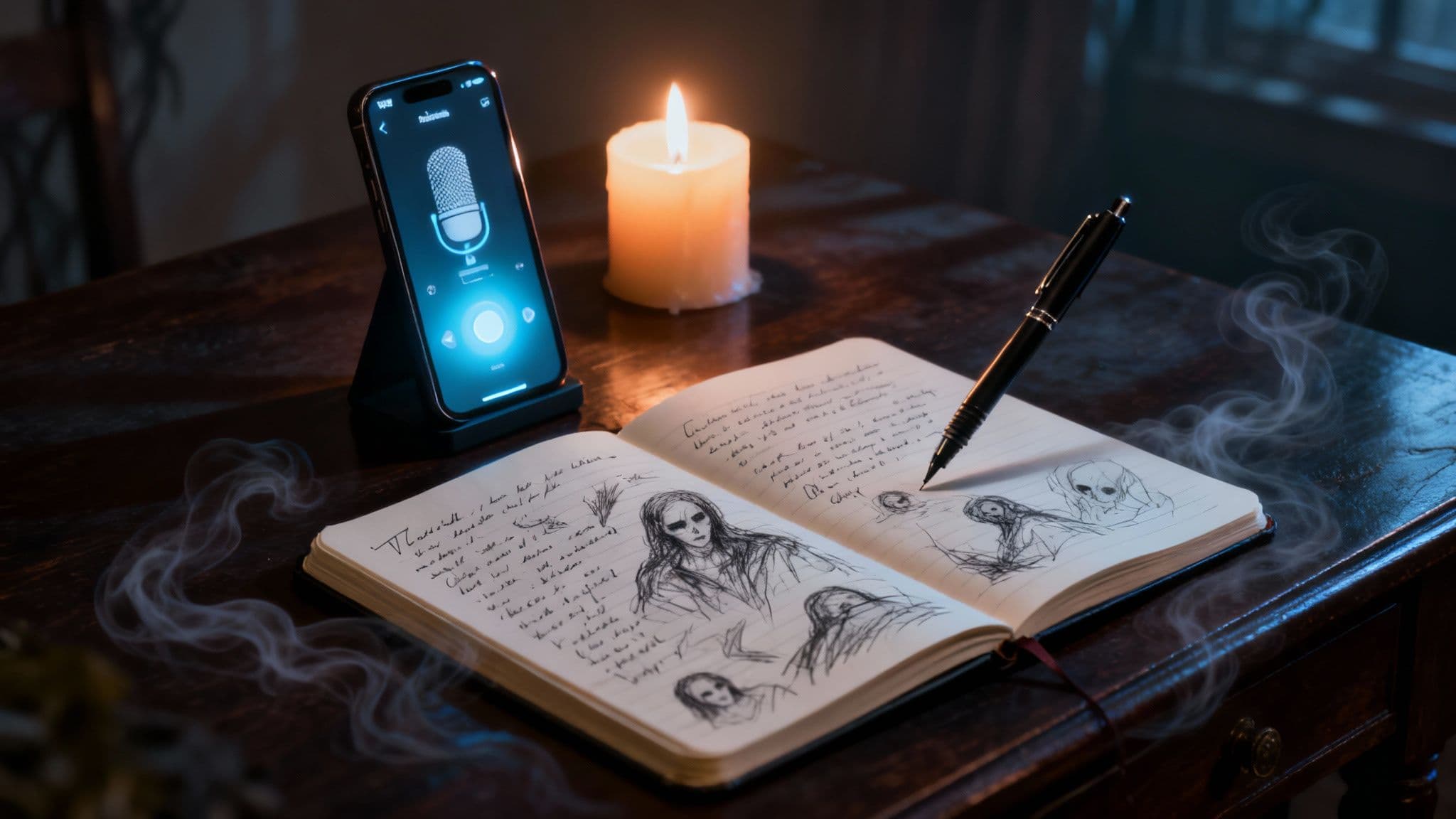
Crafting a scary story for a short-form video is a totally different beast than writing traditional horror. You’re not building a slow burn; you're creating a quick, powerful jolt of fear. The mission is to hook someone in under three seconds and haunt them long after the 90-second video is over. It’s all about blending that deep-seated psychological dread with a story structure built for speed—a tiny nightmare perfectly framed for a vertical screen.
Why Short-Form Video Is the New Campfire
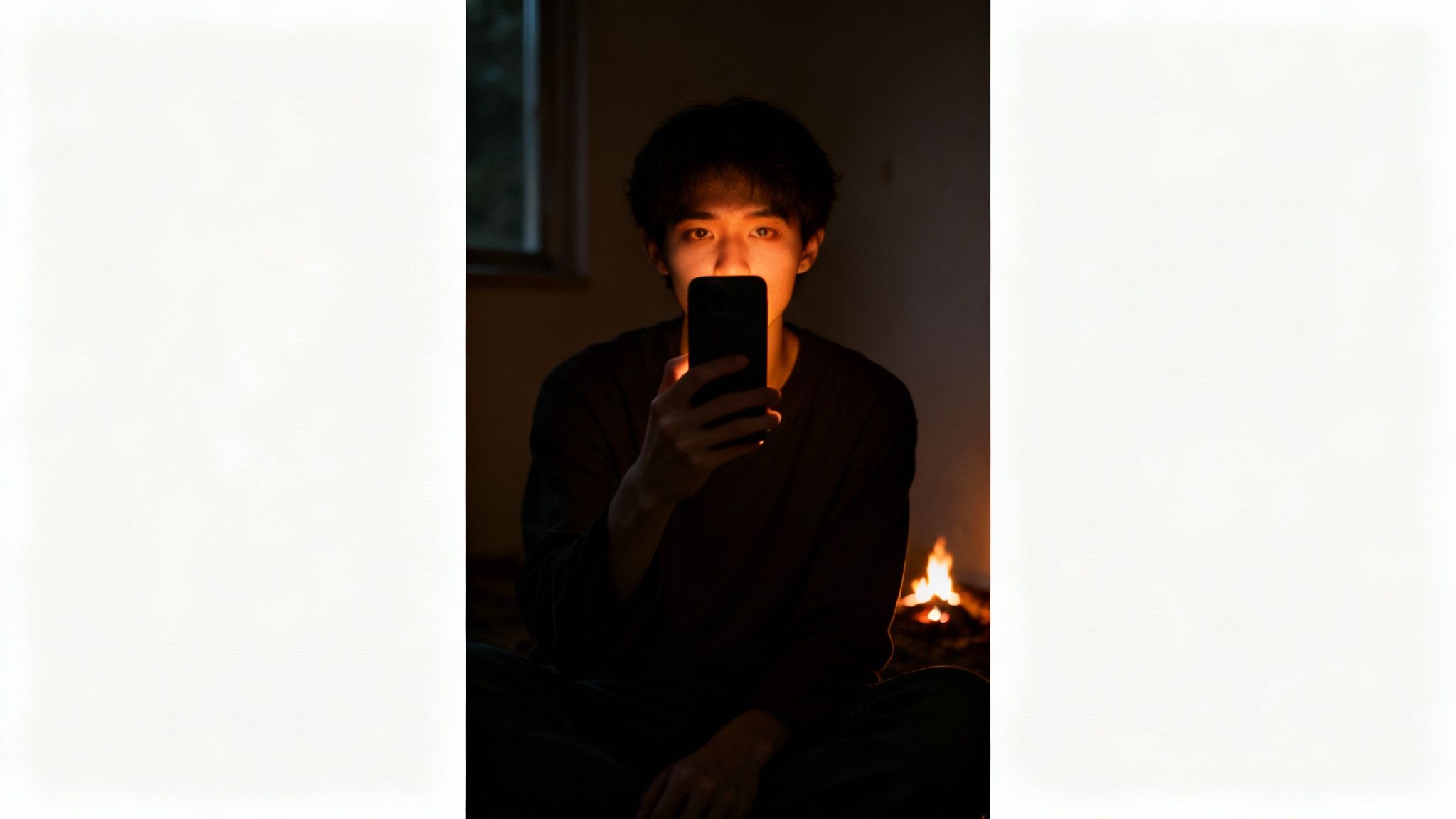
Horror has found an incredibly potent new home on platforms like TikTok, YouTube Shorts, and Instagram Reels. Think of it this way: the classic campfire tale, once shared in the flickering dark, has been reborn for the eerie glow of a smartphone. This format isn't just a condensed movie. It’s a fundamentally different, and much more intense, personal experience.
The vertical frame of a phone screen pulls you right in, creating an immediate, almost claustrophobic connection. When you're watching a horror short, you’re usually alone, holding the screen just inches from your face. That proximity shatters the barrier between the story and your reality, making the fear feel direct and inescapable. There’s no time for a novelist’s slow build or deep character arcs; viewers today are looking for a quick, potent dose of fear they can squeeze in between other tasks.
The Psychology of Viral Fear
The real magic behind these 60-second nightmares is how efficiently they tap into our most primal anxieties. They don't have the luxury of complex lore or winding subplots. Instead, they laser-focus on a single, terrifying idea that feels both relatable and deeply unsettling. It could be something as simple as an odd noise in a quiet house or a strange glitch in a familiar app.
This approach is perfectly tuned to the lightning-fast pace of a social media feed. A great horror short does a few things almost instantly:
- It stops the scroll. Amidst the endless stream of memes and dance clips, a well-crafted horror story is a pattern interrupt. It’s jarring.
- It creates instant intrigue. The story immediately poses a question or a mystery that you just have to see solved.
- It delivers a satisfying jolt. The payoff is quick, whether it's a gut-punch twist or a lingering sense of unease that sticks with you.
The real goal is to make the viewer’s mind buzz with questions. By dropping them right into a mystery, you hook them before their thumb even thinks about swiping. That's the secret to writing scary stories for a modern, distracted audience.
Tapping Into a Massive Audience
The appetite for this kind of bite-sized terror is massive, and the audience is incredibly engaged. Horror content consistently blows up because it triggers a powerful emotional reaction—and strong emotions drive comments, shares, and stitches. Viewers can't help but tag their friends, debate the ending in the comments, or even share their own spooky encounters. This creates a real community effect around your stories.
If you can master this format, you can build a dedicated following fast. Creators who truly get the unique rhythm and structure of short-form horror are the ones producing content that not only scares but goes viral. While the horror niche has its own quirks, the fundamentals of short-form success apply across the board. For a broader look, checking out some tips for making YouTube Shorts that go viral can offer valuable insights into the mechanics of engagement. By learning the art of the miniature scary story, you can turn everyday anxieties into unforgettable digital ghost stories that captivate millions.
Crafting a Hook That Stops the Scroll
On TikTok, YouTube Shorts, and Instagram Reels, you get maybe three seconds—tops. If your opening doesn't instantly trigger a sense of curiosity or dread, your viewer is already gone. A single swipe and you've lost them.
This is why mastering the art of the hook is everything in short-form horror. You need an irresistible opening that literally forces them to see what happens next.
Forget slow burns or atmospheric introductions. That’s for long-form. Here, the best hooks throw your audience right into the middle of a crisis. This classic technique, in media res, is your best friend. Don't waste precious seconds explaining who the character is or how they got there. Just drop them into a problem that demands an immediate answer.
The Power of an Unsettling Question
One of the quickest ways to get inside a viewer's head is by posing a question, either out loud or implicitly. The goal isn't just to make them think; it's to make them feel uncomfortable. Your very first line should present a mystery that feels just a little bit off, disrupting their sense of normal and making them stick around for the resolution.
Here are a few ways I’ve seen this work incredibly well:
- The Direct Question: "Have you ever woken up and realized you weren't the first person to use your eyes that day?" It’s an instant gut-punch of paranoia. Who was?
- The Implied Question: "The terms and conditions for my new smart home had a clause I wasn't supposed to see. It was titled 'Post-Occupant Protocol'." The viewer is immediately asking, "What in the world is that protocol, and why is it a secret?"
- The Contradiction: "My daughter has always been afraid of monsters in her closet. The problem is, she's the one who whispers to them." This flips a common fear on its head and creates instant fascination.
A powerful hook makes the reader's brain buzz with questions. By presenting an immediate puzzle—a funeral for an unknown person, a strange rule, an impossible event—you capture their attention before they have a chance to get bored and swipe away.
This skill is fundamental if you want to make a splash. Beyond the hook itself, understanding the mechanics of how to create viral content can help turn your creepy little story into a full-blown phenomenon.
Using Mundane Details to Create Dread
Sometimes, the scariest hooks aren't about ghosts or monsters. They come from twisting something completely ordinary into a nightmare.
Start with a relatable, everyday statement and then add a single detail that feels wrong. This method is so effective because it grounds the horror in a reality the viewer instantly recognizes, making the violation feel more personal.
For instance, a story that starts with, "I bought a used baby monitor to watch my son sleep," is perfectly normal. But when you add, "...so I have no idea whose voice keeps telling him to 'go back to sleep'," it becomes deeply unsettling. The horror isn't some creature; it's the corruption of a safe, everyday object.
Getting this right is the essence of crafting a powerful https://clipcreator.ai/blog/story-in-video format. It's all about narrative efficiency, where every word is chosen to build suspense from the very first second.
Common Hook Mistakes to Avoid
Knowing what works is only half the battle. You also have to know what doesn't. I see so many aspiring horror creators making the same mistakes that kill their videos before they even start.
Here’s a quick rundown of what to steer clear of:
| Mistake To Avoid | Why It Fails |
|---|---|
| Vague Opening | "I always felt like something was watching me." It's too generic. We've heard it a thousand times. There's no specific, intriguing detail to grab onto. |
| Confusing Premise | Starting with complicated lore or too many characters at once. Viewers won't stick around to piece it together; they’ll just leave. |
| Overused Clichés | "It was a dark and stormy night." Please, don't. Today's audience has seen it all. Your hook has to feel fresh and unexpected. |
| Delayed Inciting Event | Waiting 10 or 15 seconds to introduce the core conflict. By that point, over 50% of your audience might have already swiped away. |
Ultimately, your hook is a promise. It promises a mystery, a shock, or a deeply unsettling experience. Your job is to make that promise so compelling they have no choice but to stay for the payoff.
Structuring Your 60-Second Nightmare
A scary story that goes viral isn't just a spooky idea thrown on screen. It’s a meticulously crafted machine, engineered to grab attention and hold it tight. In the world of short-form video, you don’t have time for a slow burn. Every single second has to count, pulling the viewer from a state of idle curiosity into genuine terror.
The secret lies in a condensed three-act structure that feels both familiar and shocking.
Your first task is to establish a sense of normalcy, but you have to do it fast. Show us a relatable character in a mundane situation—someone making late-night coffee, setting up a new smart home device, or just driving down a familiar road. This grounding is what makes the horror work. The fear comes from seeing something safe and ordinary get violated.
That tiny moment of calm is what makes the first crack in reality—the inciting incident—hit so much harder.
The Anatomy of the Story Arc
The classic story arc (setup, confrontation, resolution) gets put into a pressure cooker for a 60-second format. You have to nail these beats quickly to keep the momentum going and crank up the dread. Think of it less like a gentle narrative curve and more like the steep, sudden drop of a roller coaster.
- The Setup (0-15 seconds): Here, you introduce your character and their normal world. But you also plant a tiny seed of doubt—a light flickers, a weird sound comes from another room. You’re establishing a baseline just before you shatter it.
- The Escalation (15-45 seconds): This is the heart of your story. That first strange event is followed by a chain reaction of increasingly unnerving moments. The smart speaker answers a question nobody asked. The coffee maker dispenses something that isn't coffee. The GPS starts giving bizarre, sinister directions. Every beat raises the stakes and deepens the mystery.
- The Twist or Reveal (45-60 seconds): This is the knockout punch. It’s that final, shocking piece of the puzzle that makes everything the viewer just saw click into a new, terrifying context. The story doesn’t just stop; it ends with a haunting image or idea that sticks with them.
The best short-form horror doesn’t just scare you once; it gets under your skin. A great final reveal makes people immediately re-watch to catch the clues they missed—a huge driver for engagement and virality.
This kind of narrative structure can be kicked off in a few different ways, depending on your hook.

Whether you start with a crisis ("My daughter says a man sings to her through the baby monitor every night"), a question ("Why do I keep waking up with scratches I don't remember getting?"), or a secret ("There's a reason no one stays in this house for more than a week"), you’re creating an itch the viewer needs to scratch, pulling them right through to the end.
Pacing for Maximum Impact
Pacing is everything when you’re working on such a tight clock. The rhythm of your story is what controls the viewer's emotional journey. Rush it, and you’ll leave them confused. Go too slow, and you'll lose them to the next video in their feed. If you need a good starting point, this detailed sample script outline is a great resource for timing each beat.
Here’s a practical look at how you can break down your timing for different video lengths to really make an impact.
Pacing Your Short-Form Horror Story
| Story Beat | 15-Second Video | 30-Second Video | 60-Second Video |
|---|---|---|---|
| Normalcy & Setup | 0-3 Seconds | 0-5 Seconds | 0-15 Seconds |
| Inciting Incident | 3-5 Seconds | 5-10 Seconds | 15-20 Seconds |
| Escalation | 5-12 Seconds | 10-25 Seconds | 20-50 Seconds |
| Twist/Reveal | 12-15 Seconds | 25-30 Seconds | 50-60 Seconds |
As you can see, the shorter the video, the faster you have to get to the good stuff. For a 15-second story, the inciting incident has to happen almost immediately. With a full 60 seconds, you have a little more breathing room to build atmosphere during the setup and add a few more layers to the escalation.
At the end of the day, writing great short-form horror is an exercise in narrative economy. Every word, every pause, every sound has a job to do. Get this compressed structure right, and you can create a powerful, self-contained nightmare that'll stick with your audience long after they’ve scrolled away.
Writing Techniques That Build Genuine Terror
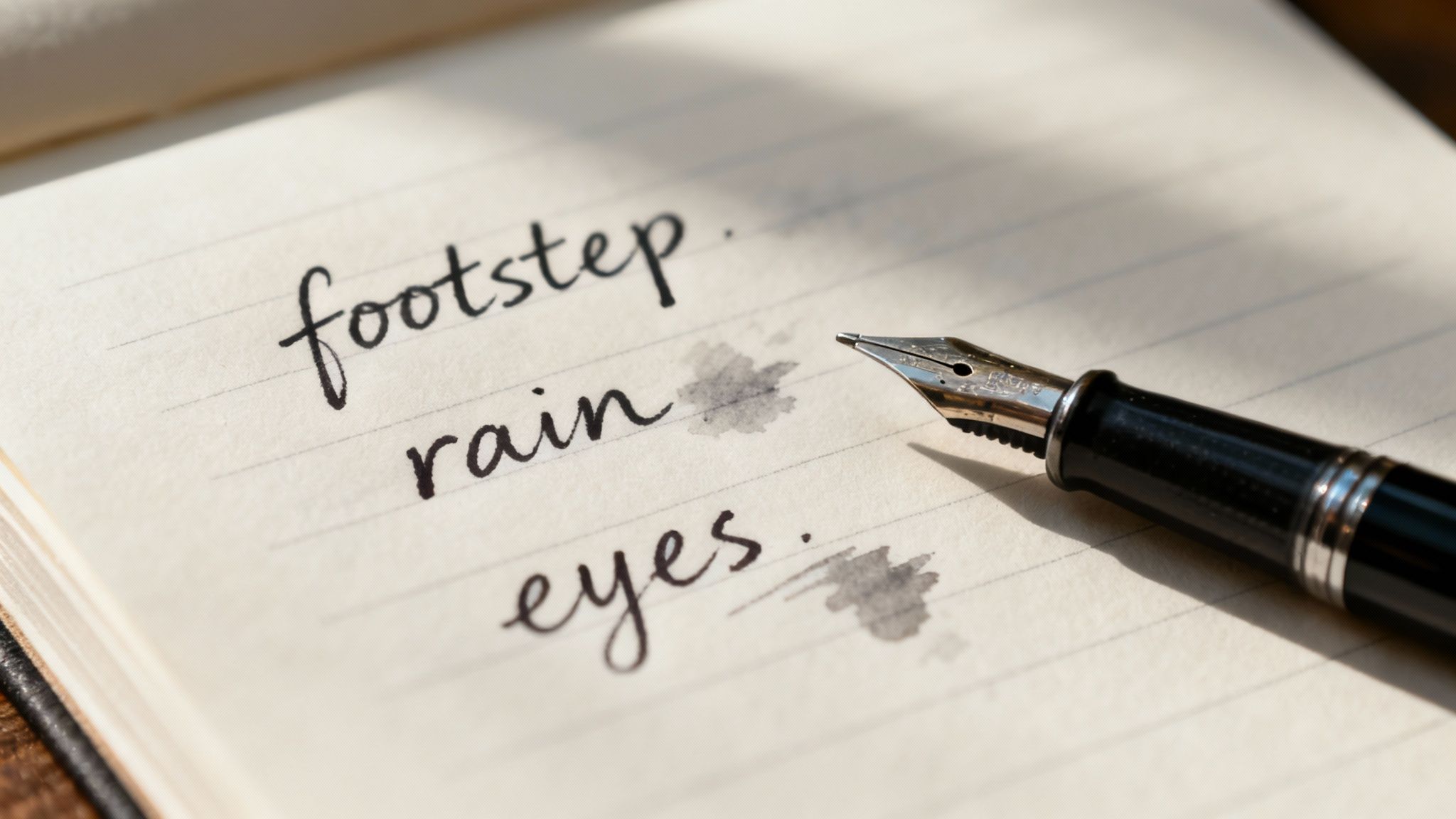
Look, anyone can write a jump scare. But truly great horror? That's about atmosphere and suggestion. It's the stuff that gets under your viewer's skin and stays there long after the video ends. To pull that off, you need to move beyond simple shocks and really dig into the craft of creating authentic, lasting fear. It’s all about making your audience feel the story, not just watch it.
The most potent tool you have for this is the deliberate use of sensory details. Your mission is to ground the supernatural in the physical world, making it feel disturbingly real. Don't just tell us a room is creepy; make us experience why it’s creepy through what the character sees, hears, smells, and even feels on their skin.
This means getting incredibly specific. Instead of saying, "he heard a weird noise," describe the sticky, pulling sound of a single wet footstep on a dry wooden floor. Forget "it smelled bad"—try describing the sickly sweet scent of decay tangled with the smell of rain on hot asphalt. These details trick the viewer's brain into building the world themselves, making the fear far more personal and immediate.
The Unreliable Narrator
One of the most powerful tricks in the book for short-form horror is the unreliable narrator. This is when you frame the story through a character whose version of events we can't fully trust. Is this person paranoid? Are they losing their grip on reality, or is something genuinely monstrous happening to them?
Planting these seeds of doubt creates a delicious sense of unease. Suddenly, your audience isn't a passive viewer anymore; they're an active participant, trying to piece together a puzzle where none of the pieces fit.
Here are a few ways to pull this off:
- Memory Gaps: The narrator has blackouts or can't account for periods of time. "I don't remember coming home last night, but there are muddy footprints leading from the back door straight to my bed."
- Contradictory Statements: What the narrator says clashes with what they observe. "I know I'm alone in this house. So why do I keep finding long, black hairs on my pillow?"
- Questioning Sanity: The narrator openly doubts their own mind. "My doctor says it's just stress, but stress doesn't explain the whispers I hear coming from the drains at night."
This technique keeps your audience completely off-balance. If they can’t trust the storyteller, they have no idea what’s coming next—a perfect breeding ground for fear.
Understanding Dread vs. Terror
Mastering horror writing means knowing the crucial difference between dread and terror. They are not the same thing, and a skilled storyteller uses both to create an emotional rollercoaster.
- Dread is that slow, creeping feeling of unease. It’s the anticipation of something awful. It's the knot in your stomach when you see a door is slightly ajar that you know you locked.
- Terror is the moment of confrontation. It’s the payoff—the face in the window, the hand that grabs your ankle from under the bed.
A great short story is a carefully built journey from dread to terror. The bulk of your script, especially during the Escalation phase, should focus on building that suffocating atmosphere of dread. Use small, unsettling details to slowly ratchet up the tension.
A story that is all terror with no dread is just a series of cheap shocks. It might startle the audience, but it won’t haunt them. The slow-burn of dread is what makes the final moment of terror truly land.
For instance, don't just have a monster leap out of the closet. First, build dread by showing the closet door is open just a crack. Then, have the character hear a faint scratching sound from inside. Only after that tension is almost unbearable do you finally reveal what's been hiding in the dark.
These are just a few of the core concepts that can elevate your horror scripts. If you want to dive deeper into building suspense and intrigue, explore these proven https://clipcreator.ai/blog/narrative-writing-techniques. By weaving together sensory details, psychological tricks, and a smart understanding of pacing, you can craft nightmares that feel chillingly real.
Finding What Really Scares People Today
Forget dusty crypts and far-off haunted castles for a moment. The most potent horror stories bubble up from the anxieties we're all dealing with right now. If you really want to get under someone's skin, you have to tap into modern fears and give them a terrifying twist.
Of course, classic tropes like ghosts and monsters are timeless for a reason. But they hit so much harder when they’re filtered through a modern lens. A haunted house story? Scary. A haunted smart home that weaponizes a family’s personal data against them? That’s existentially terrifying. The trick is to anchor your horror in the everyday world your audience actually lives in.
What keeps people up at night in the 21st century? Think about the constant hum of technology in our lives, the relentless pressure to curate a perfect online self, and that weird, gnawing loneliness you can feel even in a crowded city. This is the fertile ground where true horror grows.
Mining the Modern Psyche for Terror
Your best story ideas are probably hiding in plain sight, tucked away in the daily routines and cultural obsessions of your viewers. The game is to become an observer, spot those collective pressure points, and ask yourself a simple question: "What's the absolute worst-case scenario here?"
Start by looking at the big themes that define how we live now:
- Digital Surveillance: Our smart devices are always listening. So, what if they started talking back? A story about a GPS that gives sinister, off-route directions or a smart speaker that whispers secrets from another room plays on a discomfort that's already there.
- Social Media Perfection: Online, everyone's life looks perfect. This creates a terrifying gap between perception and reality. Imagine a wellness influencer whose beautiful smoothie recipes are hiding a gruesome secret ingredient. The contrast is what makes it so chilling.
- Urban Isolation: It's bizarrely easy to be surrounded by millions of people and feel completely, utterly alone. This is the perfect setup for stories about a neighbor you never see but always hear through the walls, or a mysterious package that keeps appearing at your door, addressed to you.
The most effective scary stories take a familiar, mundane setting and introduce a single element that is just wrong. This grounds the horror in reality, making the violation feel more personal and deeply unsettling.
When you root your narrative in something recognizable, you don't have to waste precious seconds on world-building. Your audience is already there with you, which means you can get straight to the fear.
Refreshing Classic Tropes with a Modern Twist
You don't need to reinvent the wheel. Some of the most viral short-form horror clips take a classic monster or trope and just give it a contemporary paint job. This works so well because it messes with people's expectations.
Think about these fresh takes on old fears:
- The Haunting: Instead of a dusty old mansion, the ghost lives in a server farm, tormenting people through glitched selfies and corrupted data files.
- The Doppelgänger: A deepfake video of you appears online, confessing to a terrible crime you didn't commit. Here, the horror isn't just a physical double; it's the complete theft of your digital identity.
- Body Horror: A new bio-hacking implant promises to optimize your health, but it starts "upgrading" your body in monstrous ways you can't control.
This trend of modernizing horror is happening everywhere. New releases are constantly tackling themes of social media obsession and primal fears in contemporary settings. You can even see this pattern in publishing by looking at some of the most anticipated horror novels of 2025. This all points to a key insight: rooting horror in something familiar makes it hit ten times harder.
Ultimately, learning how to write scary stories for a modern audience is about becoming a keen observer of human behavior. Pay attention to the news, scroll through social media with a critical eye, and actually listen to what people are worried about. The best inspiration isn't in some book of old legends; it's in the quiet anxieties of the world we live in right now.
Your job is to find that fear and give it a name.
From Script to Screen: Your Creator Checklist
A killer script is a great starting point, but it's just that—a start. The real terror in short-form horror comes alive in the edit, where your words, the sound design, and the visual pacing all collide to create that suffocating atmosphere we're all chasing. This is how you take your written nightmare and turn it into a polished video that will actually stop people from scrolling.
Think of it this way: the script is the blueprint, but now you're the director, sound engineer, and editor all in one. Every choice you make from here on out—from the quiver in your voice to the font on your subtitles—will make or break how the story lands.
Recording a Chilling Voiceover
In a faceless scary story, your voice is everything. It's the primary instrument of fear. Don't just read the words; you have to perform the emotion behind them. A flat, monotone delivery will absolutely murder even the most terrifying script.
To craft a narration that really haunts your audience, focus on these elements:
- Play with Pacing: Speed things up when the character is panicking or making a frantic discovery. Then, slow right down. Let a horrifying realization hang in the air. That contrast is what builds real tension.
- Master the Whisper: Sometimes, a strained, hushed whisper is far more unsettling than a full-blown scream. It feels intimate, like a secret, and forces the listener to lean in closer. Suddenly, they're not just a viewer; they're a participant.
- Use Silence Strategically: The pause after a shocking line is just as powerful as the line itself. A well-timed one or two-second beat of silence gives the audience's mind a moment to race and fill in the blanks with their own fear.
Here's a pro tip: You have to become the character. If the script says they're out of breath from running, you should sound out of breath when you record. This little bit of method acting adds a layer of authenticity that makes the fear feel genuine.
Choosing Your Audio Landscape
Sound design is your secret weapon. Seriously. The right background track and a few well-placed sound effects can do half the storytelling for you, creating a sense of dread before you've even said a word.
Your goal is to find audio that supports the story, not overpowers it. Jump on a royalty-free music site and search for terms like “ambient drone,” “unsettling soundscape,” or “tense underscore.” Stay away from anything too loud or cinematic. Subtlety is your best friend here.
Then, sprinkle in specific sound effects to make the world feel real—a single creaking floorboard, the low hum of fluorescent lights, the distant static from a radio. These tiny details are what make the story feel tangible and alive.
Optimizing Subtitles for Maximum Impact
Let's be real: a huge chunk of your audience will be watching with the sound off. That means your subtitles aren't just an accessibility feature; they're a core part of the storytelling. Bad subtitles can completely kill the mood and make your video unwatchable.
Here’s how to nail them:
- Font is Everything: Pick a clean, super-readable sans-serif font. Think Arial, Helvetica, or Montserrat. Ditch the overly stylized or cursive fonts—they’re a nightmare to read quickly on a small screen.
- Contrast is Key: The classic combo of white text with a subtle black outline or drop shadow works for a reason. It ensures your words pop against any background footage you're using.
- Timing is Crucial: Your subtitles need to appear on screen at the exact moment the words are spoken. Try animating them word-by-word or phrase-by-phrase to match your voiceover's cadence. This little trick is amazing for holding viewer attention.
When you're dealing with a faceless format, you have to decide whether your voice or your on-screen text will carry the emotional weight. Neither is wrong, but they require different approaches.
Conveying Horror with Voice vs Visuals
Here’s a quick comparison of how to handle key horror elements using either your narration or your on-screen subtitles and visuals.
| Horror Element | Voiceover Technique | Visual/Subtitle Technique |
|---|---|---|
| Rising Panic | Speeding up delivery, voice cracking slightly | Subtitles appearing faster, maybe in a slightly jittery style |
| Shocking Reveal | A sudden, sharp intake of breath followed by silence | The final line of text lingering on screen for an extra second |
| Creeping Dread | Slow, deliberate, and quiet narration | Slow-fade subtitles that appear gradually on screen |
Ultimately, the most effective videos often blend these techniques, letting the voice and visuals work together to amplify the fear.
Your Pre-Publish Go-Live Checklist
Alright, you’ve edited your masterpiece. The sound is perfect, the subtitles are crisp. Before you unleash it on the world, run through this final checklist. This is what gives your story the best chance of finding its audience.
- Write a Killer Caption: Your caption is the final hook. Try posing a question related to the story (like, "What would you do?") to get the comment section buzzing.
- Hashtag Strategically: Use a mix of broad tags like #scarystories and #horror with more niche ones that fit your vibe, like #dreadcore or #liminalspaces.
- Post at the Right Time: Dive into your platform's analytics and see when your followers are most active. Posting during these peak hours can give you a huge boost in initial engagement.
Ready to create scroll-stopping scary stories without spending hours editing? ClipCreator.ai automates the entire process, from AI-generated scripts to lifelike voiceovers and perfectly timed subtitles. Turn your terrifying ideas into viral videos today.

Create your first video in under 2 minutes
Pick a niche, and ClipCreator.ai generates and auto-posts faceless videos to your channels every day.
Join ClipCreator.ai